I live in an area that has probably >100% pick-up ownership per adult male. I've noticed that these people will not go to the grocery store on days when the weather is inclement due to the chance of the groceries getting wet. Seems like a bad vehicle for grocery runs.
I don't get the whole American thing for Pick-up trucks. Unless you're hauling hay or manure, why would you want your cargo area exposed to the elements?
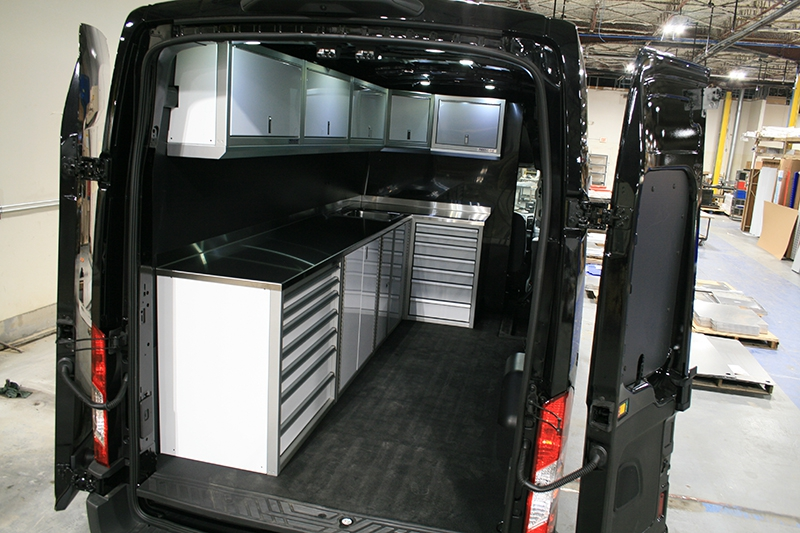
I used to work for a general contractor who did residential remodels and construction, and a little bit of commercial work. He exclusively used cargo vans. He would carpet the interior to protect the cargo and your knees. It made me question why anyone would use a truck. As you alluded to, it doesn't just protect from the elements, but also from thieves stealing tools out of the back of your truck.
Van's aren't sexy and cool, and there is no marketing as TOUGH and REAL MEN and COUNTRY MUSIC the way there is for trucks.
The bourgeoning Van Life movement that is picking up steam on places like TikTok and YT may do more for that, but in a lot of ways it's a statement about doing without, as opposed to being country rich and tough the way trucks are.
You are forgetting "soccer moms". For some dumb reason America decided there were two genders "masculine" trucks and "feminine" vans. It still makes no sense, but it certainly seemed to sell a lot of trucks to misogynists.
I always find this talking point so weird. Trucks are great and people want them. There is no ultimate truth here where people can't see the light and evil corporations are making us buy trucks. Theyre making trucks because we want them. I love mine, and admittedly don't really "need" it.
This is a fun reply because the easy flippant response is "okay then the propaganda got you." Something neither of us can prove or refute.
Pickup trucks are popular in the US and the Americas broadly where they are heavily marketed. Pickup trucks are less popular in places where they are not marketed as heavily. Even outside the auto industry, there is a general consensus that marketing works. Make of that observation what you will.
I mean I don’t doubt that marketing has some positive return for anyone selling something. But are they marketing me to buy a truck or to buy their truck. There’s a huge distinction.
Pick-up trucks aren't meant for work. Like, at all. They are inherently grocery/family vehicles.
Europeans don't use pick-up trucks even for cargo that is suitable for pickup trucks, because small flatbed trucks [0] let you open the bed from the side, making pickup trucks mostly an obsolete concept for work purposes.
I agree that they probably don't serve most people well.
But I know someone that has a huge truck with a cap on his bed (google "pickup truck bed cap" or "topper"). That solves the weather problem and makes you wonder why you don't see more trucks covered up. The answer is obviously it looks less cool and doesn't fit the image. But it serves him well because he works in construction and frequently has the bed full of materials, sometimes which are longer than the bed. And he uses the truck occasionally to tow trailers.
But he's not most people. And he has another car for getting around town when he's not working.
I don't have a full sized truck, but I do have a Tacoma (similar to the Hilux iirc for Europeans). The main reason I got it was because Toyota is well known for cars that last forever, but also to tow a camper and to do some offroad exploring and camping. It has also come in handy for helping move stuff for friends, I recently used it to carry a bunch of bags of sand and dirt for a friend. The utility it offers has come in handy compared to my old Ford Escape.
When I was a kid, my dad owned a pickup truck in Mississippi, and there seem to be tons of ways of avoiding getting the groceries wet, a bed-width toolbox behind the cab was the simplest way (and this was way before extended cabs were a thing).
If you are living in such an area where they can't even figure that kind of thing out, it sounds like there might be something in the water.
When I was a kid, a normal-sized American adult could open up a bed-width toolbox, look down inside of it, and easily remove a few bags of groceries before re-closing the lid -- all while standing flat-footed on the ground beside their normal-sized American truck.
Things are not that way anymore; trucks got bigger.
The top of the bed rail of an F150 Lightning is around chin height for a lot of folks: https://imgur.com/ZBOBqJc
Oh, I was a smaller kid back then and I guess I wouldn’t find it very accessible either way. Also my dad was tall. Coolers fit in the back also if you want to use those instead.
> I've noticed that these people will not go to the grocery store on days when the weather is inclement due to the chance of the groceries getting wet.
A modern pickup truck can fit the payload capacity of an entire Honda civic in the back of the cab. I've never seen someone put sacks of groceries in the bed of their truck. Maybe packs of water or charcoal, but no one is putting their produce and boxed goods back there.
Yea… you can actually fit two adult-sized road bicycles, without removing the wheels or disassembling them in any way, in the back of an F-150 cab!
And still have more room for stuff in the back of the cab before you even start talking about the bed.
I’m also confused how groceries in the bed would get wet in the rain… everyone around me has a tonneau on the bed. My guess is that some of these are not real anecdotes.
I see it, at least weekly, at a Costco in Texas. Not just the pallet stuff but refrigerated goods and smaller stuff (gathered in boxes as is the custom at Costco)
Wait do people put their groceries they intend to eat on the bed of their trucks, exposed to exhaust, asphalt, tire rubber and all other forms of road pollution?
I am, but still it sounds bad to me to expose them to the road elements on the way home.
And food in packaging, it is usually in boxes or other containers most of the time in supply line transit. Individual items only get unpacked in the store, so I would think this practice adds considerably to their “dirtyness”.
Not really. Bread, milk, soft drinks, and bagged snacks like potato chips all get delivered and stocked by the individual vendors, but everything else goes through a single warehouse ran by the grocery franchiser. Dairy comes in extra boxes, but most of the stuff is stacked 3D-tetris-style 6 feet high on a pallet and then wrapped in cellophane on the pallet before getting loaded on the truck. It's used just as a convenient way to bind the stack together so it doesn't dump in traffic. When it gets to the store, the pallets sit in the back until they are needed and then the cellophane is cut off and the items go directly on the shelves. Packing them up further would slow things down too much and confuse the stock workers too much (it's mostly teenagers and mentally challenged people, not exactly a life long career). It was not uncommon to find rat and mouse feces and urine on top of cans and boxes.
Almost all of the produce is in nearly the exact form at the warehouse as you would find them in the store. For example, watermelons are in an open-topped, cardboard bin that just gets moved from the warehouse to the grocery floor in exactly its final state. Berries are all in their plastic clamshell boxes, no extra packing, no tape. They rack them up in flat cardboard boxes with no top, just tall enough that a single layer of berry boxes can fit in it and the next layer stacks on top.
This one time, one of the pickers had a pallet full of berry racks, six feet tall. He took a corner with his pallet jack too fast and dumped the entire load on the floor. Berries scattered everywhere. They used a snow shovel to scoop them back up and back into the boxes and back into the racks. Then out to the truck and out to the store, where they would have gotten relabeled "mixed berries."
Almost everything from a grocery store starts in, or ends up, in a water resistant package. There are a handful of exceptions like eggs in cardboard casing, but you can just wrap them in a baggy to solve that. For that matter, unless it's like an insanely torrential downpour, very little, if any, water is going to get through a closed bag.
If your observation is accurate, the more likely reason is that people just don't like going out when it's raining. Getting your shoes/pants wet sucks, getting your car (or truck) seats wet sucks, rain traffic sucks, there's more crashes - which suck, and by contrast you could just be sitting at home enjoying the relaxing sounds of rain, which doesn't suck.
My hunch is that the people who buy an F-150 for groceries are not the people interested in buying EVs. The advantage of an EV truck is solely on cost and maintenance, so the natural market is businesses looking for practical vehicles, not people who buy impractical vehicles that are costly to operate for status reasons.
Then again as I’m typing this I realize that I have a phone with a better processor than most computers on which I … browse hacker news and read email, so go figure.
I drive a 2017 F150 with the back commonly filled with either sports equipment or outdoors gear, or photography equipment. I would like to additionally have a city car but am not willing to spend the money (or consume another parking space in front of my house). Since I only have one vehicle, I do also use it for grocery shopping.
I drive a Honda van, usually with the seats out/folded down.
It's really big back there. It holds an enormous volume of stuff.
4x8 sheets of plywood fit inside with the doors closed, and so do 10-foot lengths of pipe.
It's easy to access stuff at the front or the back. It's all contained under a roof in a locking, conditioned space (3 zones of HVAC) and is easy to get to from either sliding door or the back tailgate.
Works great for hauling stuff like sports equipment, outdoors gear, or photography equipment. Mine is full of tools, ladders, and boxes of wire right now, but it's been awesome for taking a mountain of camping gear and a PA system across the country. (Or, you know: Groceries. It does groceries very well indeed.)
(It's not so great at hauling stuff like bulk stone or mulch, but that stuff is usually pretty cheap to get delivered.)
The Volkswagen Transporter has a towing capacity of 750kg for an unbraked trailer and a maximum towing capacity of 2800kg for a braked trailer. That's 6000 pounds.
Good question. I don't usually think of towing stuff because that's seldom been a part of my life.
3500 pounds is what Honda lists for towing capacity (same as a 2WD Honda Pilot, even though an AWD Honda Pilot with exactly the same engine and transmission is more like 5000).
If towing capacity is defined as "what people can expect a thing to reliably do for many thousands of miles, in a row, over and over again" then I think a bone-stock Odyssey would roll over and die with 6000 pounds behind it.
Slow trip to the dump that's right over there across flat terrain? Sure, probably OK if it's rather heavy. Through the Appalachians? No; that's sounding like a bad day.
And the usual variables can be wiggled: A better transmission cooler can be added without too much difficulty (and Honda used to sell kits for this, themselves). There's seemingly-reputable companies that sell air suspension (read: adjustable) helper-springs for many years of Odyssey, and reports are that they're not particularly hard to install (as a DIY, in the driveway). Weight-distributing hitches help a ton (literally), but IIRC Honda doesn't list a separate capacity for that.
There's other vans with similar interior volume and features that are stated on the door sill sticker to tow trailers better.
And there's certainly some things that trucks like an F150 can get very right. Towing is one of them.
If a person wants to occasionally haul a decent-sized camper around or something, then owning a pickup truck may be exactly the right solution.
Transmission coolers and suspension kits are great but one of the things that’s really even more important is the ability to stop it comfortably. I think it’s prudent to build in a safety margin of at least 25%. More is better here.
And ideally, the trailer should have its own brakes and (mostly!) stop itself.
I've never found the brakes on an Odyssey to be particularly lacking on their own, even when loaded heavy in mountains. They're fine. 2-pistol calipers, decent-sized rotors. Nothing fancy, but also nothing lacking. The ABS behaves sanely.
The only thing I see people complain about is warping, but the causes of that are very varied (and may have nothing to do with anything actually being warped).
Like many vehicles, they get a lot better with good rotors that have cooling improvements, and well-selected not-ceramic pads.
It goes from "yeah, those are fine" to "Holy Toledo. My sunglasses just flew off of my face, and I think the seatbelt hurt my shoulder (but there was no crash, so it's fine)"
This is anecdotal but I have a gas F-150 that is often a grocery getter (I work from home and take a motorcycle when I can so gas mileage for me isn’t as big a concern as for some) and I would gladly trade it for an electric or a hybrid version (one that does not have the gas motor do anything but charge the batteries). But the cost was absolutely asinine for the Lightning. These trucks were made from unobtainium.
But I would also trade this truck for an all electric or mostly electric Maverick as long as it had enough cabin space for my needs (children).
We have a f150 raptor and a rivian and a model 3. I drive the gas truck and the model 3. Depends on the weather. Truck is an amazing road tripper. We are not the typical customer, but we do exist.
Meanwhile Chevy has a 400 mile range, unknown but more than the 100 mile range the lightning has for towing and is a work truck at about 70k or something street price last I saw. Its compelling, where the lightning is not.
The Silverado EV does have a big battery, but for actual real world use you’re keeping it within a band of about 60% (20-80) so 400 is really 240 with an emergency reserve. (This is common to all EVs).
You lose about half your range towing so you’re still going to drive two hours, stop for 30-45 minutes, repeat.
So it’s still far from compelling for anyone towing or doing truck stuff.
If you are planning a trip and know you are, your first left is easily 20-100% or 80% range, and then it depends on charging speed versus stop purpose.
it's my impression that electric vehicles are 90% grocery getters, unless the drivers are young in which case it's takeout. what else would you use an electric for, commuting? when you commute, on the way home, you shop.
They are suggesting that most F-150s are not purchased for real truck work like hauling stuff. Instead, they are purchased by people who use them exclusively to drive on paved roads, in towns/cities, mostly carrying passengers instead of large cargo. Therefore the concern about going off-road to remote locations isn't a real concern for this market.
>They are suggesting that most F-150s are not purchased for real truck work like hauling stuff
correct, but it's in the context of the their misimpression that "truck stuff" would be the reason to buy electrics. and I'm pushing back on that saying that the people who buy groceries are the people who are buying electrics. people who "have a commercial job to do" are less likely to experiment with a new technology: "if it ain't broke, don't fix it, especially if your income depends on it"
It’s a real concern in the sense that a lot of them care about the capability.
Objectively a Ford F-150 is the wrong vehicle for what 90% of its buyers need. But it’s an aspirational purchase. It can go off-road. It can haul a boat. It can haul a bed full of gravel. It doesn’t matter for these purchasers that they rarely if ever actually do any of this.
This logic is only ever applied to trucks. The majority of HNers did not make an economically rational decision when they bought their Macbook or iPhone. Consumers buy what they like and feel like they need and can afford. They place an almost absurdly high value on convenience and not having to think about things like "oh I need to move this thing I need to go rent a truck because I only ever need to do this once every two years, making it irrational to buy one."
I have a long history of sneering at people who ceaselessly buy Apple products despite their lack of economic "efficiency" but I "have a finely calibrated sense of value" ie I'm a tightwad.
Being "economically efficient" with laptop purchases saves you a few hundred to a thousand dollars.
Being just reasonable with a car purchase saves you $25k.
These are not at all comparable to the average american.
The average new car price is $50k. Almost zero people need that. The Toyota Corolla, which is overpriced, still starts at under $25k. Considering inflation it's about 30% more expensive than the base model from the 90s, but the modern Corolla is more comparable IMO to the old Camry, who's price point it exactly matches.
For that money you get a safer car than the 90s, dramatically so. You get modern infotainment, like CarPlay and AndroidAuto. You get a backup camera and bluetooth connectivity. Aircon, power windows, central locking. You get 170HP from a 2.0L 4cyl that is rather silly for a commuter car. Only 32 mpg City. This is a small family car.
But Americans do not want that. Americans want to put down $50k for 80 months for a MANLY man truck for MANLY MAN things. Or the same money for a stupid box on the same frame as an """SUV"""
This is not "avocado toast" or "Just get a roommate". Americans are spending absurd money on absurd vehicles for absurd reasons.
Advances in the reliability of modern cars made the car market weird. If you have any financial sense at all, new cars almost never make sense, because the 5 year old model is still excellent. That means the only people left in that market are not making decisions on financial merits. But that also means the entire market is controlled by the whims of the easily persuadeable and financially illiterate.
> Americans want to put down $50k for 80 months for a MANLY man truck for MANLY MAN things
Most people buying F-150s are spending way more than $50k.
But the hate big trucks get isn’t because they are expensive. I don’t care if someone spends 25, 50, or 100 thousand on their vehicle and I doubt most others do either. Trucks get hate because they are more dangerous to everyone else. A collision with a truck is 2.5x more likely to kill the driver of a car than a collision with another car. [1]
But the attacks on the “manliness” and ridiculous cost of modern trucks are more emotionally satisfying than discussions about their safety profile.
I drive a Corolla (great highway mileage!) and will probably get something larger the next time I buy because it's smaller than most everything else on the road, both in terms of visibility and collisions. My person tightwad math changed after a drunk driver crossed the median and took off a mirror. If I did have children this would doubly be a concern, even if I could manage to fit the car seat and stroller in the Corolla.
As an aside the base Corolla engine for the current gen was formerly the 139HP 1.8L 2ZR-FAE and the 2L was limited to the "sporty" models but this was dropped at some point. The power figures are somewhat deceptive, it does a very good impression of a v6 under 3000RPM or so, but if you need to wind it out to merge on the highway there's not much there unlike a early 00s VTEC Honda or something.
> But Americans do not want that. Americans want to put down $50k for 80 months for a MANLY man truck for MANLY MAN things. Or the same money for a stupid box on the same frame as an """SUV"""
I’ve driven a Corolla in the last year. Despite not being particularly tall, my head is jammed against the roof. I have to put the driver’s seat all the way back, into the knees of any rear passengers.
The owner’s manual states the car should not be used to tow anything, eliminating the claim throughout this thread of “just buy a trailer when you need to move something big.
Why is it so hard to just admit that trucks and SUVs do in fact offer greater utility and convenience in most situations than small sedans? And that this utility and convenience, even if not needed all the time, is the main reason people are buying them?
I mean, your contention is that the average American, no doubt hard up for money, is so dumb they are willing to pay a 25k+ premium to feel “manly”. Does this really make sense? Economics are not people’s primary motive but they do have an impact.
Despite driving and loving the Honda Fit for 15 years, I bought a large SUV. Can you imagine no other reason for this than I am a madman?
> Why is it so hard to just admit that trucks and SUVs do in fact offer greater utility and convenience in most situations than small sedans? And that this utility and convenience, even if not needed all the time, is the main reason people are buying them?
In general I agree that they do offer a lot of comfort. This is actually a common criticism of these trucks, that they are “pavement princesses” that never haul anything more than groceries. Ironically, a lot of trucks have gotten so tall that they need a step for short people to get into, though, putting the claims of comfort into question.
Personally I think a lot of the justifications about big trucks are true but also not why people buy them. They see more convenient (sometimes; they are a bitch to park in cities). They are more comfortable. They can haul. They can go off-road. But these being true doesn’t mean that’s why most people actually buy them.
Marketing folks understand that. That’s why truck ads show manly shit like rocks being dumped into the back of the truck and off-roading around a mountain even though that’s not how they get used. Consumers are buying the feeling. Just like BMW sells sports cars but showing them whip around mountain roads rather than sitting in traffic.
It’s very much like guns. People who buy guns justify the purchases by saying they need them for self defense or home defense. But the reality is that most guns are never used for any of that and most people who buy guns would move somewhere else if there actually thought they needed them. They are bought because people like guns and find them fun to own. These are of course not mutually exclusive reasons. A gun can be fun and also quell feelings of fear about hypothetical home invasion.
> I mean, your contention is that the average American, no doubt hard up for money, is so dumb they are willing to pay a 25k+ premium to feel “manly”.
Is that actually hard to believe? Americans are notoriously terrible with money and many buy dumb stuff as status symbols when they are missing rent payments.
Again, marketers don’t seem to have any trouble grasping that most money is spent on feelings.
Yeah but you buy a truck and all of a sudden you have a lot of friends.
I might not move furniture regularly, but it’s reeeeal nice to be able to do so when I need to. My dishwasher broke on Christmas Eve when I was hosting so I went to the store and got another and installed it within an hour. Not doing that with my Subaru.
I’ve literally transported dishwashers in a Renault Twingo. And the „small car + trailer“ combo will always carry more than a pickup. Pickups are pure lifestyle.
In a lot of smaller cars, you can fold down back row.
And if you are ok, with having trunk open, and tied down, you can transport fridges (I used reno clio, that is slightly bigger). Done that myself (not two door wide ones, one door fridge).
That's said I just found out you can hire van for 35EUR 20min away from where I live, so nowdays I just do that.
I looked it up. It does not appear to me it would be possible to fit an American dishwasher in that car in the box, seats folded down or not, based on the internal dimension and hatch width/height or door width/height. It might be possible if you take it out of the box.
It's important to note that American appliances are generally larger than European ones.
I drive a small very useful car almost every day I have moved a ton of stuff in (including a DRESSER) but it's inarguable that trucks simply have greater utility for this sort of thing. And any time I do need to move something...I just use the cheap pickup I bought so I don't even have to worry about it or spend ages trying to squeeze it in.
Most recent purchase: Christmas tree. Yeah, that wouldn't have fit in my car.
Christmas tree? Real ones are usually tied to the top of the car for transport. Artificial ones absolutely fit inside a car with the back seats folded, and possibly just across the back seat. I bought and transported my current artificial tree in my WRX years ago.
An artificial tree that can’t fit in a car would be a big tree.
1. Let the Christmas tree farmer toss a 8’ tree in the back of my truck, tying the base to the anchors behind the cab. Very little overhang with the tailgate down. Drive away. This is what most people do.
2. Spend 15 minutes balancing the the 8’ Christmas tree on the roof of my Honda Fit with substantial overhang, precariously tying it, I guess leaving the windows down in the cold weather and praying the Highway Patrol doesn’t pull me over. This is not what most people do but I’m sure it can be done.
Lots of things “can” be done but people value convenience.
I don’t know where you live but around me I see people carry trees on top of their cars all the time at Christmas. It’s not complex. You put the tree on the car. You open the doors and tie the tree. You get in and close the doors. You don’t drive with the windows down because why would you? And why would highway patrol pull you over? I’ve never even heard of anyone getting pulled over for carrying a tree or anything else.
Is it more convenient in the back of the truck, though? Sure. I didn’t say otherwise.
I will say that buying a giant truck with poor visibility and 2.5x the kill rate of a sedan so that you can haul a tree once a year is nonsense. It’s a shitty tradeoff and a much smaller truck would do exactly the same job. But little trucks don’t sell like giant trucks because people are not actually buying them for their utility.
Do you think suggesting people who do things you don’t like are just not as enlightened and rational as you a productive way to change hearts and minds?
Of course not. Probably more than 99% of online conversations are a complete and utter waste of time. I would assume there is literally nothing anyone could say to you that would make you get rid of your truck.
With that said, you admitted with your first comment that buying these trucks is based on feelings and not rational.
“Consumers buy what they like and feel like they need and can afford. They place an almost absurdly high value on convenience and not having to think about things like "oh I need to move this thing I need to go rent a truck because I only ever need to do this once every two years, making it irrational to buy one."
Because a 7 bedroom McMansion is unlikely to drive over my child in a parking lot or kill my wife in a collision. The dangers of these giant trucks are not hypothetical. It’s documented that they kill drivers of cars at 2.5x the rate of cars.
In terms of pure annoyance, the McMansion is also not using 3 parking spots at the grocery store.
An minivan will transport almost anything a normal person would want to move, while being more practical the other 99% of the time, but of course they have the wrong image.
A number of my whitewater paddling friends really like their minivans. There are still at least a couple of models available but they have largely gone out of fashion.
Personally I have a mid-size SUV but if you regularly need to transport around a lot of people, minivans seem more practical in general than a lot of the big SUVs.
The anti truck sentiment is directed largely at the ever-growing full size trucks. SUVs get less hate because the market for the absurdly huge SUVs is much smaller than the market for reasonably sized (by American standards) SUVs.
I don’t think smaller trucks get the same level of hate.
I absolutely use the capacity of my mid-size SUV quite often for a variety of purposes. Don't need anything bigger or the towing capacity of a full-size truck. And, given where I live, renting for a weekend would be very inconvenient. Sure, I could use a smaller hatchback/SUV day to day but I'm not going to own two vehicles at this point (though I used to own a two-seater as well) which some folks would probably also object to.
You pick a reasonable compromise and arguably a full-size truck is overkill for many but a Mazda Miata is probably too small for a lot of people even if it largely works for a lot of day to day stuff.
I own a small/mid-size SUV (and a van) so I’m not judging your car choice, but why would you not be able to rent a truck in Boston? Home Depot, Lowe’s, U-Haul, and more all rent trucks.
I don't live in Boston--about 60 to 90 minutes outside.
So, sure, I could pay for a delivery or rent something from Lowe's if I needed to for a specific purpose but I routinely use my mid-size SUV for weekend trips, transporting a canoe, picking up construction supplies, and the like. I need a vehicle in any case and it makes sense to own a somewhat larger one than I really need day to day to run to the grocery store, especially given that parking isn't an issue and my gas mileage really isn't bad.
If one actually lives in a city (which I don't), renting a vehicle can actually be something of a hassle on a weekend based on what I saw people go through when I was in a ski house after school.
If it’s a regular thing, yeah, renting becomes massively inconvenient because of the frequency. I misunderstood your comment to mean that even a 1-time rental would be extremely inconvenient somehow.
I don't need to transport 8 people around and I can always get mulch or gravel delivered. But, yeah, it's not uncommon for me to want to easily stuff a mid-size SUV's worth of stuff into my vehicle for a weekend or longer trip. I could probably do it with a somewhat smaller vehicle but why? The longer drives are probably when I need to do so anyway.
I did also have a smaller car as well when I did more shorter regular local drives but I really don't do those much any longer other than very local drives to the grocery store or nearby hiking trails.
A lot of standard SUVs don't have particularly great ground clearance relative to Jeep Wranglers and the like. Though that doesn't really matter unless you're going off-road in Death Valley and the like. The current Toyota Sienna (which has improved a lot) is better than my Honda Passport in terms on gas mileage.
Yeah. I don’t really need or want high ground clearance. But I would like enough that parking at a curb doesn’t risk dragging the front bumper. My van (Odyssey) is low enough that I’ve scraped on a few unexpectedly tall curbs and I would be pretty uncomfortable with anything resembling off-road. I wouldn’t drive my van anywhere I wouldn’t drive a Civic.
> The current Toyota Sienna … gas mileage.
Better mileage and optional all wheel drive were the only things I preferred about the Sienna. But while I don’t like the mileage the Odyssey gets, I also don’t actually drive far very often so it doesn’t matter much. I put less than 10k miles on my car every year.
I was actually surprised when I looked at what the current Siennas get. I have a friend with a, now, quite old Sienna who was really surprised at how high the mileage of my relatively new Honda Passport was. And the current hybrid Sienna is a fair bit better.
Also most people I know who use F-150s in the way you describe also typically have two children or more. It's not as if this was a segment that was particularly hard to pin down.
The vehicle has been in production for almost 5 years now. See the date on that video. Vehicles break and get damaged and need replacement so we always need to build them. Newer ones are also more efficient and provide greater safety and overall benefits to the owner. People's needs change and family sizes change.
You may perceive that there's "enough" but the market has clearly decided that you are wrong.
it's a stylistic comment haha. it's not that lamentable that something is being discontinued, and i don't know what it says generally except, "too expensive" maybe.
the market is for people who buy cars, not for people who need cars. most new cars shipping today are a stack of regulations, like road and parking subsidies, safety features, emissions standards, and most of all import quotas, decorated with marketing, financing and post-sale monetization scheme shapes. if you really wanted to innovate in the car "product" for the audience that actually buys cars, imo you should focus on figuring out how to sell parking up front and affordably, whatever that means. if you are only focusing on stuff for people who buy cars - i don't think people who buy cars really care that much about today's USPs and things that hacker news cares about like energy.