From the link posted above: In Campbell v. Acuff-Rose Music Inc, the Supreme Court recognized parody as a potential fair use, even when done for profit.
Mansplaining is much more specific than men showing off; it's men assuming women are clueless and talking over them (e.g. the prototypical case where a man explained a woman's book to her, oblivious that she wrote it).
The benefit of making up words to dismiss people is that you get to make up the definitions too. "Mansplaining" means whatever is convenient at the time. This is why it is preferable to use real words and ignore people who make up nonsense words.
Isn't "quantum computers are proven to be more powerful than classical" proof that BQP != P, which would imply P != PSPACE, which hasn't yet been proven?
Not quite. Suppose there is some problem, whose best classical algorithm C, and whose best quantum algorithm is Q, with Q in o(c) [0]. Given that this relationship cannot exist in reverse (that is, quantum computers are at least as powerful as classical ones), this would mean that quantum computers are more powerful.
The statement BQP!=P means that there exists a problem that a quantum computer can solve in polynomial time, but a classical computer cannot. This is a stronger requirement.
For example, consider Shoore's algorithm, which can search an unsorted list in O(sqrt(n)) time, strictly better than the O(n) time it takes a classical algorithm.
[0] Note that the little-o means strictly less, whereas big-O means less than or equal to.
From what I recall this is actually against the code of conduct that Sony makes all their suppliers sign (which includes a prohibition on forced labor), so it's probably a breach of contract.
Nintendo's been mainly working off their portables for years, really. The N64 didn't sell that great either, and the Gamecube did pretty awfully, ending up selling what few units it did almost entirely on the merit of its first-party games and a couple rare gems, like Tales of Symphonia. The Wii was unusual -- the Wii U is more "normal", by Nintendo sales standards!
Fortunately for them the 3DS is doing great, gathering dozens and dozens of great games, and probably makes a tidy profit margin too. They did a wonderful job pivoting the console; people pretty quickly lost interest in the 3D aspect, but there was no reason they had to market the console on those merits to begin with, so as far as I can tell they've mostly de-emphasized that aspect of the device (and nobody I know even uses it!)
It's also cheap enough that even as the Vita does finally pick up sales and actual games (and it's happening, finally), it probably won't hurt the 3DS' sales -- their game lists seem more mutually exclusive than not and if someone can afford a Vita, they probably already have a 3DS if they ever wanted one.
The Vita is really its own interesting story of a console with (initially) almost no games -- a lot of more minor and independent developers have found that they can get great sales on the Vita since the market is much less saturated. Amazingly, a few months ago, the top selling Vita game was actually a rather niche title that was released with no prior announcement on the e-shop and no marketing whatsoever. I kind of wonder if the Wii U will have a year or two (or ten??) of the same kind of thing -- it definitely could be an interesting platform for indie devs.
It's true, they've pretty much owned portable gaming ever since the original Game Boy. But the problem they have there is that the portable gaming market is undergoing a huge shift from being about dedicated devices to being just another feature on smartphones. The 3DS' real competition isn't the Vita, in other words, it's the iPhone. And there's not a lot of evidence that Nintendo has a strategy to deal with this sea change.
Honestly, i could not disagree with you more. Here's why.
Games that can be played on an iphone/android can almost always be played on a 3ds/vita. Games that can be played on a 3ds/vita can almost never be played on an iphone/android. Is the mobile phone market exploding? Absolutely, but that doesnt mean its taking away from the mobile console market. Frankly it never will. They are two different mediums, there is some overlap, but very little.
This mainly comes down to controls. Because phones are primarily limited to touch screens, so is the kind of games you can effectively play on them.
Phones are great for casual games, but move to anything that require even the smallest amount of control and they start failing bad.
It's not about the controller, it's about software quality.
"The Legend of Zelda: Spirit Tracks" and "Kirby: Canvas Curse" are Nintendo DS games that are using touch controls for about 99% of the the game. From a hardware perspective, there's nothing stopping a developer to create a game as good for iOS or Android.
And yet, imho, there are none. I've tried out about 2k iOS games in the past 5 years. There are about 10 or so that are pretty good (Carcasonne, Real Racing 2, Sword & Sworcery, Orbital, Cut the Rope, Dark Nebula, Beat Sneak Bandit, Hundreds, Infinity Blade, The Room, Horn, Ridiculous Fishing, Tiny Wings), but _none_ of them really reach the breadth and artfulness of Super Mario 3D Land, Ocarina of Time, Mario Kart 7 or Spirit Tracks. They're not even in the same league.
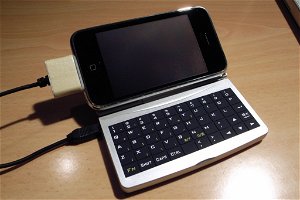
It will be really interesting to see, if Apple can emulate the Nintendo 3DS experience with a bolt on controller for the iPhone. And if the game developers are willing to compete in a much smaller market of iPhone users who actually have, and are willing to carry the controller with them. And games that, go both ways, won't be able to compete with games designed for D-pad + buttons control.
You think? I connect controllers to my Android devices on occasion, it works beautifully. Still I don't do it that often unless I'm sitting at home. That's been an option for Android users for years, I just don't see it taking off unless the controller is built into the device.
On public transit, or an airplane, I tend to use my 3DS for gaming.
There are some that are... acceptable. But you're right.
The fact that Apple has announced APIs for game controllers on iOS means that this will change with iOS 7, and that could be a big problem for Nintendo.
That seems to be a de-facto-standard away from being solved though. Someone, or some collection of someones, are going to hit on a controller and/or case and/or variant device that establishes some set of inputs that clicks with the market. [1]
And developers will design for said standard and that will be that.
That seems much easier (if not entirely inevitable) than Nintendo discovering some way to halt and/or reverse the trend away from dedicated gaming devices.
[1] a standard along the lines of the modern console: "dual analog sticks, d-pad, shoulder buttons, four face buttons"; or stand-up arcade fighter's: "analog stick + 6 buttons", etc. It doesn't have to be one-true-piece of hardware, just a general arrangement of inputs that developers can design for.
I don't think lack of hardware or standards here is the issue. It's still an open question as to whether those same people who buy mobile games would walk around with a controller+phone in their pocket/purse.
The question isn't whether happy touch-gamers would buy these controller cases in bulk. The question is: should these cases exist and get developer support, how many 3DS and Vita gamers would continue paying a premium for their dedicated devices and software libraries?
Android and iOS already "have" the larger slice of the market. (The "touch gaming" slice) My point is that they're a very short step away from essentially taking "all" of it. (Not literally all -- focused devices may still live on -- but enough that Sony and Nintendo's current model can't sustain itself.)
Also, I think you're "off" on the size estimate.
Extend a hypothetical mobi-style battery case an inch-and-a-half on the 'head' and 'chin' of an iPhone. D-pad on the left, some buttons on the right -- maybe even shoulder buttons if you're feeling saucy.
The result is still pocketable and smaller than a Vita or 3DS. (Similarly for any number of popular Android phones -- though phones with 5" screens would push the arrangement directly into Vita-ish dimensions.)
Stand-alone controllers are an important part, but they'd be something that provides consistency on the TV-screen side, with things like GameStick, Ouya and/or Apple's rumored AppleTV gamepad play.
I've still yet to play a smartphone game half as deep as any of the games I played on the original Game Boy as a kid. Modern smartphone games are really not that far removed from Snake on the early Nokia phones: Simple time wasters you play for a few minutes during lunch break or while waiting for a friend, distractions to fill the little gaps in life, only now, they all have slot machines taped onto their sides. The thing is, Nintendo's portables were never competing in this market in the first place. It's not like the original iPhone came out and regular people everywhere said "oh wow, now I don't have to lug a DS around everywhere!" When did you ever seen someone over the age of 10 waiting on the sidewalk with their face buried in a Game Boy?
The actual "on the go" use for a handheld is for people that are regularly stuck in transportation for long periods of time -- mostly children in the US, but public transportation is more common elsewhere. If you were going to be stuck in a car or other vehicle for hours on a trip, you'd probably want something more involving than Angry Birds to occupy your time. You simply can't offer that kind of gameplay experience with just a touch screen (with the possible exception of menu-driven games like RPGs, which I'm surprised there aren't more of on smartphones... probably because it's harder to make a good RPG than it is to lock a tired old flash game in a Vegas casino for a few hours and drape a nice coat of fur over whatever stumbles out...), and the moment you bolt a more game-friendly input device onto a phone, it stops being a fashion accessory and becomes a "toy" that no adult wants to be seen carrying around in public (I'm not immune to this effect, but it's still ironic since smartphones are mostly glorified toys in the same way that expensive cars are)
The other main use (and the way I've enjoyed Nintendo consoles for years) is for lounging around the house. There's something really nice about curling up in bed or on the couch on a lazy day and getting lost in Animal Crossing or whatever for an hour or so. Or, uh, taking it into the bathroom and spending more time than you expected to...
What I'm getting at is that the main competitor for Nintendo's handhelds is actually the iPad: Something you can pick up at home, hop right into a game/web browser/whatever without tedious load times or a serious commitment, and put away at a moment's notice: just close the lid/hit the lock button and it'll all be waiting for you when you feel like it. Only, they aren't really competitors, because people don't surf the web and watch videos on their handhelds, and they don't sit down with their iPads for hours playing Fire Emblem. Neither has the right form factor or input method for the other use case, so neither can completely replace the other.
Nintendo and to a lesser extent Sony are the only ones that seem to get the appeal of this kind of experience, so I'll keep buying their handhelds 'til they stop making them. As will a lot of other people who grew up with various iterations of the Game Boy. Really, my only complaint is that their platforms aren't more open to indie developers, though I get why they don't want to harm the reputation of their consoles with an app store free-for-all. At least Sony seems to be moving in the right direction on that front.
The 3DS has only been out for a couple years, and sales are still rising -- I don't feel like you can really compare it to a console whose entire lifespan has already passed.
It might be better to compare the N64 to other consoles of the time, like the Playstation.
Got my 3ds about 2 months ago and I absolutely love the 3d aspect. To my eyes the 3d view is beautiful to view/play and is oddly nostalgic (it reminds me of a Viewmaster).
One thing these calculators seem to be missing is side-money: like, let's say I'm earning some recurring income outside of my job (from a website or app or something), and quitting my job wouldn't mean losing that income. It'd be nice if they had an input box for that kind of income too.