IMO Microsoft has made progress, but has clearly not turned the corner. Nadella made a good start, it just isn't enough.
Let's keep the hate aside and forget MS's past. The biggest problem facing MS now is the loss of mind share on the Windows platform. The brightest minds aren't programming on Microsoft platforms if you look at colleges and conferences worldwide. This cannot be reversed; Open Source products are now technically superior, the community is very well organized, and it is free. Interesting research, frameworks, libraries and programming languages spawn on Open Source before they show up (if ever) on Windows. Windows engines have run out; though they will keep going for a while.
MS had a great run for over twenty years because the entire world ran on DOS and then Windows. That gave them enormous influence and power, power to make mistakes, fail over and over, and yet succeed. The real challenge will be in adapting to a future in which Windows is irrelevant. The long-term future of Azure, Windows Phone, Windows Desktop, Windows Server and their overpriced Office Tools looks bleak to me.
> Interesting research, frameworks, libraries and programming languages spawn on Open Source before they show up (if ever) on Windows
You might not realize it hanging around on HN, but a huge portion -- dare I say a majority -- of developers don't give a hoot about this.
New languages don't matter. They've already seen a bunch. Their employers aren't interested.
New frameworks especially don't matter. If they ignore the new frameworks, 90% of them will be gone in three years, and most of what's left that's useful will be pulled into .NET or Java.
Name one open source IDE which is superior to Visual Studio. Or an open source database that is better than SQL Server. Not to mention C# which imho is the best language out there (arguably .NET though isn’t that good). I won’t argue that there are aspects of the ecosystem that can’t hold a candle to open source solutions especially in the administration tools area.
As for community, have you bothered to take a look at MSDN? There is an insane amount of free information online for their APIs. In terms of documentation MS is light years ahead of everyone.
Lastly, the “Windows/Microsoft is irrelevant” argument is very prevalent amongst our ranks but only there. MS might be irrelevant in our industry but in the enterprise, where by the way the big bucks are, they’re dominant.
>Name one open source IDE which is superior to Visual Studio.
Here's a list in no particular order of open source editors/IDEs I would use over Visual Studios.
1. Vim.
2. Atom.
3. Brackets.
4. LightTable.
5. Codebox.
6. Slap.
> Or an open source database that is better than SQL Server.
Depends on what you mean by better and what compliance you need I guess? MongoDB can provide benchmarks better than SQL Server.
> Not to mention C# which imho is the best language out there...
Language preferences obviously change based on the needs of the developer. I prefer javascript just because I need a language that can run anywhere and I prefer prototypal inheritance over classical.
> In terms of documentation MS is light years ahead of everyone.
I use vim and brackets (in addition to Visual Studio), but is codebox even an editor? I thought it was just a snippet organizer. Also, Atom can't open files greater than 2MB at the moment.
The OSS IDE community is trapped between eclipse, emacs, and vim...these projects are all based on mostly stale ideas and I'm pretty sure when the right project starts with better ones, you'll see great open source IDEs that compete with and even surpass VS. Perhaps lighttable is that, but it's too early to say.
It's just that IDE developers would want to eat as well. For some reason open-source only works for frameworks and libraries. But it works really great for them!
> Name an open source database that is better than SQL Server.
OK I'll name two: SQLite and MongoDB. I suspect that both of these are better than SQL Server on criteria I care about: ease of deployment on Linux systems, lack of issues around licensing.
Speaking of programming: I have recently tried the free version of Visual Studio - Community 2013. To my surprise (I had tried Visual Studio Express before and wasn't exactly impressed) it is hands down the best IDE for Cordova/PhoneGap environment I ever worked on. The killer feature: DOM inspector and JS debugger/console inside the IDE.
But the funny thing is: even in a Microsoft product it's way easier to debug Android than Windows Phone.
Nonetheless, I agree that Nadella made a good start, and that (despite the good impression) it's certainly not enough for now, but - unlike you - I don't think it's a lost cause. Not yet.
Doesn't Windows still have around 90% desktop market share?
The open-source community simply refuses to do the work necessary to harm Microsoft on the desktop. Developers would rather fork another version of open office, create a new Linux distribution, or start a new window manager.
The only way the Microsoft monopoly will be harmed is if Google turns Chrome OZs/Android into a real competitor.
So what, though? The vast majority of people running Windows are using it to run 2 things: web browsers and Office. IE no longer has a dominant share of browsers, and Office is available across many platforms besides Windows.
Microsoft still gets paid for its 90% market share. Developers still target it, and often release the best versions of their apps for Windows. Office isn't available for Linux. Adobe products? AutoCAD? Games? Nope!
Microsoft makes a lot more money than it did five years ago. The only real difference is that Apple and Google have grown a market and Microsoft has been unable to gain traction. Give them long enough and I'm sure they will. After all, the can afford to because Windows and Office are huge cash cows, and they've got the money to burn.
58% of desktops is not dominant browser share. IE does not today, in any way, set a standard that web-based companies feel that they need to meet.
That's the thing with Microsoft: I doubt they will go out of business or anything; in fact I think they will continue to have lots of success.
But they don't dictate anything to the rest of the computer industry anymore. And that's a big transition because for decades, their business model and culture were built around their ability to do that.
So we can drop support for IE8 and IE9? Almost 6 out of 10 people on a desktop use IE. Most corporations in the world still run on Windows, and 9 out of 10 people still do. If you get a corporate job, you'll be plopped in front of a Windows PC. There's no option B.
But hey, you feel good because people have smartphones that aren't Windows based.
Those stats just don't create leverage for Microsoft anymore outside of the enterprise. And even within the enterprise, their influence is shrinking with the growth in hosted SaaS applications like Salesforce, Basecamp, Google Apps, etc. Heck, even MS themselves are going down this route with purchases like Skype and Yammer.
I work in a corporate job; almost everyone has a Windows PC on their desk. Here are the stats for our Sharepoint intranet:
    IE- 47%
    Chrome - 47%
    Firefox - 5%
    Safari - 1%
Why? Because IT now installs Chrome and Firefox on every desktop. Why? Because most employees need to work with hosted services, and all the hosted services target their development to Chrome and Firefox first.
Open source doesn't need to dislodge Windows from the desktop. Instead they just used the server/client model to commoditize desktop OS's in general. Heck, Microsoft is the only company still trying to charge money for their desktop OS at all.
Well, Google Docs is free -- and Office Online is free. The subscription is for the desktop software (that Google doesn't have) and 5x unlimited OneDrive storage and some Skype minutes -- for the same price, you get 10TB storage at Google and no desktop software.
I can see the reasons why one would go for the Google suite -- just wanted to point out that MS is not more expensive, it's actually cheaper.
Google's offerings are worth exactly what they charge for them. Whether they're "enough" for "a lot of users" depends on how you define the market--by number of users or by potential revenue? They're enough for grandma writing a letter or similar informal communications, but I imagine that's a niche wholly usurped by e-mail.
There are plenty of free Office alternatives already that work for 90% of the people. The Web, Android and iOS has made such tools far more accessible for non-technical users. On the computer, use Google docs, on the tablet use QuickOffice. MS has had to react to this, Office on tablets and phones are now free. For general purpose software like document editing and presentations, people might pay $4.99 max, for lifetime.
There'll be another 5-10% of users who need advanced features. That will not sustain the multi-billion revenue coming from Office products.
I don't think I've ever seen a large organization that doesn't have a critical dependency on Excel - usually with Excel plugged directly into their core financial/ERP/CRM.
Replacing Excel in most large organizations would be like trying to give a human being a skeleton transplant.
Edit: The point I was trying to make is that I wonder how important personal use of Office is to Microsoft. Arguably people either want to use what they use at work or they use something other product (in the past one of the competing office suites, probably one of the online offerings these days) - I wonder if the size of the latter category has actually changed over the years?
I don't understand your point, Open Source programming is what it's always been. It's just that proprietary programming has switched from Windows to iOS now.
Exactly. Apple took a chunk of Microsoft's market when it comes to developers. Now this has some benefits for open source, as a more balanced market will discourage predatory behavior, but otherwise it's more of the same.
I'm no apple fan, but Apple does contribute a fair amount of resources to open source. If you're running a typical GNU/Linux distro, go to http://localhost:631/ for fun.
I don't think Microsoft are going anywhere soon, if at all. They are too established in the corporate world and while there are still I.T managers that have the philosophy of 'I won't get fired for buying IBM' then there will be a requirement for developers to make software for them.
What they have done last week is a massive step, but its just one step and many more need to be taken to catch up on lost ground.
Google, Facebook, Amazon and just about every big internet company (with the possible exceptions of EBay and, well, Microsoft) are NOT using windows in the backend and never have. They could probably afford Windows server licensing, database licensing, etc NOW, but they would not have been able to while growing.
Now, if you start a company and you think you might grow ... which stack will you use?
Not much of an issue with programs such as BizSpark. You have 3 years to 'grow' and afterwards you have to fork over a couple thousand bucks, depending on what you use.
The thing is, Unix systems (OSX included) are much more developer friendly. Windows doesn't even have a decent terminal emulator yet, you have to resort to things such as conemu.
Now, if Windows can be 'unixified', then I believe the trend may be reversed. As is is, you can't compete with the amount of utilities and server software for all unix flavors.
Yes, one has been able to graft nix to Windows since NT; however, it's still like a third arm dangling off of C:\whatever.
If Microsoft can make a POSIX layer like OS X did -- one that ships with the OS and feels like it is part of the OS -- I'd be very, very interested.
I've been on OS X since Apple was nearly dead (still have my 10.0.6 CD somewhere around here). Before jumping on, I bounced from the promise of Linux distro to FreeBSD, to OpenBSD -- trying to find something that worked as a desktop environment. Once OS X was released, I knew I found what I had been looking for. It definitely wasn't because it was from Apple (back then, using Apple was being counterculture, if not somewhat risky as the business wasn't doing so well); it was because there was finally a desktop OS that had a POSIX layer and a GUI that didn't feel like a third arm grafted on to /usr/local/whatever.
I'm hoping that MS catches the drift that DOS is dead & can kill that sacred cow; I'd love to get a Surface tablet & develop for Windows Phone, but having to deal with DOS is like moving out of a house and trying to live in a tent. My experiences with Powershell haven't been all that much better. It's definitely not got the same problems as DOS, but in my experience it didn't implement the paradigm of a pipeable set of simple tools to accomplish singular tasks.
I'd love to see a POSIX compliant Microsoft OS. And to me, these recent changes bode well -- it seems that Microsoft realizes it must be a part of a larger ecosystem. The is the kind of OS I want to work with has this kind of thinking at its core.
> Not much of an issue with programs such as BizSpark. You have 3 years to 'grow' and afterwards you have to fork over a couple thousand bucks, depending on what you use.
Are you sure? Facebook and Google both had thousands of servers when they were three year old (they are in the millions now), and facebook already had sizable databases that would have cost a small fortune had they been MSSQL (or Oracle or DB2 for that matter).
I was under the possibly mistaken impression the BizSpark covers your devtools, not your deployment.
And the costs are just the most easily quantifiable advantage - Google, Facebook and Whatsup have all modified their stack (Linux Kernel, MySQL, Erlang VM) in ways that are simply not available with the Microsoft stack.
Granted, not every business is Google or Facebook - but anyone who dreams big enough sees Microsoft's stack does not make sense .... and even when you are thinking small, there are really few reasons to rely in Microsoft except at the edges.
>The brightest minds aren't programming on Microsoft platforms if you look at colleges and conferences worldwide. This cannot be reversed; Open Source products are now technically superior, the community is very well organized, and it is free.
All I see at colleges and conferences worldwide are Macbooks. How is OS X Open Source? It actually seems to be worse, since it's legally tied to expensive hardware.
Also, Open Source products aren't really technically superior for a number of categories. I am sorry but Photoshop, Office, Exchange etc. are definitely technically superior. Software like Windows Server and SQL Server are competing with free products and still doing very well.
Imagine how much marketshare they would have if they were free of cost and MySQL/PostgresSQL and Linux cost the same as SQL Server and Windows Server now. How many would buy them instead of the free MS products? How many would pay the same as Office costs now for OpenOffice if Office was free?
How is this technically superior?
Also, Azure runs Linux and other open source products quite well.
>All I see at colleges and conferences worldwide are Macbooks.
I know anecdotal evidence does not equal real data, but I'm a sophomore/junior (switched majors) in college and I prefer to use Linux over OS X or Windows.
Also, IMO open source products are usually better than their closed source counterparts. I know what is actually running on my computer. I can alter the program how I need. Everyone who contributed to the project did so out of their own enjoyment. Being open source means experts in different fields can make the product better, safer, further optimized.
Gimp does the job for me, I personally use Google Docs because I switch computers a lot. Microsoft Office is just as bad LibreOffice in terms of usability, so I wouldn't call either superior. Don't quote me on this, but I'm sure lots of technically superior closed source products are developed with the help of open source software.
If Linux came at the cost of SQL Server... that's a weird question. How does something open come at cost to the consumer? I can see donations being greatly appreciated, but not required payment. There's to many rabbit holes I could go down here.
But I could be completely wrong, I'm just a 20 yr old dude trying to figure out if Computer Science is even the right degree for me.
OS X provides a user friendly interface on top of a unix like system. It's easy to develop for linux and unix-like systems in general on OS X. Not so much on Windows. Also, we like bash/zsh, and PowerShell doesn't appeal to many of us. Many of us also don't see much of a difference between running a Linux distribution and running OS X, other than the desktop user interface. The differences in the underlying layer get blurry. With Windows, no.
PowerShell isn't the only option available for Windows. You can install Cygwin or other alternatives and have your bash and linux-y environment on Windows.
True. But if you spend most of your time in and around cygwin, it makes sense to switch to some kind of Unix -- while cygwin is marvelous, the nearly perfect Posix layer comes with a non-trivial performance cost - e.g., fork() is horribly slow in cygwin, as are many forms of I/O.
It isn't, but a lot of people develop on open source environments running on OS X. E.g. Python/Django. Because OS X is a Unix, moving between it and Linux for web development is easy.
> Azure runs Linux and other open source products quite well
This may be the case, but there is the perception (possibly an unfounded one; I've never used Azure) that Linux will always be a second-class citizen on Azure.
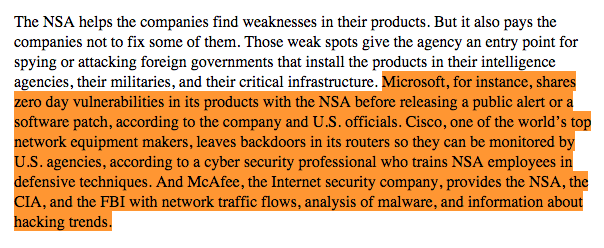
Even if that past is very much part of Microsoft's present? Such as threatening companies with patent lawsuits at a rate that has never been seen before in Microsoft's history, or its continuous collaboration with the NSA [1]? (especially after it bought Skype, and built lawful intercept technology for Skype [2] - before actually buying it).
I'm almost certain Microsoft keeps some vulnerabilities on purpose to the help the NSA, and only patches them when other parties report those bugs. In fact, I think the recent "WinShock" or whatever they're calling it, with the remote execution for its TLS library was known by Microsoft. This sort of thing is so much easier to use as an "effective backdoor", than something nefarious NSA would have to implant into Windows such as a key escrow or whatever (not saying those don't/won't exist in TPMs).


Let's keep the hate aside and forget MS's past. The biggest problem facing MS now is the loss of mind share on the Windows platform. The brightest minds aren't programming on Microsoft platforms if you look at colleges and conferences worldwide. This cannot be reversed; Open Source products are now technically superior, the community is very well organized, and it is free. Interesting research, frameworks, libraries and programming languages spawn on Open Source before they show up (if ever) on Windows. Windows engines have run out; though they will keep going for a while.
MS had a great run for over twenty years because the entire world ran on DOS and then Windows. That gave them enormous influence and power, power to make mistakes, fail over and over, and yet succeed. The real challenge will be in adapting to a future in which Windows is irrelevant. The long-term future of Azure, Windows Phone, Windows Desktop, Windows Server and their overpriced Office Tools looks bleak to me.