Probably not all that different from the last one. Economy starts heating up, and the Fed begins to tighten interest rates to damp down inflation. It takes time for interest rate hikes to make their way through the economy, so they keep tightening. Eventually, everybody realizes that money isn't cheap anymore, and moreover, they realize that everybody else has realized that money isn't cheap anymore. That causes a mass stampede for the exits as people fly away from risk.
In the last crash, the economy started heating up in 2004, the Fed started tightening in 2005 and continued through 2006, the market hit a top in August of 2007, there was a slow-motion recession through late 2007 and early 2008, and then everybody ran for the exits in the summer of 2008.
This time, I think the economy started heating up in 2013, the Fed is planning to tighten starting early 2015, it'll take about 18 months for the rate hikes to make their way through the economy, and so I'd expect a crash around 2017.
We are in a debt bubble propped up by massive central bank intervention all over the world. The intervention will fail at some point and well get a bout of deflation just like in 2008, only this time more severe.


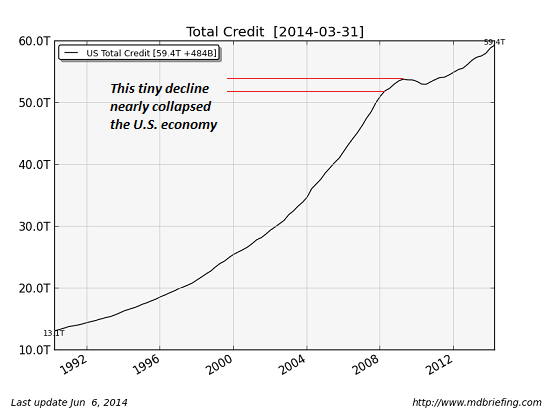

In the last crash, the economy started heating up in 2004, the Fed started tightening in 2005 and continued through 2006, the market hit a top in August of 2007, there was a slow-motion recession through late 2007 and early 2008, and then everybody ran for the exits in the summer of 2008.
This time, I think the economy started heating up in 2013, the Fed is planning to tighten starting early 2015, it'll take about 18 months for the rate hikes to make their way through the economy, and so I'd expect a crash around 2017.