This says more about the arbitrary nature of using city boundaries for studying home pricing than anything else. San Francisco certainly has high prices, but it also has one of the smallest footprints of any major city, and has lots of nearly-indistinguishable residential areas that are adjacent but fall outside its boundaries, particularly to the South and East. If you look just at pricing within the city boundary, it's going to be inflated by the fact that such a large percentage of that area is still relatively close to the "city center" and benefitting from the value that creates.
Meanwhile, "New York City" (which ranked lower on median price) includes large residential expanses that are much further away from the city center, including Staten Island. (Not to mention Los Angeles, which is what, 50X the size of SF proper?)
I'd like to see this comparison done for say, Manhattan island vs. San Francisco - that would be a much more apples-to-apples compare.
One of the interesting bits then is the differences between the common meaning of a city and the statutory boundaries.
What people mean when they say "New York City" and what it actually is are more or less the same thing (though most people are surprised at how big and diverse the 5 boroughs actually are). People don't really count the NYC Metro area in the equation. Nobody who visit Trenton or New Haven comes back home and says "I went to New York".
When people say lots of other cities, they really mean the metro area. "Washington D.C." refers colloquially to the 7th largest urban area in the country. People can make regular repeated visits to Arlington, or Fairfax or wherever and still go back home and say "I just went to D.C.".
I suspect SF is the same. People can visit anywhere in the Bay Area and go back home and credibly say "I visited San Francisco" even if they never actually stepped foot in the city proper.
edit I notice everybody who disagrees with this premise lives or is from the Bay Area where these things matter. On the other side of the country, all of California north of Monterrey is basically "San Francisco", most people think Oakland is part of L.A. and nobody could pick out SV on a map if their life depended on it.
>I suspect SF is the same. People can visit anywhere in the Bay Area and go back home and credibly say "I visited San Francisco" even if they never actually stepped foot in the city proper.
No, no they couldn't. Residents of SF are quite prickly about what is and isn't the city. You'd say you visited the bay area or possibly silicon valley not SF.
I've visited that part of the country before. I tell people I visited SF. I have no clue if I was actually inside the city proper. The problem with the "these people are prickly" notion is that THEY'RE NOT WITH ME BACK HOME TO CORRECT ME and thus I don't really have to give a shit if I stepped inside the city boundaries or not.
[nothing personal]
by that logic (no one is around to correct you and also you don't give a shit) you can start making plenty of things up. Oh what a stories you should have about your travels and adventures!
Yes of course, I completely agree. You're 100% right that I can make up any lie I care to and it's even easier if there's nobody to call me out on it. And I don't take it personally, it's not offensive.
My point, though, is that the notion that the residents of SF have any ability to sway the visitors to SF as to what they tell people back home is bogus.
>>I suspect SF is the same. People can visit anywhere in the Bay Area and go back home and credibly say "I visited San Francisco" even if they never actually stepped foot in the city proper.
>No, no they couldn't. Residents of SF are quite prickly about what is and isn't the city. You'd say you visited the bay area or possibly silicon valley not SF.
This second statement one I take issue with, made by coolsunglasses. What mechanism does coolsunglasses have to force me to know the difference between "bay area" and "san francisco" and "silicon valley"? How does he propose to regulate my speech such that I don't offend his (or others) sense of which areas are which?
I get that people who live in SF proper might get upset if someone said that. That is their right. But for the vast majority of the population (think "flyover states" and probably a good bit of the east coast) visiting anywhere in the bay area is just as good as the "real" san francisco. At least from a communicating-the-idea-of-what-happened perspective. And the folks in SF or the bay area not liking it doesn't do anything to make it impossible to say. Inaccurate? Perhaps. But uninformative? Not at all.
Actually I do recall meeting some people in one "tourist's destination" place who answered "we're from San Francisco" to "where are you guys from?" and then later specified they from bay area not far from SF (I myself live in SF). It's a matter of convenience I guess, when you are in the place with plenty of people from different regions it will quickly give an idea what part of US you're from without going into detailed explanations when not necessary.
When people ask me where I'm from I say "DC". I actually grew up in Alexandria, VA. But I'm not lying to those people[1], I'm trying to give them a general idea of where I'm from that they are most likely to know. If they follow up with "what part of DC" then I know they are more familiar with the area and I say something like "well actually, i grew up outside DC in northern virginia".
Now that I live in Oakland I say I live in Oakland, but if I lived in, say, fremont, I'd probably just say the SF Bay Area. People probably know Berkeley, Oakland, SF, Palo Alto, and San Jose as specific places around the bay, so you can safely say those, but if you are from Walnut Creek...no one (generally) outside of the area can actually place that, so defaulting to "SF Bay Area" or even "SF" is simpler and puts the person you are talking to in the right geographical area.
>But for the vast majority of the population (think "flyover states" and probably a good bit of the east coast) visiting anywhere in the bay area is just as good as the "real" san francisco.
Not really, no. If I said I visited SF, my grandfather from Florida would ask me what neighborhoods I visited and restaurants in SF I went to.
I kind of doubt anyone visits Oakland or San Jose (both of which are huge destinations in "the Bay Area" but have their own international airports) and says they "went to SF." I sure hope not. It's pretty clear cut if you went to SF or not, since there's water on 3 sides of the city and not much to visit on the 4th side.
I'm not familiar with housing costs in SF, so I'm not sure how considering surrounding areas would change the data, but I know in DC that the surrounding areas are by-and-large as expensive (and in many cases more expensive) than DC-proper.
The point being that whether you consider DC-proper, or DC/Arlington/Bethesda/Silver Spring/McLean doesn't really change things too drastically. Expensive cities tend to be expensive everywhere. I know that in Atlanta, for example, you can live in the city center in a nice place roughly for what it costs to rent an apartment of comparable quality pretty much anywhere in Northern VA. There is a floor (a very high floor) beneath which you will not find quality housing and really not much of a ceiling.
In SF, some of the immediately adjacent areas (connected by subway) are drastically cheaper, like South SF, Oakland and Alameda. Like 50% of the cost if you look at the median sales prices. There are definitely some expensive suburbs, but they're either to the north in Marin or much further south down the peninsula down by Stanford.
It's worth noting that after New York and Brooklyn merged (I think around 1900), SF considered merging with Oakland.
> Nobody who visit Trenton or New Haven comes back home and says "I went to New York".
You're stretching things. Trenton is 2 hours from Manhattan by car. If you stay in Northern New Jersey, you definitely "went to New York". I can get to Manhattan within 15 minutes from Hoboken or Jersey City. When you're that close, you're definitely part of the city.
No one I know in NYC considers Jersey City to be "part of the city" any more than people consider Oakland to be part of SF. Hell, I know people living in Brooklyn who only consider Manhattan "the city".
Sure - it's like having a stopover at SFO and saying you've "been to San Francisco"... or at CDG and saying you "visited Paris." They're both 15 minutes from the city, too.
> I can get to Manhattan within 15 minutes from Hoboken or Jersey City.
As a figure of speech most people won't consider either of those NYC. Somebody visiting Jersey City went to "New Jersey" colloquially.
Actually, I take it back, people who don't know NYC well "know" that Manhattan, Brooklyn and the Bronx are "places in NYC" even if they aren't quite sure what they are, I'm not sure Queens registers for most people, and Staten Island, even though it's geographically one of the largest parts of the city, may as well not even exist. People picture Manhattan in their heads though and that's about all they ever visit. Some people might confuse the name Yonkers as part of NYC because it's kind of a funny name like Brooklyn or Bronx and they've probably heard it on NYC area TV shows and movies. But nobody outside of the NYC area will visit White Plains, Paterson or Newark and claim "I went to New York City".
Meanwhile, people who visit Palo Alto definitely say "I visited San Francisco". But I do agree with other comments that people don't usually conflate San Jose or Oakland with San Francisco.
It's the colloquial semantics of place names that I'm referring to. It's a little bit like how "Asian" means either East Asian, or East Asian + South Asian depending on your dialect of English, but nobody who ever visited Aermenia or Cyprus ever claimed they "visited Asia". Or people who visit Egypt visited "the middle East" when really they visited Africa.
Part of it is name recognition. If I'm not from the Bay Area, "Belmont" or "Millbrae" doesn't mean anything to me or to the people I'm talking to, even if they're clearly distinct places well outside of SF. The identity of SF has subsumed those other areas, at least in the geographic knowledge base that people from outside the area walk around with.
Most people know Jersey City is obviously not NYC. But most people from outside of the D.C. area couldn't pick out Annandale nor does it have any meaning to them. So people just say "I went to D.C."
This has some embarrassing and sometimes hilarious side-effects for out of towners. Like for example, somebody visiting San Francisco proper, knows that they have a buddy that lives near there (because in a past conversation his buddy said "I live in SF" because it was easier than saying "I live in Emerald Hills" and doesn't understand why it's not immediately convenient for them or their buddy to just hop on a street car and meet up for a quick Coffee.
Or I know a company from the West Coast that set up shop in "D.C." expecting it to be convenient to their Government customers, only to find out that none of their customers would come to their office since it was a 2 hour drive in traffic from the actual customer locations out in the larger Metropolitan area.
I think the exact boundaries to use for comparison are really difficult to pick, and vary on an individual level. For instance, the superb connectivity of the public transportation makes me feel as if Brooklyn, Queens, the Bronx (sorry Staten Island) are very much a part of NYC. I did not feel this way living in Mountain View; SF felt like a major chore to get to and a different world of its own. Plus it helps that the boroughs have the urban amenities I associate with a city that the suburban Bay Area towns like Mountain View lack.
So, while you might personally want to compare SF to Manhattan (which is totally fine based on what you value), when I think of my own quality of life metrics, I consider the NYC boroughs (excluding Staten Island) a cohesive unit that the SF Bay Area is not.
This was the metropolitan area, though. If you look at the chart, the top-left column states "Top 25 metropolitan areas, by population". After all, everywhere in Silicon Valley is expensive, not just SF proper. San Jose is not itself cheap.
SF isn't in Silicon Valley. San Jose is one of 10 largest cities in the county and Oakland's pretty big too. I'm guessing that "San Francisco metro area" probably can't include either of those two larger cities, nor would it include Silicon Valley (which is 15-20 miles from SF and closer to San Jose.)
That's absolutely right, and in the few articles I've seen that break out Manhattan, it's still significantly more expensive than SF. Of course, that's old news, right? And being old news, "Manhattan is the most expensive place to live" doesn't fit into the current tech boom, linkbait narrative that all the blogs and news outlets are exploting.
That's funny, because I often make the opposite point about SF. Living in the Boston area, there are areas of Boston that are as expensive as SF (Back Bay, South End), but I can go a very short distance out of the city (Somerville, Medford) and find considerably cheaper housing.
It's not that different, depending how far north you get in Manhattan. The distribution of housing types might be different, but things get pretty residential in the northern end of Manhattan, and you're as far away from "midtown" than those places are from downtown SF.
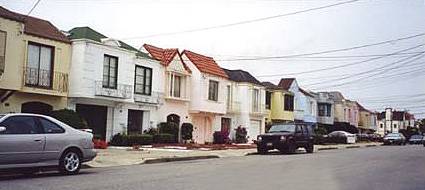
It's as far away geographically (even further for the north in terms of miles), but even if you get to harlem/university heights the types of buildings and the way the streets feel is different from the sunset/outer richmond. There is just some sort of gloom and emptiness because of the density of people & climate in those neighborhoods compared to manhattan. You'd hardly find a street in manhattan that has the feel of this : http://foundsf.org/images/2/23/Photo9Ungaretti.jpg
Maybe the light colors in San Francisco's outlying neighborhood's architecture make them look just even more distant and quiet / abandoned?
Also, the ease of getting into the heart of manhattan (say Union Square for both cities) from north Manhattan just feels different than taking the Muni/Bus in SF. You're inside the subway, enclosed and underground. The neighborhoods that have that distant feeling in NYC are ones like Flushing, Gravesend & Jamaica. Or Canarsie. Canarsie is so far away...
Also, Hi Tom - This is Alex from the first Stuy meetup :)


Meanwhile, "New York City" (which ranked lower on median price) includes large residential expanses that are much further away from the city center, including Staten Island. (Not to mention Los Angeles, which is what, 50X the size of SF proper?)
I'd like to see this comparison done for say, Manhattan island vs. San Francisco - that would be a much more apples-to-apples compare.