OP here. That's a really good point. I just think the original article overreached in saying that zipper merging is a "simple cure" for traffic jams, without taking into account that the road might at or near capacity (and you hit capacity in a hurry when you lose a lane).
My article doesn't account for variance in flow rates in congested traffic, but variance in car length (% of trucks on the road) might explain it. I'm not convinced that merging behavior is the culprit; the original article only speculates that that's the case. I'm putting forward a reasonable explanation for why that isn't the explanation, and a basis for evaluating whether it might be — in particular, whether a zipper merge results in higher flow rates after the bottleneck.
Isn't variance in flow rate the crux of the issue? Merge lanes are a special case in traffic, where another flow is entering the channel. This creates turbulence around the merge point that does not exist where there is pure laminar flow and all lanes can be treated equally. Would it help if "simple cure" was renamed as a "simple improvement?"
Sure, there exists a point where the input flow is great enough that traffic must move slower. OP's entire argument is based off of this. The problem is that there are many things you can do to slow down the flow rate even further, and merging poorly creates this "turbulence" which wastes further flow.
And, it's clear that no improvement in merging behavior can beat the maximum road occupancy, however we can approach that limit much more closely.
I think that conceptually modelling traffic as fluid flows is quite clever, and the "turbulence" idea is particularly satisfying.


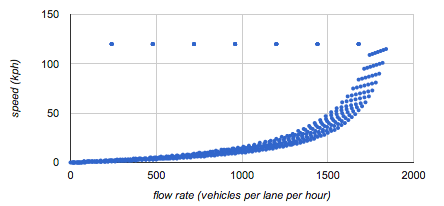

It utterly fails to explain the extreme variance in real traffic throughput during congestion. The original article does.