I don't know a polite way to say this so I'll be blunt. The first words out of mouth were "holy crap" at how bad the art is. The big image in the link and on the kickstarter video look like mediocre high school art. It's really bad. The game interface is then pure programmer art. Please, please, please hire multiple artists.
The card art is pretty high quality, and I disagree with whoever said it was high school art. They're professional artists doing a good job.
That being said, the app's UX is actually really usable and what people expect when playing. It's evolved to the way it is currently based on user testing. It doesn't look as pretty as it could, but it's very easy and natural to use.
This is somewhat off-topic, but HN'ers may be interested to know the business history of the Magic: The Gathering trading card game that's this YC company's inspiration.
MTG was a bootstrapped startup designed by a mathematics PhD student. A great product that resonated with fans, a then-unique market niche, good retail distribution (pretty important for physical products in the early '90s), and favorable acquisitions led to a nine-figure exit for the founder [1].
Magic:the Gathering is a freak of nature. It was a clever game that was brought to a niche company of RPG geeks who's day jobs were managing aerospace projects. In short a bunch of well-to-do hobby publishers with day jobs saw the product and "bet the farm" on making it work out when lightening struck.
From that point on, its been an anomaly in the gaming market, often imitated, never duplicated the exact mix that sparked it. WoTC has learned the limits of where their formula works as well, even THEY can't copy Magic.
The best CCG I've seen is Dominions [1], because it eliminates the more annoying and expensive aspects of the game involving accumulating and managing large, valuable collections of cards. But I've always been more interested in the strategy aspect of games much more than the collectability aspect.
But from a business standpoint, the latter tendency is more desirable to cultivate in players because it's more profitable. When I actively played both, I spent at least an order of magnitude more annually on Magic cards than on Dominion and its expansions.
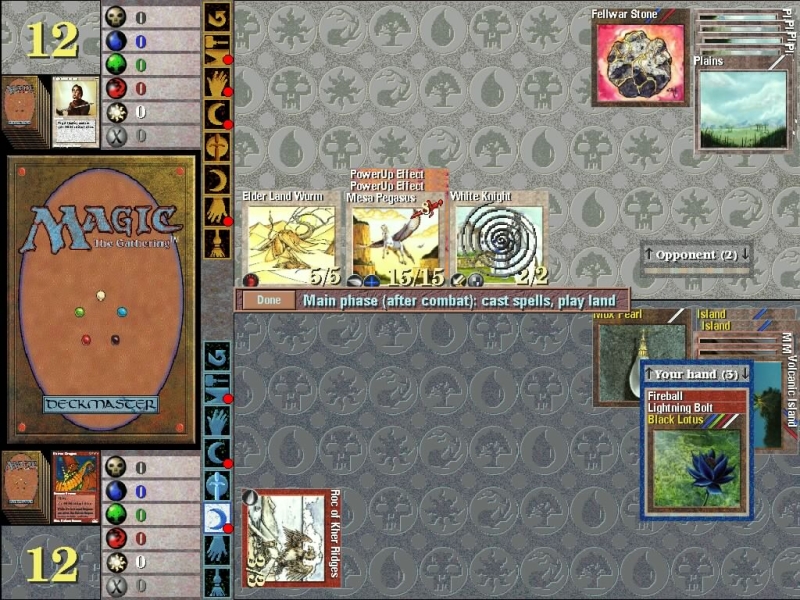
M:tG is a behemoth in the space, primarily on the back of the physical cards. Magic Online has a really poor interface, but it can qualify you for a pro tour which has a fairly large payout. The other digital magic games have much better interfaces, but don't tie into the competitive aspects of the game. They still solidify the brand.
I'm curious how these guys plan to compete with the major players in the space. Most of the real products have a huge backing and insane marketing budgets.
Is there a way they're trying to sell this beyond, "hey, why aren't you just playing the largest (and currently growing) CCG?"
The biggest point of differentiation is asynchronous play. You can't play Magic and most CCGs asynchronously, because every card you play has the option of being responded to (by counterspells, for instance).
The benefit of asynchronous play is that you get to play with your friends and family, regardless of time or location. This makes the game more social and fun, and better than playing random players from the internet.
Are you concerned about competition? Many online CCGs have rulesets capable of supporting asynchronous play (Might and Magic: Duel of Champions, Solforge, Sword Girls, Elements the Game, etc.) and Infinity Wars' devs have publicly announced that they will do it.
Notably Hex seems to have the same issue as MtG where asynchronous play is not practical.
Well there's a lot of difference in all those games, and they're going to attract different types of players. Just compare Sword Girls with Solforge, for instance.
Just as important if not more than competing with other games is competing for awareness. I've done surveys of what other games people play, and the majority of players know about Magic but are unaware of the other games out there.
So I'm not overly concerned but I have done my research and follow what the other games are doing.
I've only played Magic: The Gather a few times, but it would be interesting to focus more on deck building and then let the computer "play" randomized head-to-head games. Players could tweak their decks between rounds or games.
I feel like a very crucial bit of information was left out: how does one acquire cards? Is it like traditional TCGs where you pay a few dollars to get a random dozen? If so, count me out.
Yes, you can buy booster packs and starter decks. This is the business model of all virtual goods games. You can also earn cards for free too in the game.
Game designer here. Like the idea. I doubt it will catch on among ex-M:tG players due to uncanny valley effects. It could still be a great game and I really hope it succeeds, but I don't see the CCG model itself generating a hit.
If I were to do a CCG, I'd take serious inspiration from the German-style board game genre. #1. Use a Victory Point goal instead of "kill the other guy" so you have interesting 3+ player play. #2. Use market-type mechanics and lots of options to avoid mana screw type degeneracies.
That said, I've heard of CCGs failing for not having enough random luck... so take my advice with a huge grain of salt. If you optimize away all the luck, you take out of the fun and most players will say you've gone too far at that point.
The problem with most of these post-Magic CCGs is that they're too similar to Magic, which was groundbreaking in its time but couldn't benefit from the German-style aesthetic, largely because it hadn't developed yet.
Secondly, being online is a disadvantage. Cards are part of the experience. Also, physical cards make Magic's love/hate scarcity socially acceptable in a way that it won't be in an online game. The way to win is to make the online aspect an advantage instead by open sourcing it. However, that requires a lot in the way of community management. It'll be a lot of fun, but hard to scale.
Those are some good points. The point about mana screw is really important because it's a big turn off for players. Orbs has no mana flooding or mana screw, because there's no dedicated resource card. Instead, once per turn, any card may be discarded for one energy of its color, and this energy regenerates each turn.
Being a digital CCG is a big advantage, actually. There's huge opportunity in the digital CCG market right now, and five years from now I think we'll say 2013 was the year that DCCGs started taking off. If not 2012, even: look at how well Rage of Bahamut did (technically a card battler, but still relevant). Rage of Bahamut is falling off the charts now, but I believe that if a digital CCG were balanced and had a pro community (for e-sports), it could be evergreen, where you come out with new sets regularly. Magic, for instance, is on its 20th year.
I think one macro reason DCCGs are taking off now is that virtual goods games are more acceptable to Western audiences. It used to be people didn't want to pay real money for virtual goods, whereas now it's pretty much expected in most games.


That said, this is a great market to be in as HEX raised 2.2 million. Their project already had significant investment before hitting kickstarter though. The bar is quite high. http://www.kickstarter.com/projects/cze/hex-mmo-trading-card...