It's a matter of people imputing notions of "special" where they don't belong. Hence the importance of "proof" in math.
ETA: People are surprised that they can turn a sweater inside-out thru a sleeve or neck hole ONLY because they've imputed a "special" ability to the largest hole in the garment. The mathematical concept of "proof" strips away such imputations, leaving surprisingly unsurprising results - in this case, you can reverse a garment by pulling it thru one of its holes, be it the largest, smallest, or even a tear, because they're all just holes with nothing inherently topologically special about them. In a larger social concept: people tend to impute special attributes to various things where such attribution is not warranted; people who understand the concept of mathematical proof are less likely to get caught up in such incorrect imputation.
Ctdonath was claiming that many people notice that a shirt can be turned inside-out through the main hole at the bottom, or a glove through the wrist hole. Far fewer people try turning a shirt inside-out through a sleeve or neck hole, or a pair of pants through a rip in the knee. They then abstract the wrong way from this experience, inventing the idea that the size of the hole is important (or maybe just that the “main” hole is special).
I’m not sure how prevalent these misconceptions are. It would be interesting to do surveys of the general public to see what kinds of mental models people have here.
If you actually tried to turn a pair of pants inside out through a rip in the knee, the rip might get bigger. In fact, it almost certainly would. Likewise for turning a sweater inside-out through the neck hole, it would stretch it out a bit. Yes, it's mathematically possible but there are real reasons people don't treat their clothes that way even if they know they can.
Love this question and all the answers. I find topology fascinating even though I understand maybe 5% of it. I took a decent amount of math as part of my CS degree, but beyond basic calculus it was concentrated in probability, stats, and linear algebra; never came near topology. In hindsight I wish I had taken more math, but as a 19-20 year old student at the time, I was happy to be done with it.
If I invented a time machine, sometimes I think my second use of it would be to give my college self class choice and scheduling advice.
Topology is fun, and not especially mysterious if you give it the time. One of those subjects that is at the same time highly abstract and exercises the visual–spatial–kinetic thinking part of your brain. You can learn it whenever you like! (For a motivated student, I think self study of mathematics topics is better than a course with fixed problems anyhow, because you can move at your own pace, and take any path you prefer. Requires some focus though.) I don’t have enough experience with all the various textbooks to compare them, but I thought Munkres was alright.
It depends, modern algebraic topology is frequently considered to be one of the most mysterious and abstract fields of math, along with things like algebraic geometry.
I wouldn't compare algebraic topology to algebraic geometry. In my opinion the later is much more difficult both one the conceptual and technical side.
Really? I don't find conceptual and technical difficulty of considering (co)homology theories determined by spectras/infinite loop spaces like K-theories and cobordism theories, study of stable homotopy theories, spectral sequences, triangulated categories etc. to be much smaller that the difficulty of algebraic geometry. As I said, I find them both to be really abstract and mysterious.
Many concepts from algebraic topology can be applied to algebraic geometry after appropriate redefinitions. These new tools seem harder to use than originals. For example I find it technically more difficult to work with étale fundamental group than with a topological fundamental group. Similarly cohomology of a topological space looks simpler than cohomology of a scheme with coefficients in a sheaf. There are many similarities but working with schemes and sheaves is more troubling (at least for me). This of course can follow not from intrinsic difficulty of the subject but from my ignorance and inappropriate intuitions.
I majored in math with a minor in CS (undergrad). Of his entire technical explanation, I'm only familiar with the notions "automorphism" and "topology". To add insult to injury, I did have a course on topology, but it covered only so-called "point-set" topology, and not the algebraic variety thereof.
For the result to be different, the real world would need to have a different sort of topology. For example, if we lived in a non-Hausdorff space, the result would potentially be different. A Hausdorff space is one where for any two different points, you can take a small ball around each point, and the two balls won't intersect. A non-Hausdorff space is just a space where this isn't true for at least one pair of points.
So, for example, if wormholes are real, the space we live in might not be Hausdorff. And if you had a wormhole sewn into your shirt in the right way, you wouldn't be able to turn it inside out.
When I think of topology the first I do is remember that size means nothing in topology.
So the long sleeve of the shirt? Shrink it right down - you are left with just a hole, and no sleeve.
Then flatten out the curvature of the neck and other parts, and you are left with a flat sheet of clothing, with two holes in it. There is no inside or outside to this, meaning the two sides are interchangeable, and that's why you can turn the real shirt inside out.
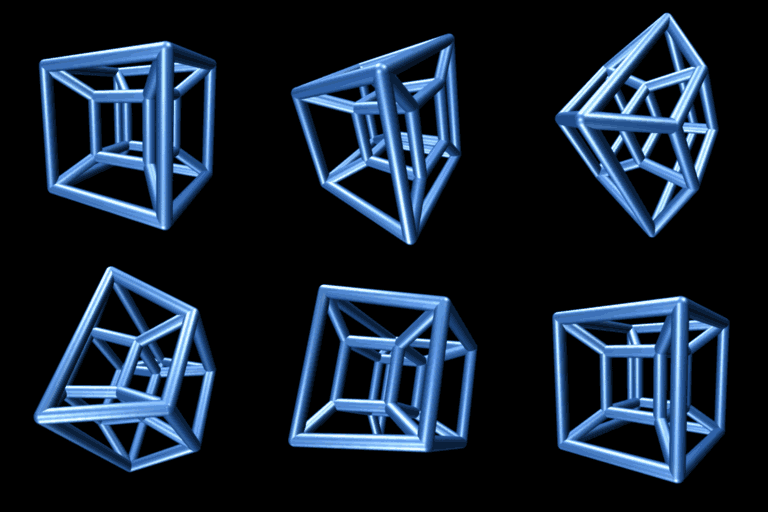
Not really. That looks like a 2-dimensional projection of a rotating 4-dimensional hypercube. The StackExchange question concerns 3-dimensional topology.


ETA: People are surprised that they can turn a sweater inside-out thru a sleeve or neck hole ONLY because they've imputed a "special" ability to the largest hole in the garment. The mathematical concept of "proof" strips away such imputations, leaving surprisingly unsurprising results - in this case, you can reverse a garment by pulling it thru one of its holes, be it the largest, smallest, or even a tear, because they're all just holes with nothing inherently topologically special about them. In a larger social concept: people tend to impute special attributes to various things where such attribution is not warranted; people who understand the concept of mathematical proof are less likely to get caught up in such incorrect imputation.