Though I mostly understand how much of a different algorithm it is, its results are surprisingly similar to hq4x. It sort of looks like a vectorized form - edges are smoothed better, but everything is excessively curvy (seriously, there are almost no corners anywhere). Not quite, as vectorized forms of images tend to mess up horrifically on some corner-meetings (examples of which are in the paper). Which this doesn't seem to do - very impressive!
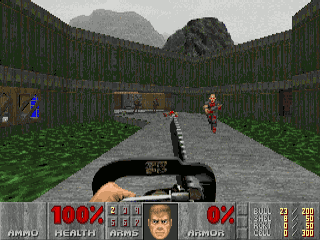
Does anyone know what hq4x does to the Doom picture? I'd be interested in comparing edge-cases like that, especially as it seems hq4x would handle it decently well, while this algorithm does pretty poorly. Understandably so, but I wonder if it can be adapted to handle broader blending forms.
hq4x is certainly in the sweet-spot for real-time emulation upscaling.
However, this algorithm does actually vectorize the image, which has interesting uses for e.g. running all the sprites of a game through it and using the static results in a remake (they also talk about extending it to fill in animation frames in time which would be extra cool).



Does anyone know what hq4x does to the Doom picture? I'd be interested in comparing edge-cases like that, especially as it seems hq4x would handle it decently well, while this algorithm does pretty poorly. Understandably so, but I wonder if it can be adapted to handle broader blending forms.