Can anyone please characterize that accent/cadence to me?!? It reminds me very strongly of an accent I've been hearing on tech support telephone call frequently in the past 5 years but never recalled hearing before that. I have a pet theory that it's actually from a new technique for more rapidly teaching intelligible English pronunciation to folks learning it as a second language. But maybe it's just an accent from a region that only recently started hosting lots of tech support calls?
Sounds like a Northern to North Eastern European accent to me. But I will say that YouTubers have their own accents that permeate different genres of videos as well, which can add ambiguity.
My favourite accent tidbit is the English voice of the Shinkansen in Japan. It is voiced by an Australian, imitating a Canadian, who was imitating a British accent. The result is a totally ambiguous accent that sounds almost disconnected from geography. I say that as an Australian with a british twang.
I would not consider this representative of any Dutch accent I've heard from living in Amsterdam, Rotterdam, or Nijmegen. Nor even for the strange Zeeland Belgian accents. This sounds like an odd Russian Dutch English combination.
The drones were being used by the engineers on site who to monitor things and help plan for the intended demolition. It was more or less pure luck that one happened to be there at the time it happened.
Unfortunately for the viewing public it was facing the wrong way for the spectacle, but it'll probably be a fixture in engineering classrooms for years to come as a real world example of cable failure caught on video from up close.
Some neat things going on there regarding the cable. If I see it correctly, it looks like a few fibers snap at 0:02. Then nothing happens until 0:05. Stepping frame by frame with comma and period, it seems like a few more fibers snap, after which the strain is too much and the cable just explodes.
Cable number 2 goes in a more gradual way.
And on cable 3 there is a prominent wave before it falls to the ground.
I noticed this too. Even though it was facing the wrong way, I think engineering classes will still find it valuable to dissect the first and second order effects on these cables over time
During the press conference the NSF gave they indicated that the drone monitoring was continuous. They had a drone up to inspect the array every few hours. It was probably under drone observation for a significant fraction of the time.
> Or the drone wash was the straw that broke the observatory's back.
Technically not impossible, the drone was close enough to the cable that it was likely exerting some force, no matter how small, on them. There is certainly some chance that in that moment that force was all that was needed to push it past the breaking point.
That said obviously from a practical standpoint if it were that close the the edge then the next gust of wind would have done it in anyways.
wow those pics are incredible; must have been a hell of a sight to put up. although, i guess that's true of a lot of the public works-y sorts of things we did in the 40s-70s (not that this really technically counts, probably, but whatever).
Wow, it looks like Scott Manley's assessment of the failure was spot on. Incredible footage, and equally incredible that they caught it on drone in such high detail!
Wow. As tragic as the collapse is, at least it has been filmed (i thought it had not when I saw the announcement tweet with its far-away photo). If nothing else it's about as spectacular as I had expected.
Had I been in the area I'd have been tempted to set up my camera somewhere close (remember that the risk of collapse was known to be high).
Arecibo was also a massively powerful radar transmitter, used to map other bodies in our solar system and arguably more importantly to get precise position and trajectory information for the various objects floating around out there. Losing it is a massive hit to our ability to accurately track potential asteroid threats.
Now we're down to just Goldstone, which is both much less powerful and has a much smaller dish.
You may know two people who have no use for Arecibo, but I know of many many more people who know the actual capabilities of Arecibo and know just how impactful the loss is, and that's just on the science side. The telescope also served as a gateway and source of inspiration for many young students in Puerto Rico. The Observatory ran many STEM related outreach programs over the years, with far reaching impacts.
The entire field of Planetary Astronomy has lost one of the best instruments for Earth-based observation of planetary objects in our solar system. Additionally, our capabilities for observing near-Earth asteroids has been been diminished, with Goldstone being the next most capable though it's sensitivity is nearly 20x lower than that of Arecibo.
FAST can perform some of the same science Arecibo can, but there's still a fair amount that can't. It's frequency range only goes up to 3GHz, which is only a third of what Arecibo's range was. Off-zenith, it's illumination area was only 25m in diameter larger (off-zenith it's beam was only 300m compared to Arecibo's 275m) so for most cases it's gain factor isn't substantially larger that Arecibo. Additionally, it's focal platform is much smaller, leading to less flexibility, though it's reduced frequency range does mean it needs fewer receivers to cover that range.
I think characterizing Arecibo as a microwave observatory is not correct. While AO did observe between 3 & 10GHz, that's only a tiny portion of the Microwave spectrum. AO's design was adequate for it's purpose, though clearly a newer redesign would make plenty of sense.
A white elephant it was not. It had modest budget needs compared to many other facilities. It's base operating costs was around 10 Million USD. For more serious maintenance efforts, it needed supplemental funds. However, it's been operating below that since NSF Astronomy started dialing back funding in the late 2000s.
NASA and NSF Atmospherics stepped in with additional funding as NSF Astro stepped back, but that still just met the operating costs and left little on the table for larger maintenance efforts.
Like many have said, the time for major maintenance was a decade ago, however, the funds weren't there, and neither was the knowledge that anything was wrong with the primary cables. All inspections performed showed no indication of major problems. We now know that the cables were not performing to the designed ratings, but hindsight is always 20/20.
Yes. The drone was accessing the tower where cable has snapped before, so other cables there were under highest load. The fact that drone was there in the "right" moment likely just a coincidence, probability of which was increased by the hourly inspections.
For a use case like this, I'd imagine that tethered multicopters could be a very nice fit. If you can just plug the base station into a power outlet, suddenly 24/7 doesn't seem that crazy.
PS: Apparently I'm not alone with this idea, search engine comes up with hits. https://elistair.com/ even have a tether kit you can plug into some DJI models (and others) instead of the conventional battery pack. Out of Lyon, France, nice!
Bonus, if they tethered it to the suspended receiver, it would automatically follow the action right down to impact, albeit with unpredictable viewing angles.
On the bottom of the linked page there's a press release from last month: one cable failed in August, then another a few weeks later at 60% of expected of load, and they decided on Nov19 it's unsafe to fix it and it should be decommissionned.
Is the loss of Arecibo a big blow to the scientific community? I was of the impression that Arecibo was long past it's heyday and in general that large arrays of smaller receivers were now considered superior.
Allow me to gently contradict the previous responders. The community of radio astronomers is feeling the loss of Arecibo very keenly.
I've mentioned this in a previous comment [1] so I won't rehash it again, but here [2] is a statement from the NANOGrav collaboration - we have been using the Arecibo telescope on a weekly basis (along with the Green Bank telescope) to observe a large number of radio pulsars for over 15 years now, and when we announce the first detection of very low frequency gravitational waves, Arecibo data will play a critical role.
This loss really hurts. The US community is scrambling, and we are going to have to rely on the generosity of our international partners going forward - there's just not going to be enough telescope time to do all the science that we'd judged as very important through competitive review processes.
(And that's before we get into the unique radar capability, etc.)
I would also encourage everyone to read what this loss means to the local communities in Puerto Rico [0], and most particularly, to the young kids who fell inspired by it.
"Kevin Ortiz Ceballos, a physics student and aspiring astronomer at the University of Puerto Rico, said in an email that it had always been his dream to work at Arecibo.
Now he said, “It feels like the rug has been pulled out from under us and our dreams to work in astronomy in Puerto Rico has vanished.”"
Very suspicious in my mind this happened soon after the Chinese 500-meter FAST telescope came online. Is this what you mean by relying on international partners? Maybe it's time for the US to build a new telescope.
I work at UW astronomy. It’s mostly symbolic. The main capability loss is that Arecibo was able to transmit, which is unique at its size. As an example, that was useful to rescue the ISEE-3 explorer when it passed through a comet trail in the 1980s. Only Arecibo was powerful enough to blast a radio message through the comet trail. (PDF reference: https://ipnpr.jpl.nasa.gov/progress_report/42-84/84T.PDF)
Arecibo was certainly still used actively, but it’s not the only observatory in its class - its not like the LHC or Hubble blowing up or something.
There was still way more requests for observing time and the total amount of time available in the last cycles. Also there is a lot of value to have long-term datasets that are recorded with the same instruments as it removes a lot of systematics. Nanograph is being badly bitten by that, as they use pulsar timing data over 10 or 12 years. (And were likely only 1 or 2 years away from results, which may now be delayed for several years if they have to switch to timing with another instrument.)
Are requests a valid measurement of value? Why didn't the astronomer community band together to save it?
They've funded a good number of very expensive telescopes the last 20 years, the fact they didn't fund refurbishment here sees to tell a great deal about its actual value over building new radio telescopes.
The astronomer community couldn't save it the same reason they can't build a new one - these are national projects, funded from national funds. The scale of academic science funding is simply on the wrong scale for major projects like Arecibo, or CERN, or the NIF. No grant of a few thousand dollars is going to crowdsource a radiotelescope. In any event, the NSF would be the one giving the astronomers the funds in the first place, so if it was important, they would simply have repaired or replaced the telescope, if this was the intent.
I heard estimates that fixing it could have cost up to $150M.Yet just in the last few years, Astronomers were able to find funding for:
MeerKAT: $330M
ELT: > $1B
GMT: $1B
Thirty Meter: $2.4B
Vera Rubin: $473M
James Webb: $10B++
WFirst: $4B
FAST (China): $180M
SKA: $1B
NOEMA: $70M
The last three are radio telescopes, which show both the range of funding available for new radio telescopes, and also serve as evidence we've gone beyond Arecibo.
I am no astro-rocket-surgeon, but I've been led to believe the problem with Arecibo is that it's giant dish was only an advantage for sending signals, while astronomy's overwhelming needs are to receive fainter signals which networks of dishes like SKA can do a much more amazing job at.
Note that FAST was built by China alone, SKA is an international collaboration but without US involvement and NOEMA does have a partnership agreement for data access with the university of Michigan, but is operated and payed for by IRAM, a collaboration between France, Germany and Spain. Meerkat (at the top of the list) is also a radio telescope and while it is not build solely by South Africa and Germany, I have not heard of any US involvement that goes beyond US citizens hiring on at Hartrao or Cape Town. And in the last few years NSF has not just stopped funding Arecibo Observatory, but also Greenbank Observatory. (But they were more successful in finding their on funding and staying operational.)
And while the planetary radar at Arecibo was one of a kind, and something that simply no other facility has right now, it is not the only food thing about AO. The huge collecting area and the low noise receivers were actually rather good at finding faint signals. Networks of dishes shine when it comes to resolving power, but they have their own drawbacks such as poor coverage of the u-v plane or the inability to image extended faint objects.
Asking as a non-astronomer: my understanding is that other telescopes in this class are synthetic/multiple aperture, and not single-aperture like Arecibo (with a small number of exceptions, like FAST).
Is there any science you can do on extremely-large single-aperture telescopes that you can't do on comparable synthetic/multiple aperture telescopes?
Answering as a non-astronomer: Arecibo had two major advantages over synthetic aperture arrays. The first was the "seeing" power or total sensitivity. Because it's a large single dish it collects far more photons than multiple smaller dishes.
The receivers were also cooled with liquid helium IIRC so the noise floor was ridiculously low. Those features combined made for not just high resolution but high sensitivity observations. Most telescope arrays (to my understanding) have a higher noise floor.
The second feature was the ability to transmit. Arecibo has been used for decades as a radar to image asteroids and such. Many asteroids are too small and dark to effectively image with optical telescopes where Arecibo's radar is no problem. It also gets extremely accurate distance and rotation measurements.
Though, as the linked article explains, you can’t use the entire 500m as a single aperture. You can only use 300m of it at a time, but you can “point” it in different directions by using different 300m windows.
I studied pulsars in University and worked with Arecibo, Green Bank, did some data analysis with VLA, and worked on some undergrad projects using low frequency arrays.
The details get complex, but the gist of it is that arrays let you see bright small scale things, while single aperture telescopes let you see large scale that are dim.
Additionally, an array suffers with sensitivity and noise issues if they don't have enough antennas covering discrete distance pairings. This usually occurs at short baselines since array elements often have a minimum spacing. Single aperture telescopes have a large instantaneous gain factor due to their large collecting area, which is really hard to make up without an exceedingly large number of array elements. For example, Arecibo has the same collecting area as ~148 VLA dishes.
Data handling for an array is complex as well, as you need to mix and process the data from each telescope to sync them together (correlation), while a single aperture telescope doesn't need this step.
On the other hand, an array is generally much less sensitive to instrument noise as the cumulative signal means noise from a single array element has a much lower impact overall. Also, it generally dodges the single-point failure modes by being essentially redundant. You can still operate with one or more elements missing/out of action.
Each telescope type has it's pros and cons, and there are equally valid use cases for each one.
One thing that I imagine is quite difficult to perform on an array is the type of planetary radar Arecibo specialized in by nature of it's high-power S-Band radar (2.38GHz). With AO's S-Band radar, it was possible to get highly detailed imaging and orbital parameters of near-Earth Asteroids with short observations, while determining orbital parameters with optical observations can take numerous observations (and doesn't generally give you the same detailed 3d models). NASA's Goldstone Observatory is the next best telescope for this, but is nearly 20x less sensitive due to it's size and different operating frequency.
While maximum resolution is limited by the diameter or the largest baseline in an array, there is one advantage to single dishes: There is no lack of small baselines. Which implies that you can only really get images of large, dim structures with a single dish.
Also sensitivity is given by total collecting area, which is very competitive for a single huge dish compared to a limited number of small dishes.
Arecibo was initially built to excite plasma balls in the atmosphere to study them, and was also used for other transmitter uses that required a super powerful transmitter, initially designed for that plasma use.
Built to “excite plasma balls” sounds like it would be creating plasma balls if it’s own. It was used as a scatter radar to study plasma in the upper atmosphere.
This statement ignores the fact that the radar capability put Arecibo in it's on class when it comes to Planetary Astronomy.
The capability to study near-Earth Asteroids and perform radar observations of the Moon and other large objects in our Solar System has definitely been diminished with this loss. Even Goldstone, the next most powerful radar telescope, is 20x less sensitive.
Not to mention the pairing of Arecibo's radars with the LIDAR system and it's HF Ionospheric heater system. I don't think saying Arecibo was not the only observatory in it's class is being rather disingenuous.
It is, but I don't get anything from hosting it, It's not monetised. I kept getting timeouts on the actual site, and the sharing URL was nasty long (I wanted to share it to friends). I did credit them in the video description.
They barely had funding to do maintenance. There's no money to build a whole new one. The NSF is under contract to return the site to its original natural state. (I can't find a recent source for this but it's mentioned in https://www.scientificamerican.com/article/search-for-alien-... )
IIRC it was a total loss by the time the first cable broke. With the collapse, at least the structure is now safe to approach and begin scrapping/full deconstruction.
Well, the F-35 is actually a useful instrument which maintains US hegemony. A better comparison would be the movie Cats, which had a budget of 95 million, and serves no purpose to society.
What we need is to get scientific instruments categorized as artwork.
You can buy arecibo for $120M. You can't do anything with it, and you give it on loan to the NSF. Then eventually you can transfer it to somebody else.
The flyaway cost for domestic units of the F-35 are about $100M. [1]
The FAST radio telescope in China cost about $170M. [2]
While the Arecibo Telescope is significantly smaller, costs if rebuilt by US contractors would also be much higher than in China.
FAST can also only use about 300m of its 500m dish at a time due to limitations with focusing, so its effective size is closer to the Arecibo Telescope than its total size suggests.
So make that two F-35 and we're pretty much spot on and we'd have a budget for some 3-5 years of operation, too.
Wikipedia seems to have the unit cost for a F-35 at a hundred million dollars.
While I cannot find a number on the construction cost it seems that just running the observatory originally cost around ten million a year. So even if one F-35 was enough to finance a rebuild you would have to drop in a second to keep it running for just a few years.
The only way I see that happening is if we can get congress to allocate funding for a new one. It would be seen as widely popular move so I don't think there is zero chance, but it would take a concerted publicity effort
That's the rub. Yes it wasn't a streamline design, but rather the result of a series of upgrades over the decades, but it was still producing important and meaningful science.
A full refit of Arecibo (obviously while it was still in one piece of course) would have likely been much cheaper than building an entirely new telescope.
The instrument platform was listed at 900 tons. The maximum takeoff weight of a Boeing 787 is just over 500,000 pounds, or 250 tons ... is it fair to say the instrument platform was the equivalent of three fully loaded 787s, plus two M1A1 tanks piled on for good measure? That's a lot of weight for those cables to support.
I always think it's funny when people use large planes as a reference for heavy weights, since they're designed to be as light as possible for the volume.
I think the Golden Gate Bridge is massively overengineered (although nobody really knows) because materials engineering wasn’t super advanced back then.
“During ongoing aerial drone surveillance of the Arecibo Observatory’s 305-meter telescope, engineers observed additional breakages on the exterior wires of the remaining cables attached to Tower 4. This is the same tower to which the failed auxiliary cable and the broken main cable were attached.”
“Engineers have been examining the Arecibo Observatory 305-meter telescope since August, when one of its support cables detached.”
The risk of collapse was known to be very high. Two cables had snapped beforehand and they already didn't have people come near it for safety reasons (hence inspection via drone).
To aid in future investigations of the structural failures I would imagine?
As I understand it from reading various news reports and a video from one Scott Manley, the damage from the recent earthquake had this collapse in the “when” column not “if”.
Arecibo scientists reported creaking and cable fraying from days before. These videos took their sweet time to surface, given that the observatory was likely monitored close since it was deemed too dangerous to salvage.
The first day we had a picture of the dish and some dust, the next day we had a video that was blinded by the sun, basically just audio. I didn't expect drones, but I'm grateful for that closure.
There's probably a lot more warning than the video makes it look like. For example, the cables flaking significant chunks of paint could be a clue that the cable's changing geometry.
It seems fairly logical that it was being inspected precisely because this was anticipated. It's not like it was a surprise, it's exactly why they said they couldn't put manpower on it.
I was expecting the drone to look towards the falling platform a bit quicker, after all the cables broke. I don't think the operator was prepared to see that.
There is a lot LOT LOT of tension on these cables. So if something seemingly small snaps, then the strength of the rest of the cable is compromised. Each of the strands in the cable is rated for a specific amount of weight/tension. I'm sure there was some tolerance/over-engineering in the amount the cables could support, but as the individual strands started to pop, it was only a matter of time.
>seems like it was pulled out of its base
That's pretty much what happened. All of that weight on the cable pulled it away from its support structure on that tower. Gravity did the rest.
The anchor is made by unraveling the strands, covering them in concrete, and wedging the solid block in a cone-shaped opening so it can't pull out. One of the other cables also failed at its anchor, which is really not supposed to happen, so maybe something similar happened here. One or two strands managed to pull out of the block individually, leaving enough room for the rest to pull out in one piece?
Why not both? At first a few strands of one cable are snapping. Then the remaining strands break altogether. Then the remaining cables also break. Finally, one of the towers fails because it's designed to take a vertical load and suddenly it is supporting a net horizontal load.
So they had a drone focused right on the cable that snapped? I got the impression from the early articles that it collapsed during the night and wasn't witnessed.
The collapse happened around 7:55AM local time, about an hour after sunrise. It happened "overnight" (before dawn) as far as most people in the continental US were concerned.
NSF is responsible for the site restoration, which is one of the reasons NSF wanted to "divest" (transfer ownership). The last EPA study from a few years back had an estimate of something near $100 Million USD (roughly 10yrs of operating budget for AO prior to collapse).
So if they knew there is no money to even maintain it and this collapse was a likely outcome why not lower the platform in advance before any cable breaks? Just from a safety perspective omitting this seems to be somewhat negligent, no?
As it existed, it didn't have any of the equipment needed to lower it. It was raised to it's position with temporary equipment, then the cables that held it up were fixed in place, and then the temporary equipment was removed.
So to lower it, they'd have had to do a lot work adding stuff near the cables. Which they already knew to be a lot weaker than they were supposed to be, and of which two had already failed. That would have been the really negligent thing to do, instead of just removing all people from near the dish which was done.
There is no way to lower the platform safely. The cables are anchored to the saddle block you see in the drone footage.
The closest you can get to a safe lowering would be to sever all the anchor points simultaneously so that the platform falls vertically, rather than having a rotational component due to differing total tension forces. And even then, I don't see how that can be done particularly safely, given that any human in proximity to any of the towers at the time of premature collapse would be dead.
Just to reiterate: any person working on the support tower platform would have been dead. If not from the cable snapping (you can see how much damage it does to the remaining cables!), then from the support tower itself toppling over a few seconds later.
There is no safety perspective if there is nobody there to get hurt. It has been evacuated for a long time now. Putting people anywhere near it would create the safety concern.
I'm not sure it was possible, the cables were likely anchored (frayed then sunk in concrete), it would have required setting up a mobile anchor, cutting the cable from the anchor, adding lengths of cables somehow, and unspooling those extra lengths. It's already not done for suspension bridges[0], I don't think it could be done here.
And the risk would obviously have been gigantic as two cables had already snapped in the same place, so the remaining cables would be under insane and completely out of spec tensions, meaning they could fail at any point during the tentative transfer work.
[0] you either splay open the main cables and replace strands, or you need to jack the entire bridge from below to take down and replace the main cables at once
Quick google: Presently, cable replacement designs are being developed for three suspension bridges in the United States. All three are important river crossings at or near a major metropolitan area and must remain open to traffic during construction. These cable replacement designs will need to overcome myriad difficulties, including cable support at the existing tower tops and placement of new anchorages within restricted available spaces. Alternatives will include placing the new cables above or adjacent to the existing ones. The construction procedures and load transfer sequencing is a critical part of the design. The new cables will need to be erected in their free position and will undergo substantial deformations as the load is transferred to them. Additionally, the existing cables and towers will undergo their own deformations, as will the bridge superstructure as it is released from the old and supported by the new suspension system. The work will require extensible hangers to accomplish the load transfer, and all operations must be coordinated to limit changes in the roadway geometry and stresses in the superstructure, towers and suspension components.
> The NSF made the announcement on November 19, 2020 that they would decommission Arecibo over the following few weeks after determining the safest route to do so with a safety exclusion zone immediately put in place.
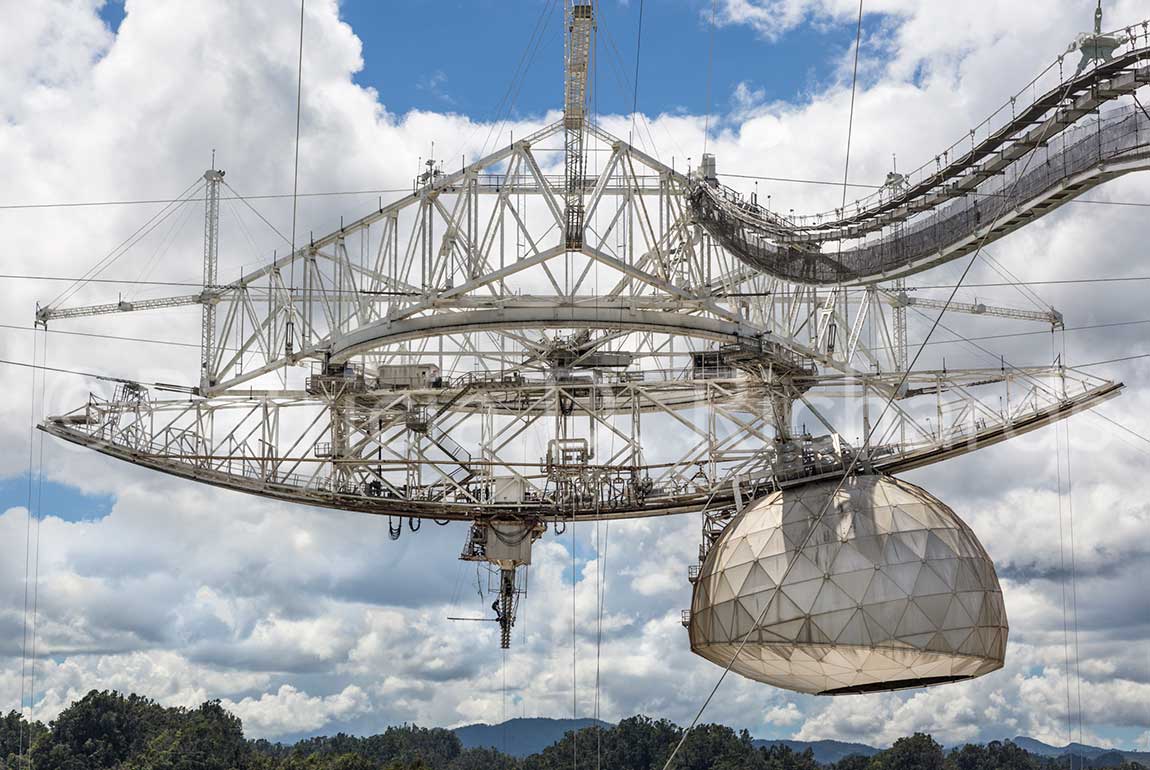
The rectangular blocklike structure above the left side of the ring in this image is a roughly 8 ft x 8 ft x 20 ft (2.5m x 2.5m x 7m) shack. There might be a few humans in the frame though they're difficult to distinguish from equipment. The long structure descending off to the right is a gantry / catwalk.
This came up in a recent thread on this topic. I was surprised to learn that NSF funding has actually increased basically continuously since 1951. 2020 is the second highest funding level ever.
The loss of Arecibo is painful and we have certainly lost capability but it isn't as bad as it looks.
We've fallen from the era where we sent echoes to our neighbours and the stars. When we found clearings in jungles and turned them into monuments to humanity. The time when we put our best foot forward and reached ahead, into the future, racing towards a brighter tomorrow for humanity.
I mourn for what has been lost.
The American century wasn't punctuated by a war, but by callous neo-mercantilism and disregard. The fall of America's aspirations from the heavens to the bottom of a sinkhole.
This is your take on the day before SpaceX attempts to fly the worlds first fully reusable spacecraft to 15 km and land it? That if successful will put larger payloads into space at less than one hundredth the cost of the Space Shuttle, and enable manned deep space missions to Mars and beyond?
Just weeks after Apple unveiled the worlds fastest CPU core running on only 15 watts (with credit to a Brit architecture)?
If you look at the world through a filtered lens, of course you only see what you want to see.
My take on it is that many of the fundamental advancements in the last couple of decades are increasingly shifting from the public sector into the private sector.
SpaceX benefits NASA, but it is beholden to itself and it's shareholders, not the public (this being said as a massive SpaceX fanboy). Same with Apple. These companies exist to benefit themselves first, civilization second.
Conversely, if the development of the fastest CPU was funded by direct government funding it would be available as a foundation for future use by all, instead of other manufacturers needing to (re)discover the techniques themselves.
Maybe his take is after the USA didn't manage to contain an epidemic, used its power to steal medical equipment from other countries, developed a marvelous vaccine that will sell at a high price for other countries after vaccinating itself.
>Maybe his take is after the USA didn't manage to contain an epidemic
Combined with the crucial failure of China that kept it under lid for too long, and followed by most of the rest of the world who also failed to contain it.
> used its power to steal medical equipment from other countries,
What are you talking about?
> developed a marvelous vaccine that will sell at a high price for other countries after vaccinating itself.
Good thing the world is capitalist by nature and we have two more (cheaper) vaccines ready to go, and Moderna will have to lower its price or sell it to those who are willing to pay them a premium for whatever reason. Right?
And I'm not sure if this is even a thing, but even if it is, what is your problem with each country requesting their labs to provide for their host nation's citizens first, specially in a case where all labs AFAIK received funding in some form by taxpayers?
If it was deprioritized, which it seems it was, it was still done in a disappointing and rather eye-opening manner. Just letting an expensive and important scientific instrument deteriorate and just collapse is not the same as properly deprioritizing and decommissioning it.
No doubt. But how many scientific tools also become cultural icons? in an era where we need more young people becoming passionate about science and space, the loss of Arecibo feels like the loss of the Challenger to many.
Should we really be allowing James Bond movies to choose where we spend our scientific resources? Just in the telescope domain the James Webb Space Telescope should finally launch next year and if it works will be an enormous step forwards.
So many people commenting about Spacex and such but I feel they're missing the point. This marks the end of an era where publicly funded science was driving the frontiers of human knowledge faster than ever before.
We went from having never left the ground under power to the moon in 65 years.
65. Years.
And in the subsequent 51?
We've gotten really good at making cheap electronics and our consolation prize is a low cost-to-orbit with no concrete plans to do anything extraordinary with it. Cool.
2020 is a year where SpaceX flew humans to space for the first time ever on a commercial vehicle, we created and started to distribute a vaccine for a never-before-seen virus in under a year, and we began to hook rural people who've never had access to high-quality internet up via a constellation of thousands of micro-satellites in LEO.
Sure, not everything is rosy, but we're still capable of some impressive feats of engineering.
Oh, and AlphaFold made an incredible leap in protein folding prediction. Like, a true "paradigm shift" in one of the most historically intractable problems in biology.
Technology-wise, the vaccine you mean was developed in Germany by a German company. Pfizer is the manufacturing partner and did logistics for clinical trials (except in China, where Fosun licensed it).
$445 million in funding came as a grant from the German government, the rest from licensors. The German government has split another ~300 million or so on two other companies also working on vaccines. The US government did not contribute any funding to Pfizer's license.
I'd rather say it's a cool example of international collab and winning together than an American exceptionalism narrative ...
So now, humans are going to be the intergalactic assholes of the universe who go and change their phone number without leaving a forwarding number. When our message sent from Arecibo is finally received, their response will go to a disconnected number.
https://www.youtube.com/watch?v=2BVbyCZXc5s
The Arecibo message was sent out 46 years ago, in 1974 [1]. We'd only miss responses from potential respondents who are between 23 and (23 + (time to build replacement / 2)) light-years away.
Fortunately, the message was sent to globular cluster M13, which is 22,000 light years away. As long as we get it done by the 47th millenium AD we should be fine.
Unfortunately, applying Parkinson's law to that task means we've got a lot of work to do!
[1] Side note: It somehow never ceases to amaze me how very year, my mental shortcut for approximating the number of years since a given date by subtracting it from 2000 gets less and less accurate.
>[1] Side note: It somehow never ceases to amaze me how very year, my mental shortcut for approximating the number of years since a given date by subtracting it from 2000 gets less and less accurate.
Remember when partying like it was 1999 was something to achieve? The one that gets me every year is my graduation date from high school gets further away. It is now more easily measured in decades.
>> Fortunately, the message was sent to globular cluster M13, which is 22,000 light years away.
Unfortunately, the message was aimed at where M13 appears to us today. By the time the message gets there it will have moved. The message was, is, doomed to miss.
Overall it's quite a bright time for (radio) astronomy. The number of telescopes and sensing ability only increases with time. Just this year alone, a large clone of Arecibo, FAST, just became fully operational. Other telescopes like the SKA are still in construction. In the future decades, we'll likely build even more and even larger telescopes.
FAST is not a clone. It is a very big and powerful dish, but Arecibo could do things that FAST cannot (radar astronomy). Just like particle accelerators, no two telescopes are ever identical in capabilities/missions.
FASTs other difference is location: China. The community of people who would work at Arecibo is probably very different than the community that will work at FAST.
the lack of interest in funding Arecibo at a level to even do maintenance to prevent this from happening suggests we won't bother within that millennium you are allowing.
Would normal maintenance have prevented this? My understanding from the initial reports is that they were unable to identify any flaw or anomaly in the steel cable that snapped that would have indicated the problem ahead of time, and that it simply wasn't designed to tolerate a failure of that nature. Sounds like a freak accident to me.
That's an evocative way of writing, but I'm sure you know that Arecibo doesn't usually spend much time pointed in that direction, so there's no actual practical difference.
Humans have an incredible way of elevating their universal importance to hold the conviction that an alien species capable of receiving such a message and actionably responding would have any desire to do so, let alone that the loss of one observatory would leave the species thinking that they were being ghosted and that humans are assholes. We're really nothing more than flatlanders at this point and we need to work on our humility toward the situation.
Another comment above says the NSF is contracted to return the site to its natural state and that since the collapse it is safer to enter the structure and begin removal.
Hopefully they follow through. Sometimes people find sneaky ways to get out of their contractual obligations. Especially in cleanup jobs such as this where the primary damage is to the land. It can be difficult to find someone with both the power and interest to enforce such contracts.
Well it is operated by the National Science Foundation. So we can hope that they have an interest in preserving the forest floor below.
But then again, with budget cuts and the decreasing budgets that science and climate organizations have been getting from the government lately, this is entirely possible.