Funny, about 90% of those in poverty where in China. So basically globalisation allowed the world to outsource their labor to Chinese slave labor and raise them out of poverty to the biggest economy in the world in the space of a few decades. And now we’re all going to take a back seat to a hyper-ambitious, psychotic, totalitarian regime with a hard-on for world domination. Not exactly inspiring.
looking at number of chinese military bases outside of China, or number of actual wars China participated in last 20 years, you can probably say that China's hard-on for world domination is pretty modest, as compared to... other countries with such hard-on.
Before they where slaving in rice fields and starving. Factory labor actually gave them a lot of freedom and self determination - even with all that suicide going on, but the point is that its far more nuanced then you make it out to be.
Edit: this article gives a fairly nuanced perspective on this topic, and its even more against my comment and for your comment.
But what share of the aggregate benefit? How is the growing gap between productivity and wages explained? It's still a race to the bottom, it's just that the bottom has risen a bit.
To me it matters very little if that same industrialisation and growth in consumption dooms us to a future of dying biospheres and growing atarvation, conflict, displacement, etc.
https://www.politifact.com/global-news/statements/2016/mar/2... . You can debate how to define "poverty", and I'd certainly agree that somebody making $1.91/day isn't terribly well off, but real income has been consistently rising especially in the last 30 years.
Except a number of researchers and academics dispute that fact. Many say that it's a PR campaign for the World Bank and that it doesn't tell the whole story. If you raise the poverty line just a little higher to $5 then abject poverty has been increasing.
True. I'm very anti-capitalist but no modern anti-capitalist disagrees that capitalism has (and must, to work) given people what Marx called double freedom.
Because I view capitalism (or, strictly speaking, capital) as authoritarian (mandating human energy be expended to its ends, working in tandem with welfare states towards administered living), exploitative (the labour produced by wage labourers in aggregate is less than the aggregate profit created due to their labour) and allowing only an ever-shrinking space for genuine human expression (it degrades art by forcing it to be marketable and commodified).
I'm not alone in this; even pro-capitalists agree that a relationship can be exploitative even if both parties benefit in some way - they just disagree that capitalism is the cause of such a relationship which we can see the world over.
I think the argument for capitalism improving peoples' lives by measurable degree is a valid one, but it is only as valid as the argument that feudalism (for instance) improved the lives of those without any sustenance or access to land at all. I think we have the capability to do better than pursuit of profit.
But how specifically do you think we can do better? Can it be done without a different kind of human being that does not pursuit his own self-interest?


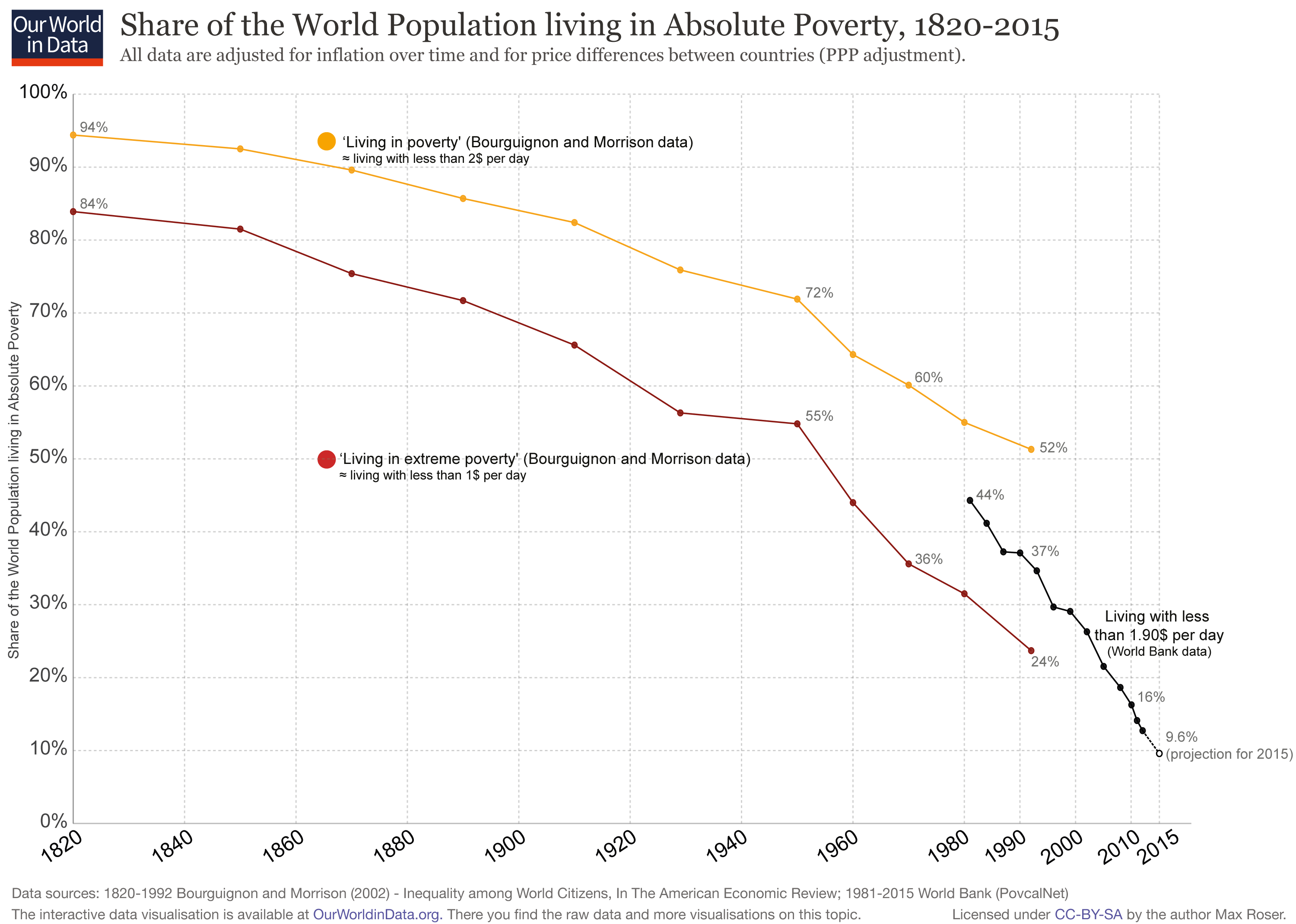

During globalization we've had the fastest and greatest reduction of poverty on earth. Seems like a benefit to the poorest to me.