I'm in Egypt at the moment. We're in Dahab, on the Sinai peninsular - but we spent several weeks travelling on the Nile from Cairo to Aswan and Luxor before we got here.
The experience that really brought home the importance of the Nile was taking the overnight train from Cairo to Aswan. You wake up in the morning to sunrise over the Nile. If you look out of the left hand window of the train, you see desert - nothing but sand and rocks. If you look out of the right hand window, you see literally just a few hundred metres of lush green farmland followed by the expanse of the river. It makes you realise that a large chunk of Egypt's usable land is hundreds of miles long but less than half a mile wide.
Great video. I find it depressing that they couldn't think of anything better to do with that fertile land than to put a highway along the middle of it.
From Luxor onwards the fertile band is substantially wider, more like 20km, as can be seen on Google Maps.
Does anyone know why the desert of North Africa is so... desert? - In Australia, even the deserts, which are supposed to be some of the driest in the world, in terms of rainfall, have far more vegetation. See here for an example:
I just returned from a very similar tour (Cairo to Aswan to Luxor, skipped Dahab), probably one week before you. The tour was in Dahab last week. Maybe we crossed paths as our group was leaving and your group was coming.
I took the hot air ballon option in the Valley of the Kings, and from the basket you could see the Nile. Turn a little bit, and you see the farmlands, and turn some more you would see the desert.
At a wide angle, I was able to take a picture of all three in one shot. The Nile is truly the lifeblood of the region.
I was in Kenya a couple of weeks ago and the flight we took flew south from Luxor in Egypt - what stunned me is how empty that region is - literally nothing but sand and rock for hour upon hour with the thin sliver of the Nile running through it.
Nothing drives home the beauty, the fragility, and somehow the hospitality of the country like this image.
I didn't get to see Luxor or Aswan (it was out of season), and I missed Alex because I ran out of money. The time I spent in Cairo, Sharm, Giza, Ainh-Soknah, and 6th of October City changed my life.
To anyone considering it: if you have the chance to travel, do it. Nothing makes the world seem smaller and the people seem closer.
Pretty amazing. On the books, Cairo has 11 million people. Most people think its closer to 20, and that, day to day, another 20 or so come in from outside for work. I lived there on and off for a few years, and it's truly one of the most remarkable places in the world.
Day to day only 20 people on average and net come to Cairo? That would be just 7300 a year and nothing to write home about. (I guess it's more than that. By comparison, Istanbul grew by around a million people a year for a very short time in the 90s.)
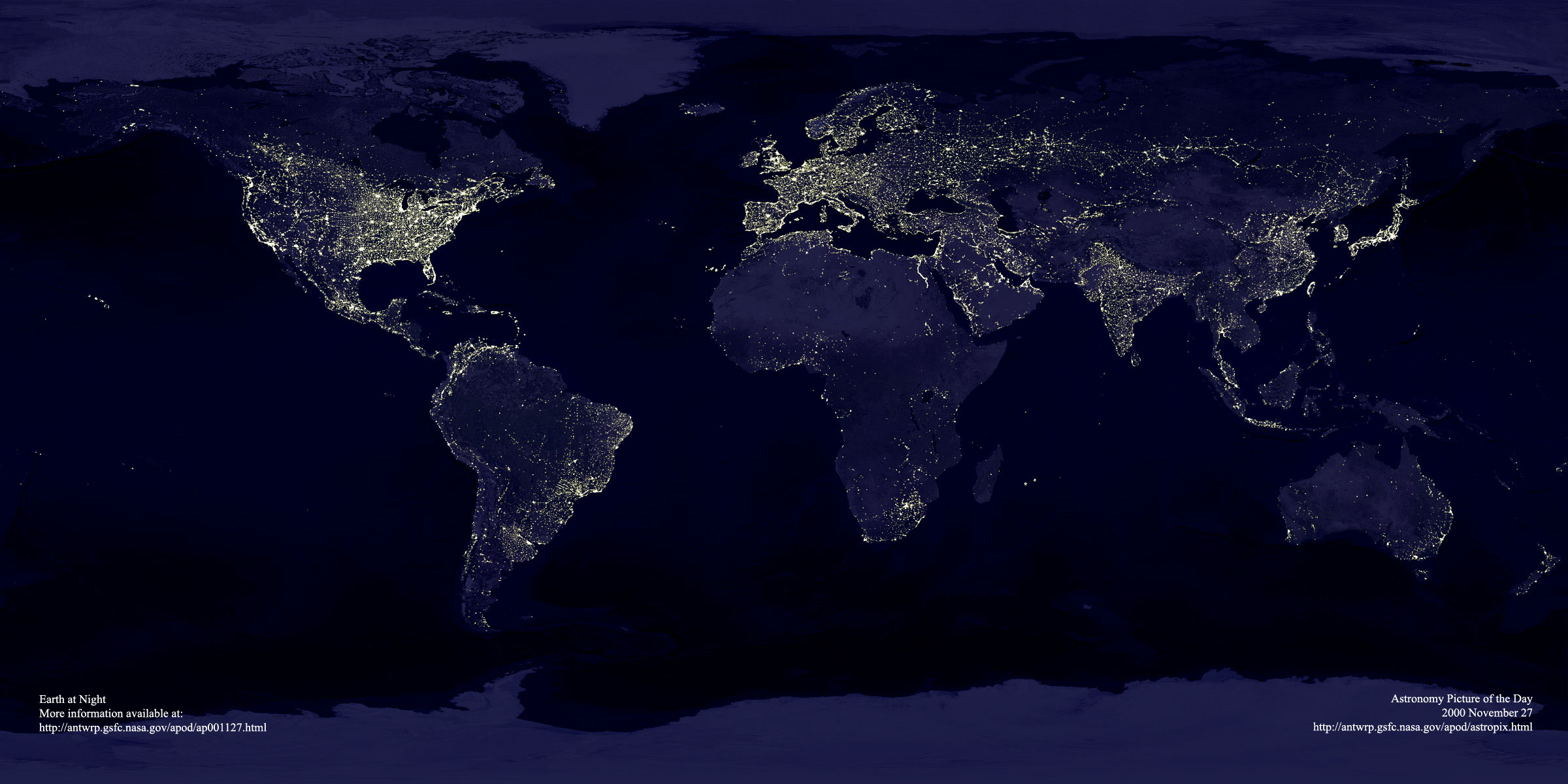
> Of course, pictures like this are more profound for what you don’t see: country borders.
Except, some country borders are phenomenally obvious from space - those that separate totalitarian / communist countries from free market / democratic countries.
Look at the border between Israel and Syria.
Look at the border between North Korea and South Korea.
Look at older pictures of the border between East Germany and West Germany.
Capitalism lets people grow, innovate, and develop. Authoritarian governments stifle that.
Thus, in pictures from space, capitalist countries are well lit (if at night), or covered in crops (during the day), and countries with large governments are dark (at night) and barren (during the day).
I'm Egyptian. One of my absolutely favorite parts of Egypt is Nuweba (North of Dahab, South of Taba) in the Sinai.
You stand in the Gulf of Aqaba and just a few hundred meters in front of you is the coast of Saudi Arabia. To the Northeast, you can have a glimpse at the port cities of Eilat in Israel and Aqaba in Jordan.
I've never been in a place with so many countries right next to each other. The profound thing, like the author mentions, is that there's absolutely nothing in that nature dictating or talking about any borders.
From that perspective, all those lands look pretty much the same: gorgeous.
One of the great ones is looking at the Trans-Siberian Railroad. It's like the man-made version of a river (that's not a canal). It's just this string of humanity reaching across Asian.
As for the sister comment, I believe China would be twice of bright, and the lights likely extending all the way to the edge of the deserts/mountains.
I think this paragraph should shed a bit more light on what the author meant:
But if enough people can get to space, they’ll see the planet for what it is: a fragile, magnificent ball with a thin shell of atmosphere protecting it from the entire Universe… and no artificial boundary lines to be seen. We made those ourselves, and we put an awful lot of stock in them. Remembering that fact might also be an important way to make sure our species endures.
I have no problem getting rid of international borders. Just install a global government of my choosing to control everything. No one else will have a problem with my choice, right?
Interesting that this was downvoted - probably because someone was impressed by the importance of remembering that we all need to unite to solve problems. I was trying point out how many problems are solved because we have international borders. Absolute power corrupts absolutely? We at least can limit power at borders. Seeking asylum? Sure is great that there's more than one country. Your government taken over by Communists? At least there are other countries reminding your fellow citizens that Communism isn't the best idea. It's not like you actually need borders to create wars.
Jared Diamond in Guns, Germs, and Steel argues that Western Europe became more advanced than China despite a head start in China because there were so many countries, so one country's government couldn't ruin things.
This idea of "containment" may have worked well in the past, but is not as practical anymore. The world is so deeply connected, and technology so advanced, that international cooperation is far more essential.
Nuclear weaponry is but one of a number of salient examples. Even such staunch realists as Kissinger have come to recognize that they must be eliminated, and that intense international cooperation will be necessary to do so:
I agree with that. (Well, except for the idea that it's practical to get rid of every last nuke.) We need to work together AND we benefit from having separate countries and borders.
That "fragile" ball and "thin" atmosphere have been going strong for millions and millions of years. What the heck does he consider "enduring"? Fashionable politics really clouds the brain.
Our pretty fragile species. As a ball of rock going through the solar system, the earth itself will keep going until the sun blows up, and so will life itself more than likely. But we don't live in the whole planet, the biosphere (and even more so the section of it we can in) is a fragile shell and its destruction will translate in ours.
The author looked at a night photo of one part of the world and made a wispy proclamation on par with a John Lennon song. Nice idea when you're stoned, but he doesn't really expound on the thought to any depth. It's not profound.
One of my favorite shows is The Sons of Anarchy, a modern day take on Hamlet with a motorcycle club as the back drop. The club was established on the principles of anarchist writer Emma Goldman, and it's interesting how they portray the world of anarchy. As a biker gang, they reject the laws of the world at large, but they seek order at a tribal level, with a president and VP of the club. They want to maintain peace in their hometown, but their quests are geared toward survival and prosperity. It's just a TV show, though. It's not profound. But as a microscopic view of what a borderless world might look like, it's a better starting point that a night photo of the Nile.
There is a whole-earth poster like this and some borders are very obvious.
Rich countries have street lighting, poor countries didn't - even the west-east German border used to be very obvious.
20 years later cheap fluorescent tubes are everywhere which has blurred this a little
"Many astronauts come back from long-durations stays on the ISS with a deep new sense of citizenship not of just their country, but of their planet."
watched "Independence Day" yesterday again. I don't think there is another way short of that to make majority of human species on Earth to feel as "citizens of planet". Things like ecology/green movement doesn't seem to be a way to do it as it is subject to tragedy of commons... at least until it will be out weighted by an order of magnitude bigger tragedy
When linking pictures, Phil Plait always adds a line that basically means "Click to enlarge". He started using the Simpsons phrase embiggen at some point, and a while after that he started making up words vaguely related to the context.
Pharaos are big in a metaphorical sense. Enpharaoronate means embiggen.
Incidentally, I've heard that 'Pharaoh' comes from an ancient Egyptian word meaning 'big house' or 'big palace'.
Another speculation is that it's related to the Arabic word فارع, meaning 'very tall'. So it's might be nearer than expected to the intended meaning :)
If 'Enpharaoronate' were a real word it would fit very well in translating a famous Egyptian proverb from Arabic: "Said to the Pharaoh: what Enpharaoronated you? He said: I didn't find anyone to stop me."
Pretty sure it's just a goof trying to make a word that sounds like it means 'enlarge' with 'pharoah' in it. The tone of the article sounds like the author may have been a little loopy on some 'medicine' when writing.
Sure, space travel will pay for itself by engendering international love. Um, ok.


The experience that really brought home the importance of the Nile was taking the overnight train from Cairo to Aswan. You wake up in the morning to sunrise over the Nile. If you look out of the left hand window of the train, you see desert - nothing but sand and rocks. If you look out of the right hand window, you see literally just a few hundred metres of lush green farmland followed by the expanse of the river. It makes you realise that a large chunk of Egypt's usable land is hundreds of miles long but less than half a mile wide.