Also interesting fact: Roughly another third of cars sold in Norway in 2018 were hybrid, taking hybrid+electric to a combined two-thirds of all cars sold.
Only one third were pure fossil fuel. That is quite remarkable.
Not really, if you tax cars at ~100% on registration (eg: $50k car has $50k of tax on it for a total price of $100k), like Norway does, then it is pretty easy to get adoption when you zero rate or reduce that tax for (PH)EVs.
It's effectively an enormous tax credit for EVs. I'm sure of the US govt increased the federal tax credit for EVs from $7.5k to $40-60k, you'd see similar adoption in the US too.
Fossil fuel cars get a huge discount for causing pollution and health problems. If other countries subsidized the damage that fossil fuel cars do as much as the USA then I'm sure there would be similar adoption as in the USA too.
A brand new Ford Raptor will clean the air in most cities. You'd have to drive that 465HP fuel guzzling toy over 3,887 miles to equal the particulate output of 30 minutes of yard work with a 2 stroke engine.
So not as much of a discount as you might have thought.
It is true that many cars will clean the air of particulate matter these days. That is the only kind of pollution that a modern ICE car will remove, but it is not the only kind of pollution worth talking about....
CO2, NOx and others are just-as, if not more important and your air filter won't do jack diddly for those.
NOx exhaust aftertreatment systems are standard, so a compliant vehicle today will have considerably less NOx in exhaust as well. As for CO2, well, it's not a small chunk, but cars and light trucks account for less than half of transportation sector CO2 emissions; and the transport sector accounts for about 28% of overall CO2 emissions. It's not silly to reduce CO2 emissions in light trucks and cars, but at most reducing those sources would only cut about 15% of U.S. CO2.
Keep in mind, this is in a country where light trucks and SUVs account for a huge proportion of personal vehicles, and where the average age of a car on the road is about twelve years. As the window of vehicle years shifts further, you can expect that proportion to shrink.
Not CO2, but particulate matter [1]: basically tiny solid particles caused by exhaust, tires etc that stay suspended in the air. They are linked to a range of health issues in the concentrations found in many urban cities. When you hear about cities banning diesel cars or ICE cars or old cars, that's a measure to reduce suspended particulate matter, not CO2. But luckily unlike CO2, particulate matter can be caught by a HEPA air filter.
> Calling that a "discount for causing pollution" when their cost is increased by a need to reduce pollution is absurd.
What if the added costs to ICE vehicles are less than the environmental costs they incur?
I'm not saying that's definitely the case or not, but just because ICEs spend money on mitigation doesn't mean they are not still getting a subsidy. You are acting like it is obviously wrong because ICEs do some things to mitigate pollution, which is clearly not obvious.
+1. So many people confuse CO2 with pollution. CO2 emission is not a pollution and causes near zero negative effects to human directly in the current concentration or in the most pessimistic prediction for future.
Air pollution, of which transportation is a huge contributor, kills tens of thousands per years in the US. There are many other effects like asthma which afflict millions.
Transportation is certainly a lot cleaner than it was but there's still a lot of improvement that can be done. Below is a link to a basic overview, it can give you hints on where to dig if you are interested in specific studies.
I just looked up the brake pad emissions. Pretty scary stuff but it seems like it would be trivially solved by some form of containment around the brake and the disc that captures all of the dust. Probably needs laws to enforce it before car makers would add such a thing.
Edit: from an old reddit post, it seems like there's a VAT, weight, engine, CO2, N0x tax. In theory, in an 'even playing field', I'm guessing EVs should be paying VAT, weight, and engine taxes. Not completely sure which of these they pay (or if the list is even correct).
I'm sure of the US govt increased the federal tax credit for EVs from $7.5k to $40-60k, you'd see similar adoption in the US too.
I get your point, but to be fair, the numbers in your comparison are a bit off, since a $40-60k tax credit would make many electric cars effectively free. That would be a much bigger incentive than what Norway has.
EV's are enormously subsidized in oil rich Norway, as they are in China. It is encouraging that such a cold country can run EV's though, it seems they generally perform much better in warmer climates
As an interesting side note to this, while we might (temporarily) lose some range on cold winter days, our car batteries have remarkable little degradation compared to EVs from warmer climates. Used EVs imported from i.e. southern France to Norway usually have significantly lower remaining battery capacity than a car that has spent it's entire life in Norway.
Better performance from batteries in hot climates but faster degradation due to heat soak. I believe this is also a significant issue with battery fire risk- the hotter the battery the more of an issue it is extinguishing compromised battery cells that are still powerful stores of energy after an accident. The recombustion issues after fires have been put out are more serious in hotter climates
I don't have any actual numbers, sorry. I just remember being warned to be careful about cars from hot climates (like southern europe, and some US locations) a few years ago when I was looking for a used Leaf. Demands for EVs were very high in Norway, and resellers had to import (and still do) used EVs from other countries.
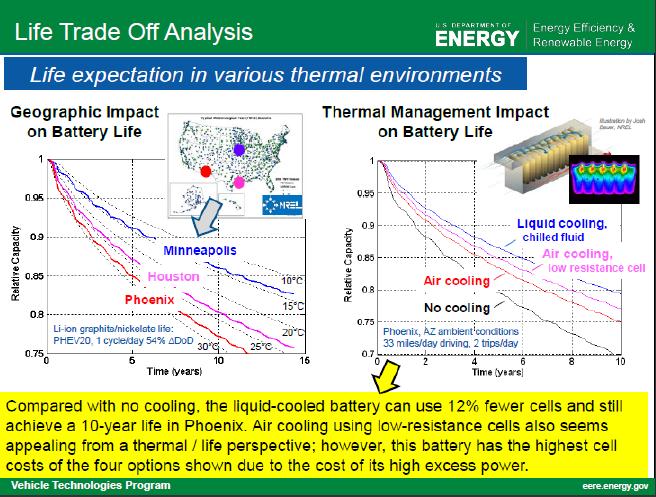
I found a life expectation chart for 3 US cities at [0].
It's well know that high temperatures (while in use and while in storage) degrade li-ion batteries[1]. However, electric cars have thermal management systems to try to protect the batteries from this effect (extreme heat and cold). Tesla have active water cooling, while Nissan Leaf use a simpler air cooling.
They also use different battery chemistries that handle temperatures differently. If you have a look quick look at this talk[2] you'll hear that Nissan is using a chemistry that experience higher degradation under high temperatures than for example Tesla's choice.
> a few years ago when I was looking for a used Leaf
The Leaf was notorious for not actually cooling the battery so I can see how they would do better in Norway. Maybe the newest generations have improved on that. I'd be curious if that was the same for Tesla though, which supposedly keeps the battery temperate under much better control.
Some Leaf generations are more sensitive than others (chemistry was slightly different). Sustained heat will still degrade them more quickly than expected though.
Tesla has active temperature management, but also has a different chemistry which should be more sensitive than the one used in the Leaf.
There are cold parts to the country, but a lot of the population lives in the South near the sea where the winter night time temperature doesn’t go much below zero Celsius.
And your vehicle is exposed to more moderated temperatures if parked indoors (even the pad of an unheated garage retains heat).
Plenty of parts of the US and Canada deal with much colder temperatures for months at a time.
Pretty much no vehicles currently do #3, despite many being capable of it with software-only changes.
I believe this is because most vehicles do a fixed amount of regen(which goes into the battery) when the foot is off the accelerator, but no additional electric braking when the brake pedal is used. I think that's because current regulations have pretty much stopped modifications to the braking system in cars, and prevent tweaking it to do electric braking when available to do cabin heating, and mechanical braking otherwise.
With a seat heater. They were popular in the old times, when engines were not digitally controlled and took a long time to heat up enough to provide any warming effect inside the car.
Every car I've been in in Norway has had heaters in at least the front seats. The Tesla S has rear seat heaters as a configuration option when you buy the car as well as an option for a heated steering wheel. Quite a lot of the cars I rented in the US had heated seats, even in North Carolina.
Heat pumps can be used to heat the cabin with far less energy than resistive heaters. It's tricky to design them to be cheap, light, and work all the way down to -30C and up to 60C that cars are expected to be able to work in.
A modern heat pump with a variable speed compressor can be more efficient than resistive heat down to about -25 degrees Celsius (-13F). See Mitsubishi's Mr. Slim series.
And if you use a ground source heat pump (that has to be interred) it would be even more efficient.
So? I don’t think that you can put either of them in a car...
The offerings from Mitsubishi and similar ones from other Asian manufacturers like LG and Fujitsu are air source heat pumps. I see no reason why the tech can't be scaled down to fit a car. It's certainly a reasonable goal for auto parts suppliers to aim at.
Their efficiency goes way down the colder it gets. They’ll work well at 5-10C, but frost up and require electrically-expensive defrost cycles when it’s colder than -2 or -3 C.
this works at 3-4C, falling down the efficiency drops off rapidly.
House geothermic heating is very similar, except the collector is buried under the ground where the temperature doesn't really go negative C (until -30C and depends on the soil, etc). Overall for EV cars in cold winters producing heat is a non-trivial task.
IC engines drive all associated 'accessories' via belts where EV has to have dedicated battery draining motors for everything from windscreen wipers to hvac
That's not completely true. For fuel efficiency, most modern ICE cars drive all the accessories with electric motors, with only the AC and brake booster being powered by the ICE in some cases.
Even if it's just "legislative decisions", it's fucking incredible that a country did what it did to get there. Do you really think the US is 2 inches away from shutting out it's internal big-oil?
Even if tech isn't the solution, and it's just decisions, it can still be remarkable.
Demand is high for both new and used EVs in Norway.
EVs are free (or significantly cheaper) on most toll roads, parking, and pay at most 50% of regular fees for ferries.
Owning an old short range EV as a second car can easily save you 1800€ a year[1] in toll fees alone. Even an old electric wreck is easily worth 10000€ just in reduced toll fees if it's able to do 5 more years of just rolling past that toll station barrier. Even banged up and with a 50% degraded battery the car is still valuable, as long as it can get you to work and back home again.
There was a time some years ago when you could essentially cover the down payments for a Tesla Model S from saved ferry fees if your daily commute crossed Trondheimsfjorden (cost like 30 USD per way, this "bug" has since been fixed, you now have to pay 50% of the ticket).
There is certainly a strong market for secondhand electric cars - I own one and it's the best car I've ever purchased. In terms of the "starting as low as 2000€", though, no. The battery alone in any usable electric car is likely worth more than that.
About the battery... Does that mean electric cars should have much better short/medium term depreciation and probably worse long term (as the batteries become too degraded for reuse)?
Electric car subsidies are generally regressive [0] and Norway is no exception.
Even worse, Norway subsidizes electric cars, in part, by defunding public transit. This seems silly from an environmental perspective, but it's nice if you're a wealthy Norwegian and want to avoid paying tolls while owning a luxury car.
"[The environmental spokesman for the Labor party] estimates that Oslo loses about [$30mm USD equivalent] a year from electric cars avoiding toll payments. At the same time, about [$80mm USD equivalent] from toll booths goes towards paying for public transport each year."[1]
There are much more effective ways to decarbonize transportation than subsidizing cars, electric or otherwise. The most compelling policy tool we have is a Carbon Tax. There is near universal consensus among economists on this fact. [2]
(Edit: pondering the down-vote. Is it because you don't like what I am saying, or that it's factually not true?)
The problem with the Carbon Tax is that right wing parties across the world (well at least in the Anglo-zone that I know about) have demonized it - even when they supposedly believe in market-based solutions.
So a regressive measure is unfortunately the only (well...) politically viable solution.
Tolls and other car taxes can be reintroduced slowly after the transition is complete.
Yes this is "stupid", but unless you can change the psychology of the populous, then that's about it.
Reframe "Carbon Taxes" as a "Carbon Dividends" and you might be able to change the psychology of the populace. The recently failed bi-partisan Carbon Tax bill attempted to do just that by establishing a revenue neutral carbon tax where the proceeds were distributed as "dividends" directly to citizens.
But I agree, getting popular support has been very hard and will continue to be problematic.
Ars Technica writes that although this bill failed, it will help shape the debate to come.
Oh and Exxon Mobile spent $1mm to support the group lobbying for the Carbon Tax.
Carbon taxes have been passed and revoked in Australia, Canada and France. They have been rejected in ballots twice in Washington. It’s not a right wing thing. People just really hate taxes and don’t want to change their behaviour. Talk is cheap.
> Washington State Voters Reject Nation's First Carbon Tax
> The measure was unpopular with social justice groups and divided environmental activists, many arguing it did not go far enough in promoting clean energy.
> Among those who decided not to support the carbon tax were Sierra Club, the Washington Environmental Council, the Union of Concerned Scientists, Climate Solutions, and 350Seattle.org.
The Carbon tax has been rejected by some provinces but the federal government is still moving ahead with it and they have the constitutional right to do.
> Doug Ford, Ontario’s premier, has repeatedly called carbon pricing “the worst tax ever” and at least five provinces have banded together to fight the tax in the courts, a battle legal experts believe they will lose.
> Along with their provincial counterparts, the federal Conservatives have pledged to repeal any carbon taxes, with Scheer dismissing the policy as an “election gimmick”. This fight comes amid reports that Canada is not on pace to meet its 2030 climate goals.
> In the 2008 Canadian federal election, a carbon tax proposed by Liberal Party leader Stéphane Dion, known as the Green Shift, became a central issue in the campaign. It would have been revenue-neutral, with increased taxation on carbon being balanced by tax cuts for individual citizens. However, it proved to be unpopular and contributed to the defeat of Liberal Party with its worst share of the popular vote since Confederation.
... revoked in Australia after the right wing party spent years demonising the "great big new tax." The government had used the income from it to compensate consumers for price increases passed onto them, so the majority of voters arguably had no real reason to hate it, other than partisan politics.
And this is despite all the options of electric cars on the market failing to live up to the average Norwegian's criteria.
Many Norwegians are still waiting for a "real" electric car to become available. Where a real car is defined by:
- Tesla range
- 450 liter+ luggage room
- Roof rack/box
- Tow bar
In particular with Tesla you get EITHER the tow bar (model X) OR the roof box (Model S). So even IF you splurge on a luxury priced car, it feels like compromising vs getting a gasoline car.
(Also Tesla is "very large", it does not fit comfortably in parking spaces; 180 cm wide cars are really a lot more convenient than 200 cm around here).
The moment anyone is ready to just deliver something like an electric Volkswagen Passat station wagon they will sell as many as they want in Norway. But, every single announcement fails to meet these criteria. It is a standard that lots and lots of gasoline cars fullfill, but currently no EVs. (Audi e-Tron is first, but still has a too large footprint, and also too expensive for most).
VW is working hard to deliver mass produced Passat-like EVs in 2020. They will be priced the same as their current fossil cars, which gives the new electric lineup a huge advantage in Norway due to high taxes on fossil cars. More info here: http://www.fullychargedshow.co.uk/electric-cars/2018/12/17/v...
Norway is one of the world's largest per capita producers of greenhouse gases. Norway adds 1.6 million barrels of oil per day to the world's market. Buying EVs might make people feel virtuous, but it makes no real difference compared to the enormous fossil fuel output.
It's not that much different than blaming the sellers of military equipment for the atrocities committed by that military equipment. If County A sells bombs to County B knowing that Country B will use them to commit genocide in Country C, County A can't be entirely off the hook for that genocide. Sure if Country A didn't sell then another country would, and sure no one forced Country B to buy those weapons, but Country A still knew what the outcome was going to be when they made the sale. And Country A decided that the money was worth the ethical consequences.
If you produce and sell oil, even if you don't use the oil yourself, you know full well what that oil will be used for.
I largely agree with you, but you have to consider the flip side: if Norway won't supply oil, countries won't just switch to green alternatives. They will be forced to go elsewhere because there just aren't any viable alternatives at the scale of global transportation. Whether they go to dirtier fuels, go to more dangerous regimes for their oil, or just straight up go to war, it's a big risk for the entire world. We've only recently found out from Kido Koichi's diary that oil was one of the primary reasons Japan began to encroach outward and the oil embargo was the reason Japan attacked Pearl Harbor.
I'll admit that argument doesn't sit right with me on a personal level, but on the scale of geopolitics the stakes are just that high. Hundreds of thousands, if not millions, died last time the US cut off oil supplies to a major country.
Purely regarding the market dynamics: one supplier exiting means immediately higher prices. Even if everyone finds an alternative from a vendor with less scruples, it will be more expensive and therefore incentivise investment in alternatives across the board.
Fair is fair: This argument works better for sane markets than for tortured oligopolies like oil. But, at its core, morally if nothing else, this is the principle. And this is why that “if I don’t do it someone else will” argument never is a strong one.
Norway can’t hide their oily fingerprints in green washed gloves.
But if Country A doesn't supply weapons to Country B, someone else will. Maybe someone who will sell them a nuke. Or chemical weapons. Or maybe Country B goes to their last resort and builds a dirty bomb to fight Country C instead of civilized bombs and tanks.
There's a game theory discussion to be had about negotiating with terrorists, but at the end of the day that oil is still getting burned and the damage is still being done.
Governments don't have an urgent pressing need to purchase the shiniest new weapons though, the comparison isn't valid.
They do urgently need oil to stay in power, plenty have been thrown out over far less.
If hypothetically the world's biggest oil exporters stopped overnight there'd be widespread geopolitical instability/war within a month after reserves are gone.
If one single word from an overly-obvious analogy is your main take-away from what I wrote, I would encourage you to just move on. It's probably not worth your time.
> 180 cm wide cars are really a lot more convenient than 195 cm
I’ll add that I have a Prius Prime that I’m very happy with, and it’s only 175 cm wide. It’s an amazing and extremely nifty car. Compact car fans are sure to love it. Practically everything about it is praiseworthy (except for the Entune software).
There’s a new Prius e-AWD [1] that should be good for driving in snowy conditions.
That being said, I live in New York, and I’ve never had a problem here. The government does a pretty good job of salting the roads, and cleaning up excess snow, so I’ve practically never had to drive on snow, even during snowy times.
On de-icing: you can have clean road if they are heavy used together with a not so cold climate since car's itself contribute a bit on cleanup phase but you practically can't on any less frequented road, especially outside cities.
Salt and gravel help avoiding ice with a "liquid top" that's super slippery but can't really melt snow on snowy days or cold days...
So they are winter tires, only spiked tires works (really) well on ice, unfortunately you can't use them on most country without majority of the roads iced for long periods...
Personally living, and have lived, in snowy area while I prize winter tire on snow I also prize 4WD/AWD, without them in many cases I'll have had to beg for a tow, no matter how good winter tire I can ever mount.
In some condition, like little snow, you only have slippery roads due to the moisture of salt/snow/dirt on the road and 4wheel help reaming on trajectory but you may still drive on 2WD at least if you are a good enough driver, on heavier snow 4wheels means have enough traction to advance and enough grip to still have traction when some wheel slip.
I grew up living on the side of a mountain in Montana. 1000 foot climb from the highway to home. Could not make it home in winter with snow tires and 2WD, period. You'd end up fish tailing and generally turning a snow packed road into a gleaming sheet of ice. Which, makes it worse for those with 4WD as now the snow pack is a polished sheet of ice.
4WD helped, but was also not always sufficient. I've had a 4WD SUV slide directly sideways after coming to a compmete stop on an incline. Some of the grades were up to 14%, not highway quality, but private road.
Only relatively assured way to get home was 4WD, snow tires and chains. And you could skip the snow tires if you had the chains.
I have a Volvo XC70. The transfer case broke and the AWD vehicle became FWD and it went from being pretty good in slippery conditions to awful. I couldn't get up hills on streets etc. same snow tires before and after the tcase broke. Maybe just that vehicle has more weight on the rear tires but the front tires sure couldn't pull that car up the hill to get me home if it was a slippery day.
Nonsense. I have just had my Tesla S 70D serviced, they loaned me a S P85 rear wheel drive. It was horrible. Just manoeuvring in a car park was difficult because the car couldn't grip the ice. Got my 70D back today, what a relief! Sticks to the road like glue unless you push it foolishly hard. Both cars, of course, have winter tyres (stud-less).
As a New England resident with a very old detached garage, I, too, wish my Tesla was not so wide. Every single time I park in my garage (which can only be accomplished in reverse, while turning about 30°) it's mildly terrifying.
Third party roof rack and tow options are totally possible for pretty much most of the mainline EVs. I'm putting a roof rack on my Volt for a ski trip in two weeks. Towing hitch is discouraged by manufacturer, but many many people have done it.
But yes, luggage is a concern. Though my Volt mostly fits my needs given we have a second, ICE, hauling vehicle.
Not many options for Model X racks; kind of unsurprising given the door configuration. Though this nutter has his skis on there with a suction cup rack:
There are aftermarket hidden hitches for the Model S. I routinely pull a trailer with my S, sometimes up to the 2500lb hitch rating. It has served me better than my pickup truck I previously owned, and it only takes a moment to drop the trailer before Supercharging at stations where I can’t pull thru.
I just got a Model S actually, and am considering installing a hitch for carrying bikes. But I would NEVER pull a trailer..
What if I do, and my trailer collides with something/someone, and I become liable for millions in damages, not covered by my insurance...
At least in Norway, how large a trailer you can pull is regulated in the license of the car. For a Model S this number is 0 kg. And insurance covers what the license says.
(IANAL, but Norwegian Tesla forums seem to agree that hitches are for carrying bikes only around here, until Tesla is bothered to officially submit trailer crash tests or similar)
My apologies for Norway’s public policy stance on the situation (I’m in the US). I’m permitted to add a hitch, and my large national insurer has confirmed in writing I’m covered up to my policy limits with the vehicle modification.
That's an impressively terrible rating for something with the curb weight of a 90s 1/2 ton pickup. I suspect the vehicle could comfortably handle far more considering how much better the power and brakes are than a 90s pickup but they don't want to be replacing certain parts under warranty (my guess would be CVs since the S has plenty of torque and traction to hurt them with).
In almost a decade of owning a 1/2 ton pickup, only twice did I pull a load over that rating. No need to optimize for rare workloads. If I need to haul more than 2500 lbs, I’m renting a truck for the job.
The underlying issue is a lot of pickups are road queens and entirely unnecessary for their daily workloads, existing as status symbols first and a mode of transportation second.
Meh. Most people only ever use the front row of seating in their vehicle the overwhelming majority of the time. Pickups are just vehicles where the extra space is optimized for non-human cargo. The richer you are the more likely you are to buy enough vehicle for the most extreme case. If we all bought what we needed for the average case there would be a lot more subcompacts sold.
Right, which is why pickups should be taxed more than cars to internalize their externalities (lower fuel economy, more damage done to other vehicles in accidents). It’s not like it can’t be done (See: this article on Norway).
They are. Any gas tax is a tax on the fuel economy of the vehicle. If pickups get less MPG, they are taxed more on gas tax. Some US states base vehicle registration fees on the weight of the vehicle, which is another tax on heavier vehicles (like pickup trucks). More damage done in accidents is something the insurance companies would have to deal with, and if it's actually a problem you can guarantee those insurance companies have already factored it into the rates.
I regularly nearly exceed the load capacity of a 1/2 pickup. Some of them are road queens but some people actually use a truck for its intended purpose.
There's a lot more to towing than just the curb weight of the vehicle. For example SUVs with CVTs often have lower towing capacity than the same SUV with a normal automatic transmission even though they weigh the same.
There's a lot that goes into making a vehicle good for towing, and a luxury sedan is not normally expected to have a good towing capacity no matter how much it weighs.
Roof rack: Skis. (And the Model X ski box behind car on tow bar solution look unwieldy and ridiculous, but there are still lots of them around here, as the only EV compromise that sort of ticks all the boxes.)
And kayaks too.
Tow bar: Not sure what others do without them. Furniture shops lend out trailers for free so that you can take your new sofa with you back home. I recently transported the materials for building my new front deck on a trailer. I tend to rent a trailer for taking things to the landfill/recycling facilities especially when renovating my home (and Norwegians do a lot of home renovation..). When helping young people move a trailer is all it takes. Etc etc. I used a tow bar at least five times a year for misc errands. (Now I have a Model S and have to leech on neighbors)
I am not sure why this is different and how e.g. US or German or French culture would be digferent.. I guess the alternative is paying others for delivery/disposal, doing less handiwork oneself, and (in the case of US) buying pickup trucks that in no way will fit on Norwegian roads and parking lots.
Trailers are pretty much unheard of in the US. You either have or borrow a pickup truck instead, because everyone has one or knows someone that has one.
As a result, almost no cars in the US has a tow bar. Except pickup trucks. That don't really need them. Because you haul stuff directly in the truck.
The reason most US cars lack hitch receivers is liability. In most of Europe, it is expected you drive slower when towing a trailer. Not so in the US. Even the same models have different tow ratings (usually zero in the US) - see VW Sportwagon for example (rated to 3500lbs in most of EU, and not rated at all in US, despite being the exact same car).
You either have or borrow a pickup truck instead, because everyone has one or knows someone that has one.
In the OP's scenario, furniture, there are very few furniture stores in the United States that don't deliver. And if you happen to shop at one of those few, there are a number of ways to rent a truck for a day or by the hour: Home Depot, ZipCar, Enterprise, U-Haul, etc...
Unheard of ... unless you live in the midwest. Here in Minnesota, a ton of cars have them because a ton of people own boats and/or rv's and/or snow machines. The same reason a lot own all-wheel drive vehicles.
Is the range still a big deal? Norway is not as big as the USA, and you can nearly get from Oslo to Bergen in a Chevy Bolt. (Stockholm, I'll admit, is too far for one charge)
Electrical (battery based) car's are more a marketing thing that a real tech change. They simply can't for now substitute fossil-fuel car's.
Battery life is still a problem, most of the people have yet do discover due to the young age of ALL electric car's in actual market, inability to offer enough electricity to recharge them at scale is another problem most people still have to discover simply because we actually have very small percentage of EV around. And that's only to cite most important problems.
Of course I expect may downvote, without comment so I expect this comment fade quickly but since today's prize of EVs people that can actually buy them is supposed to been able to compute enough to choose and REAL EV sell confirm that. Despite all the marketing.
You’ll be downvoted because you are wrong. Because battery life isn’t an issue with thermally managed batteries, Teslas are doing well over 100,000 miles and on average retaining 80%-90% of battery life. And because electric cars will provide a massive pool for demand shifting, barring four hours of peak, electric cars can be charged at any time of day, that means with price structures you can create almost any demand curve you want.
I bet you do not know anyone with a moderately used EV with more than five years. If I'm right wait a bit before try so sure conclusion.
I know few people with few not-so-new EVs (Renault ZE series most of them) and hear their practical experience outside marketing. No one of them is willing to buy an EV again.
> I bet you do not know anyone with a moderately used EV with more than five years.
I have a Chevy Volt from 2013. Bought it used. It's now six years old and has nearly 60k miles on it -- 75% of those on EV-only miles. I have almost no decrease in range or capacity. (It was EPA rated to 35 miles range off the lot. I got a real world 30 miles range yesterday, in below-freezing weather with aggressive snow tires on it, in a Michigan winter. When the weather warms up, it will go right back to 35 miles, just like it did last summer).
I'm never buying a gasoline car ever again. I'll buy Volts until they can't be found, and then I'll probably switch to a Bolt or equivalent.
The trick is to buy a well-designed, thermally managed battery. If you are lazy about thermals, the battery will kill itself. (See the original Nissan Leafs, anything from Ford, etc). But that has nothing to do with EV battery tech viability, and everything to do with car companies being lazy or cheap.
A properly designed EV battery will easily last over 10 years and over 100,000 miles. We have lots of examples of this (from Tesla, Chevy, and others) to prove it.
> A properly designed EV battery will easily last over 10 years and over 100,000 miles
The probem for me is, that's on the young end of the sort of cars I'm interested in buying. The newest car I own is a 13 years old Honda that has 190,000 miles.
Well... If for you 30-35 miles are an acceptable range ok, for me it's far, far less then my need. And I talk about daily life, not counting holidays...
I have a Ford Fusion Energi plug-in. Force air cooled using the computer's choice of cabin air or outside air (no dedicated AC evaporator). Battery is at 72% capacity (5.5 total kwh of 7.6 when new) after 40k and 3.3 years. Usable capacity is at 65% (~3.7-3.9 kwh down from 5.7-5.9 new). I would never buy another plug-in or electric vehicle that doesn't have some form of active cooling powered by the air conditioning sytem. Liquid cooling without a chiller powered from the AC system is insufficient. At minimum, chilled air routed from a dedicated evaporator through the battery (older Escape hybrid, Outlander PHEV), and ideally, a liquid system with a heat exchanger to the AC system (Tesla, Volt, Bolt, Pacifica hybrid, maybe others?)
Anyway, with Michigan's $0.15/kwh electricity and a climate that's either way too hot or way too cold, the break-even point for electric vs. gas is about $1.90 a gallon ... so at least for now (with gas below the break-even point), it doesn't hurt so bad that the battery capacity is so low.
Wait: that's NOT an EV. That's an hybrid car that can run on electricity only for a very limited distance and limited speed. You basically do not use your battery, only move it around.
21 miles and up to 85mph when the battery is new (although at 85mph the range would be considerably less). Electric heat and a.c., electric transmission lubrication. Mechanically, its as much an ev as the volt, with about half the battery. Were it not for the cooling problem, it would be a fantastic car. So much bigger and more usable for a family than the volt (it has a real back seat, unlike the volt, and can be loaded up with lux stuff in the platinum trim, unlike the volt).
More importantly, phevs with an ev mode that are intended to be driven as an ev for a significant portion of their miles are devalued by battery degradation in a similar way to pure evs (because of you pay all the cash for the expensive phev systems,you don't plan to be forced to use it as a plain hybrid).
Hum, actually any car can be "exclusively powered by electricity", see start&stop systems or a mere 1st speed/reverse + starter motor...
IMO an electric vehicle is a vehicle capable of run with electrical motor's in any condition. So a modern hybrid-series ship is actually electrical because it's propulsion is electric only, parallel-hybrid vehicle are not electrical since they can't really work only on electrical motors except for limited usage.
And the fusion energi can go 85mph in ev mode, so the speed is not limited in a meaningful way. You can also lock out the gas engine to keep from accidentally starting it with a heavy foot...
Battery degradation is less a function of age and more of thermal management, depth of discharge, and number of cycles. Along with more durable battery design, these variables can be managed through better thermal management and more conservative battery use. Durability of EV batteries has improved in leaps and bounds in recent years.
Maybe it is a problem with Renault then. Go hang out in Leaf forums instead (and the Nissan Leaf doesn't even have a thermally managed battery).
I have one. I haven't lost a SINGLE capacity bar after 3 years (first year saw really heavy usage with multiple quick charges a week). Unless it decides to self-destruct after 5 years, I would expect it to last a while.
Yes, they lose maximum capacity over time. Very slowly. They still work. This is not a phone or laptop.
No, thanks, I do not ask on some vendor's forum. I prefer ask people I can trust as sources, not eventually disguised marketing guys or bot.
As I write before I say most of them are on Renault, But one is on a Tesla. This last one essentially stop using it because it's too large for him in city and it can't use it because of reduced range to go to it's country house or on mountains to ski without recharge...
The problem, beside battery life, Renault ZE have and nobody like to recall it in marketing is 85 euro/month fee for battery (mandatory) rental.
BTW battery tech is the very same of phones, laptop, cordless drill etc, any other devices that use lithium ion battery. Only very few vendors offer other option that last even less than Li-Ion battery.
What are you even talking about? My EV's battery is 90% of the size as my old Toyota's. I drive it every day. I charge it at home. I don't go to gas stations any more.
IMO anyone buying a fossil fuel car at this point is the one being duped by marketing. (excluding circumstances such as nowhere to charge).
IMO anyone buying a fossil fuel car at this point is the one being duped by marketing.
I'm guessing this is deliberate hyperbole, because it's simply not true. The OP very much has a point: aside from Tesla X, the interior space (both rear bench seating - important for families - and boot (trunk)) in current EVs is nowhere near many combustion engine cars. (We just bought a VW Touran; we really wanted an EV, but fitting baby seat and pram plus shopping or luggage is just not possible unless you spend ~€100k on a Tesla; aside from the price, the OP's point about the footprint/width of the car is a major obstacle in much of Europe.
The range question is only really resolved on the very latest models (Renault Zoe, Hyundai Kona EV, Jaguar i-Pace) and the Teslas as well. Our absolute minimum was 200km mixed driving in all seasons and that already narrows you down to a very small pool of models. Our VW Touran has a range of 800km. (500km would be more than enough for 99.9% of our trips though.)
Owner of both a gas and electric vehicle here (Ford + Tesla).
Gas is still way cheaper. Electric (specifically Tesla) is way more convenient. All EVs will soon be more convenient as fast charging options become more available for all EVs.
I bet as EVs get cheaper, so does gasoline because of dropping demand. I doubt EVs will beat gas on long-term-ownership-cost within the next 5 years.
*EDIT: Should've noted I also live in the northeastern US which is probably relevant for both price and convenience factors.
You must admit though, circumstances such as nowhere to charge and overall cost are a pretty core problem. Electric cars are great, except when they’re not.
As said above while I do not have owned an EV myself I know few peoples with one and NO one, after an initial period of high enthusiasm, would buy another in the future.
So my data, surely not significant in statistical terms tell a really different story than actual marketing claims. And since car's are build in series I bet they have still a generally valid value.
First, it's fossil fuel that has a marketing issue. First of all, you have to pretend the second hand value of your car is not going to rapidly tank as EVs take over. If you are buying Diesel, I hope you factor in that it will be a hard sell in a few years and you might have to write off a lot more than you bargained for when you sell at a much lower price than you hoped. IMHO Diesel is the canary in the coal mine here; the same will happen to petrol cars in a few years. This will rapidly kill the market for new ICE vehicles as there is no point in buying them if you can't pass them on at a reasonable price a few years later.
Secondly, fossil fuel cars benefit from all sorts of government protection including tax benefits for big oil, tax funded expensive wars in the middle east (at trillions $ cost), silly subsidies for things like bio diesel, etc. And that's before you factor in the damage burning fuel does. Which people seem to be allowed to get away with for absolutely free. If you stop all that overnight, ICE based cars would become a really hard sell because fuel prices would rise, and manufacturers would be retrofitting cars with expensive fixes to make them stop being a health and safety risk in fear of action law suits. Think tobacco industry here. Why not? Diesel/petrol, fumes kill people, by the millions with long term health affects and measurable life time decreases. There's no good reason for any of this to continue to be the case as EVs become widely available commodity products available at competitive prices. This is more than a little marketing challenge as governments world wide seem to be cracking down on this with taxes, vehicle restrictions, etc. And that's of course aside from the whole co2 business. I know, not a popular topic but it's having real effects on fuel prices and vehicle taxes in most civilized places at this point. I don't see that ending any time soon; rather the opposite.
Norway is leading here, but plenty more countries are following. This will kill demand and increase cost for ICE based vehicles. That's why GM and Ford shut down a lot of their ICE business last year and why the likes of VW are making tens of billions of investments in production capacity for EVs over the next few years. In fact, most major manufacturers are effectively divesting their ICE business for a few years now. A few percent now, doubling every 18 months or so creates a nice exponential growth curve for EVs. Meanwhile, everything else is dealing with shrinking markets, declining ASPs, increasing taxes, government pressure, etc. There's very little future in ICE based vehicles, judging from how major manufacturers are behaving in the last year.
Charging infrastructure is just fine. There's plenty of it already and more is on the way. Actually, most of it is under-utilised most of the time (<10%). So, there's plenty of room for growth short term and plenty more long term as there are continued investments in charging infrastructure happening everywhere. Sure, in the utterly unrealistic scenario that everyone would switch overnight to EVs this would indeed be a minor challenge for grid providers. But growth as per even the most optimistic scenarios, provides plenty of room for continued investments in infrastructure, clean energy, etc. You say problem, I say business opportunity. Most healthy businesses would consider predicted growth spread over multiple years/decades to be fantastic news. Of course it kind of sucks if all you know is burning coal/gas and all the cool new hip kids are undercutting your prices with solar/wind.
Battery life is not really a problem for the vast majority of commuters. Even with the unimpressive/limited range of already obsolete first generation vehicles like the Nissan Leaf or Chevy Bolt. Long distance travel indeed requires annoyingly long charging breaks; but on the other hand taking a break after 200-300 miles is not the end of the world. And if you drive those kind of distances daily, your life sucks much more than that of most drivers stuck in perpetual traffic jams. Luckily, faster charging high end vehicles with longer ranges are becoming available as well. And that's before you factor in battery R&D over the next few decades that will decimate cost and double/triple capacities.
But most people rarely need to rely on public charging points since their car will be fully charged when they unplug it at home in the morning. And coming back to the charging infrastructure, most people see a measurable but not spectacular increase in their electricity use while charging almost exclusively at home. You have to drive a lot to double your usage. So if that's the same for most people, we're talking probably much less than 2 x increase in total electricity demand. And that's spread out over the next 10-20 years. Also, charging happens mostly off peak at night. And you can do some interesting things such as use charged cars to provide power back to the grid during peak hours. In short, this is not an issue now and unlikely to become one.
Finally, battery life span seems awesome in first generation vehicles. Mostly their batteries get reused rather than recycled after their vehicles are written off. Tesla guarantees 100K+ miles for their drivetrains + batteries at or above 70% capacity: reason: they know full well, they can do at least double that. I think Elon Musk was actually boasting numbers closer to 500K miles recently. Most ICE cars would go to many expensive maintenance cycles every few tens of thousands of miles.
First of all thanks for the long reply, while I disagree you have take times and energy to answer and today that's rare and valuable.
On my counter-point, in order:
On residual value, while I know it's not common norm I do not buy vehicles to re-sell them after few years. I tend to prefer keep them longer (around 8/10 years) and use them at December to get more discount from the vendor. I do a bit of math and found this as a good ration between having a vehicle with proper maintenance that do not give me much surprise during it's life and do not spend too much in continuous buy&sell game.
On fossil fuels, yes, they benefit from many kind of subside, however not for us "end-users" but only to the industry and resulting price does not came in relation of subsides but, at least in EU, came as a bank for our governments to milk money without introduce more explicit taxes.
So came the decision to ditch diesel that IMO pollute far less than gasoline in newest Euro6+ versions and offer few extra benefit like:
- less maintenance cost;
- less fuel per unit distance;
- safer in case of accidents (diesel does not explode and it's very hard to burn from heated metals/sparks);
- easy to stock in big quantity without explosion risk (nearly no gas production) and without loosing efficiency after years of stock.
Those IMO are the real reason behind actual marketing against diesel. Since we know that we do not have gasoline trucks, nor in general gasoline heavy vehicles nor we use anything else to start newer ship motors. So we know that we do not really ditch diesel before we have something like small nuclear reactors safer and cheap and scalable enough to be on any heavy vehicle. And those vehicle actually pollute far more than private car's.
On charging infrastructure I laugh: try to compute how much energy demand a single classic car, sum that for the total number of car of your nation and try to compute how many GWh/day your nation need to charge an hypothetical all-EV car's nationwide fleet. Perhaps only Norway, Sweden and Swiss with their nuclear+hydroelectric power and very low population can afford that demand. Without counting the fact that we can't distribute such energy without burn our actual transmission infrastructure.
Battery life IMO it's a problem, not only for the car owner but also at a scale since we do not know how to dismantle used batteries and keep pushing them to poor countries does not really scale, nor is morally acceptable.
BTW in most cities people do not have a garage so they can't recharge their vehicle at home. That's a classic marketing picture of an individual house of happy people with a garden and a private garage. That's exists for few countries and for little areas of them. Not for the vast majority of developed world.
Also on distance travels they are surely not a majority but many people do work traveling on car's for long distance, and some of them are ruffly high in "social rank" of our timocratic society...
In the end, no, I'm not convinced at all and I add few point in the mix: I can easily store diesel easily for even few months of complete autonomy (because I've moved from the city to the mountain so I have adequate space). I can do the same for gasoline but at a far bigger risk (explosion/fire and time degradation). I can't do for electricity. Of course you may say that without electricity I can't do many other things and that's right but only partially: I can't be in comfort but I still can live, far better than cave-man survival. My garage big bi-energy freezer can work on propane/butane for around 4 months without gas bottles supply. I can cook on wood stove despite it's uncomfortable. I can heat water with the very same stove + thermic-solar panels that also heat my house via a VMC, I do not have one now but I'm planning to add a photovoltaic panel that's enough for thermic-solar water circulation + VMC. So I can stand, without comfort but far better than being in a camping tent. And my diesel car can move.
Another point to the mix: EVs tend to be connected/require regular connection to the vendor for many things, internal combustion vehicle are more and more connected but I can still buy and use unconnected one's.
Long story short I'm looking for, I hoping for a greener future, but I foresee a black future instead, not only because of climate change but because of actual social trends. And EV are a part of that black picture, not a dream of a better future...
I will just answer one of your points, because this is something I looked at recently:
>On charging infrastructure I laugh: try to compute how much energy demand a single classic car, sum that for the total number of car of your nation and try to compute how many GWh/day your nation need to charge an hypothetical all-EV car's nationwide fleet. Perhaps only Norway, Sweden and Swiss with their nuclear+hydroelectric power and very low population can afford that demand. Without counting the fact that we can't distribute such energy without burn our actual transmission infrastructure.
You should do at least some rough maths before making such comments, it is not hard.
In my country - Australia:
- Electricity consumption per capita is about 11,000 kWhr/year
- There are about 0.7 cars/capita
- Annual km driven per car is about 15,000.
Electric cars get roughly 5 km range per kWhr, therefore if ALL cars in Australia became electric, the electricity consumption would increase by (15000/5)*0.7 = 2100 kWhr per year. Less than 20%.
If most of charging occurred at home at night, there would be no need to upgrade the grid, or power generation capacity, as the night-time utilisation is under 50%.
Furthermore, the batteries in the cars could, with just a little thought and effort, act as a grid reserve, feeding power into the grid during peak demand, and, in some countries, absorbing non dispatch-able power generation such as wind and solar.
Try to compute differently: how much usable energy you milk from gasoline/diesel? How many fill-up you do per week on your car? Now compute it at national scale and imaging it in electrical energy instead of chemical.
That's the "most real" consumption you can compute... Another easier and raw/spannometric computation can be counting a 70/80% recharge per day per car.
Results are far bigger than yours :-)
And I forgot to mention that Australia is one of the few developed country with a very little mean density and population so you have many possible energy sources and few people who consume them...
It is a no-brainer there because they tax cars so heavily that it doesn't cost more to go electric. This is not organic demand but heavy market shaping by the government.
Not saying that is bad but it is not a signal of anything.
That said, Norway is pretty-ethnically homogeneous country with a strong national identity and a population just below Wisconsin. I don't really think the political lessons from Norway are necessarily applicable at large.
- Relation of EV miles driven to air pollution and related health impacts
- The effect of increased EV penetration on fossil fuel infrastructure economics. For example, at what EV penetration do gas stations start to close?
- Challenges for the grid of charging large numbers of EVs
These lessons won't be universal because Norway is not like the rest of the world but they do provide useful information for later adopters. If I owned a chain of gas stations in the US, I'd be very curious about the fate of gas stations in Norway.
It's not like anybody's hiding this. It's even in the article.
"In a bid to cut carbon emissions and air pollution, Norway exempts battery-driven cars from most taxes and offers benefits such as free parking and charging points to hasten a shift from diesel and petrol engines. "
"“It was a small step closer to the 2025 goal,” by which time Norway’s parliament wants all new cars to be emissions-free, Oeyvind Solberg Thorsen, head of the NRF, told a conference. "
It's clearly being driven by a government goal to hit a certain target by a certain year. That's fine (I'd even argue that's how it should be, but that would be beside the point).
Avoiding downstream costs due to carbon emissions. Also arguable that this source of revenue in particular was small and they increased taxes to reduce purchases while maintaining same revenue levels.
another way of looking at it: realizing oil wealth is unsustainable and spending the cushion now to make the transition on their own terms instead of being forced to by climate uncertainty (annual record breaking fires, hurricanes, etc.) or market uncertainty (stranded assets).
It’s a very clear indication that adding a tax on internal combustion cars of say 100% can be a very effective way to achieve almost any fraction or sold cars being EVs. I’m not saying that’s a bad idea either, the question is how realistic a huge car tax is elsewhere in the world. That they had it in the past is a nice coincidence for them. Means they now get a “free” subsidy without making gas cars more expensive. Meanwhile in e.g Sweden polluting cars get a new added tax which is used to subsidize EV’s. It’s not nearly as high as in Norway however.
I’d much rather have society agree on a tax on the thing we don’t like then try to arbitrarily pick the one we do (ie EV rebate). The alternative to buying a ICE car isn’t necessarily buying an EV car, it could be a bike, taking trains, taking ride services, or any combo of things.
Raising taxes on things like cars is a tax on poor and middle class people, whereas a subsidy for EV makes them more accessible to poor and middle class people (lower price = more purchases = larger second-hand market).
> The alternative to buying a ICE car isn’t necessarily buying an EV car, it could be a bike, taking trains, taking ride services, or any combo of things.
That's blatantly false for anyone not living in a metropolitan area. Ride-share / car rental places simply don't exist in many places out in the countryside, and a bike is only a partial substitute.
Punishing people for bad behavior (buying ICE cars) only puts more people deeper into debt, and lowers the overall number of cars purchased by raising the market floor. Encouraging good behavior (making transit more available, subsidizing EV) encourages more people to consider alternatives to ICE such as EV who otherwise wouldn't be able to afford it or wouldn't otherwise have access.
The vast majority of EV credits go to high income / high wealth individuals. No middle or low income family is going to claim a $7500 tax credit for a Tesla. And they don’t get to claim it on a used one anyway.
Taxing bad things encourages not using them. Subsidizing winners picked by lobbyists will increase that product’s usage but it’s not necessarily the “best” answer for the core problem.
Nobody actually cares about EV usage besides EV makers. We just want to go from point A to point B with minimal cost and environmental impact. If that’s electric, gas, or nuclear fusion, it’s all the same.
You can't have a second-hand market without a first owner market, and EV prices won't drop because ICE prices rise, they drop because competitors enter a market to meet expending demand for EV, and economies of scale and demand for better efficiencies for the more expensive components.
Generally speaking, dont like either the subsidy or the tax approach, but if the goal is to get more EV than ICE purchases, you're going to hurt a lot of people along the way by going the tax approach, and we're not set up to mediate the regressive effects of doing so.
There is a big difference between the US and Norway and some other parts of Europe. In the US a car is almost a requirement for getting and holding down a job. Even the working poor need one.
In Norway if you don’t make decent money you wouldn’t get a car because they are very expensive (so much more a luxury item) and public transport is very good.
I think subsidies and taxes are probably both needed. Sweden added a budget-neutral measure where those who buy new cars get a tax penalty if the car isn’t environmentally friendly and that money is used for tax breaks for those that do get the greener cars.
Obviously the EVs are still more expensive and this measure raises the cost of the cheaper ICEs, but it’s marginal for small cars and more significant on larger luxury cars.
> Punishing people for bad behavior (buying ICE cars) only puts more people deeper into debt
Or they might just buy fewer, smaller cars, use more public transport, and get jobs close to where they live, and not move to a place without public transport in the first place.
> not move to a place without public transport in the first place.
I'm sorry, but that is absurdly bigoted and naive. Pretty much everything you use and own- from cotton, wood, glass, metal ore, food- comes from someplace that isn't a high-density urban city.
Most of those things are produced by people with middle or working class jobs, and public transit isn't an option to get there, nor are they buying extraneous cars to just have lying around. Not only that, but those people have needs too, and so many jobs are located near where they live- everything from grocery stores to car mechanics to regional hospitals.
If they go EV, they're going to get a smaller car, and it's going to cost substantially more than the equivalent ICE. Double the cost of ICE cars, and you're really doing is punishing them for not being wealthy.
If the expenses of the people producing these products goes up then they will all raise their prices to match what it costs to make. The price of wood and glass isn't set in stone.
So they became more vulnerable, dependent on big (mostly private, despite the "public" word in the name) transport network and forced to live in a city.
I suggest you a small game: we all depend on society but there are various level of dependency; for instance in a country house you may:
- have fuel stocks enough for a month or two or even three so while you still depend on fuel supply you may not depend too much on constant supply like you do not suffer casual strikes, emergencies etc;
- have food stocks (big freezers in garage) that let you live comfortably for a month and you may integrate them and re-supply from various sources, including a little bit from nature (hunting, fishing, vegetable garden+proper preservation);
- have enough water stock (rainwater recovery / sources) to not suffer both aqueduct outages or contamination;
- have enough tools and prime matter to being able to repair a bit your home in case of need for long time;
On contrary in dense cities you haven't space to stock food,
water, fuel, ... you can't even heat yourself in the winter burning wood in a stove. So you depend completely on city infrastructure, without option in case of even short outages. City infrastructure in turn depend on few countrywide networks that's are similar but LESS important than the countryside.
Today's, and not from today's, people inhabited to have anything at their fingertips do not think at those vulnerabilities not much different than many today's programmers that treat web services like a thing that always run and it's always available...
So we should actively destroy the environment. Kill ourselves from pollution and space out urban sprawl because maybe one time in the future you might need a supply of petrol.
First we still need petrol because look around you vast majority of anything you use is plastic, plastic that can't be substituted by bioplastic, from electric insulation to large part of your washing machine to dress. That's without counting lubricants that came from petrol, tires, sweeteners used everywhere, planes, ships, trucks, all heavy machines. So thinking that with EV the need of petrol vanish is mere marketing.
To avoid pollution we need a "circular" economy as much as possible. We do a little in that sense, like using aluminum that we can fully recyclable instead of steel that can't essentially be recycled (at maximum you can recycle high quality steel to low quality one, one single time). We can restart mass using glass instead of plastic for many food containers even if being heavy means a higher transportation cost, we can recycle paper and cardboard but not forever, at maximum one/two time so we need to use it far, far less to being able to have forest grown again etc.
Things are complex and the vague and simplistic idea that we can have smart Riviera's (did you see how most of "green future houses" are single isolated homes in the nature, not cities?) or never-really-designed smart cities it a sketch from a dream and marketing, not reality.
You probably pollute FAR more with EVs than actual car's, only perhaps you pollute someone's else land, for a while, until climate change and environment contamination knock at your door and in that's case is too late.
> Every study I have seen does not confirm this so I would like to see your source.
Me, myself and I, as a reasoning citizen even before being an engineer... I see exactly zero conclusive study about how to dismantle/dismiss used EV batteries and actual solution is to ship them in some part of Africa and least developed countries of Asia, the same for ship demolition, plastic etc. So there is NO viable strategy. Few peoples push totally absurd ideas like "reuse them for home energy storage" of various kind but again beside they are absurd because of costs they do not say a word about what to do when even least residual capacity will be over.
And even beside that there is exactly no real conclusive study on the effective environmental impact of EV batteries production, again the problem remain cached since work is done in China or other non-western countries.
Please do not confuse press-spread ideas from unknown with scientific study, they are a totally different beast and you can even quickly discover many of them simply thinking on what they say instead of being pampered by well constructed dreams.
If you’re a very light driver (eg: a short commute to work and back. Some people make 2 trips a week: church and grocery store), your carbon footprint from buying a Tesla is probably higher than comparable ICE cars.
This policy has been in place for a long time, but it is only in the last years that the majority is EV.
So it may say something about EV being in a better shape these days compared to 10 years ago. And/or that even when the price is very favorable, a transition from fossil fueled vehicles to EV still takes many years.
Something I’m genuinely curious about (and don’t know the answer to): how much better is the entire lifecycle of an EV on the environment versus an ICE, from raw materials to disposal of the parts? Do we have ways to dispose/recycle the enormous batteries used to power our EVs? Is the supply chain for the raw materials any more/less harmful than the supply chain for an ICE?
Battery makers are trying to reduce the amount of cobalt in the their batteries due to high cost and also because a lot of cobalt comes from regions in conflict (like Congo):
Not sure how the entire lifecycle compares with ICE cars. I would expect EVs to compare very favorably even if they were more harmful to manufacture, once all externalities are taking into account (include oil, fuel, filters and transport of these in the equation). I don't know of extensive studies to back up this, however and would appreciate if someone would point them out.
One thing we DO know is: lithium batteries are highly recyclable. Almost all lithium can be recovered (and is, as despite it's abundance, it's still valuable due to demand).
But here's the thing: car batteries are so huge that, once their available capacity is no longer attractive to use in cars, they can have a second life as stationary storage (for instance, powerwalls), where weight is not a concern.
Once they are no longer fit even for that, then we can recycle them and start anew.
Here's something cited in a talk I saw recently out of Carnegie Mellon; the paper linked has a lot more detail than the press release if you're intrigued.
Bottom line: in a lot of the country (esp. upper Midwest), electric vehicles are behind hybrids or even small ICE cars in terms of lifetime emissions.
Curious: since EVs are only using stored energy which still comes mostly from fossil fuels (afaik), is there any research that would show their total environmental impact per driven mile? That is, if we're burning coal and transmitting resulting electricity, then storing it in batteries and transforming it to motion (with all the losses along the way), how much better off are we compared to the traditional fuel?
This is called the "Long tailpipe argument", if you want to look into it further.
My understanding is that EVs are still usually a net win because
1. Power plants can benefit from economies of scale that individual cars cannot, making a gas power plant powering EVs better than individual cars running on gas.
2. As others have said, it is easier to upgrade power plants than all cars on the road.
Economies of scale are largely negated by transmission losses. Both in getting the electricity to the charging point and in conversion to/from chemical energy in the battery. EVs cab be more efficient due to regeneration though.
Power plants are similar in terms of cost and time consuming to upgrade. There are around 30 million cars in the uk. Assuming an average electric car cost of £20,000 that equates to £600 billion and cars tend to be replaced every 15 years (average car age is 8 years). A powerplant costs about £2 for every Watt installed and the uk needs about 100GW or around £200 billion. A typical large scale nuclear or wind project can take 5 to 15 years to complete but on average a powerplant can last 50 years.
A better argument is that in some countries already a large proportion of electricity comes from renewable sources such as hydroelectric in Norway. Sadly this doesn't translate to the whole world: China is mostly powered by coal.
> Economies of scale are largely negated by transmission losses. Both in getting the electricity to the charging point and in conversion to/from chemical energy in the battery.
Well, gasoline also has "transmission losses": it takes energy to move large amounts of oil to refineries, then to fuel stations. Such energy is usually also fossil fuel based.
For cities with pollution issues, they can also help move pollutants away from population centers. While not a net win for the environment per se, it is a win on population health.
It's all based on MPGe: Miles per gallon equivalent. This is on the window sticker on every EV in the US.
I don't know how to do the exact conversion; but what I've read over the last few years is that in most places in the US, an EV is cleaner than a gasoline car. The only places where an EV "pollutes" about as much as a gas car are areas that highly depend on coal.
Granted, if you put solar panels on your roof to offset your usage, you're about as clean as you can get.
I don't have numbers, and it very much depends on which grid we are talking about.
It's likely that some of the electricity came from renewables and little from coal. Even if from oil, the big power plants are more efficient than your car's engine at converting oil to power. There are losses and I don't know how those compare.
Also the grid gets greener over time, whereas your car engine only gets less efficient over time.
There are plenty of studies on this from my quick Google searches, some better than others. Disregard the one funded by oil industry that assume without further comments that batteries are discarded after 150 000 km, that is not a good assumption to make.
My summary is that a big factor is the CO2 emissions of producing the battery pack which must then be offset. So it depends on size of battery pack, how the pack is used after the car is not used any longer, how much mileage you get out of the car, etc etc
E.g. a Tesla Model X will NOT be better than a tiny gasoline car (of course)
But TL;DR is EV wins for same class cars and for most power mixes, but not by a huge factor.
However, EV + solar/fusion/wind/batteries/.. is at least a possible path (if challenging) of preserving the current lifestylr. Burning fossil fuels is something we know we just have to stop doing 100% in some decades. So there really isn't much alternative to getting the adoption underway.
To those saying Norway has 98% hydro: Fine, but that doesn't change that the power would have been sold to Europe if we don't consume it here. Computing with the EU average mix seems more fair.
You are forgetting about people installing solar on their roof. That seems to be a popular thing with people that own electrical vehicles; especially in places with high grid cost. Basically, some of those house holds end up being net contributors to the grid rather than net consumers of dirty energy. You still have to factor in production cost of solar panels. But they tend to have lifespans measured in decades. The economics for this have been going from dubious to worth it with subsidies to now increasingly also without subsidies; depending on where you live.
Also, car to grid is becoming a thing where car batteries provide power back to the grid when they are not needed. This can add a lot of flexibility to the grid and better utilization of capacity. IMHO, deploying GwHs of battery capacity on the roads in the next few years is creating a massive opportunity for electricity companies to improve their economics and decrease their dependence on gas/coal.
Exactly, and given they have the battery ingredients in their land that's where the auto industry will quickly be based. It is also the largest automobile market on the planet
Rare earths are not rare, the word refers to concentration of the element in the ore, not the prevalence of the ore.
There are many countries that have large reserves, the US included, China has a monopoly because it subsidizes processing, in particular through dumping costs on the environment through little regulation of pollution, not because they are the only country with reserves.
Once we get to scale creation of battery tech enormous amounts of these ingredients will be needed and will be a production differentiator. Good article on harvesting the oceans 'Electric vehicles spur race to mine deep sea riches'
https://www.ft.com/content/00b2e3c8-e2b0-11e8-a6e5-792428919...
If they can get to 75% adoption, as stated by one source in the article, that will accelerate further to 100%. The source states the lack of personal charges will keep it from 100% adoption, but imagine a 75% reduction the the amount of gas stations. That will be a pain too, along with increased fuel costs.
I'd also guess that if any government in the US would increase gasoline taxes to European levels (more than doubling the gas prices), they would be quickly voted out in the next elections.
Ah, yeah, true, I guess rich Norway's government has its population's support. Tragically, Merkel's policy of Austerity Uber Alles across the whole of EU has made the EU a hated institution from the left as well as from the right, and my feeling is this is also why the French government is hated by its population.
Interesting story related to this. I was in a Chevy dealership in Clearwater FL buying a Vokt on Monday. The internet sales manager was telling me how he recently sold 5 bolts to a customer in Norway. Given the reduced demand in the US and increased over there it kind of makes sense, but was interesting to see.
On the other hand, the number of cars per Norwegian has increased by 18% since 2005, and the trend is continued growth in cars per capita.
So the EVs are not displacing fossil fuel cars, they come in addition. (Probably there would have been even more fossil fuel cars without these EVs, but it is not clear cut)
- with how many energy heavy thing powered on (like AC/clima)?
Try to answer to find if you can afford a sole/primary battery powered today's car. Also check it's price.
After try to look at statistics: how many people actually buy full battery-powered cars in percentage by country? How many are essentially forced to buy hybrid models simply because of marketing choice? How many prefer to buy clean and cheap diesel Euro6+ cars instead gasoline's one?


Only one third were pure fossil fuel. That is quite remarkable.
Source: https://fingfx.thomsonreuters.com/gfx/editorcharts/NORWAY-AU...