Do try to stay in practice a little bit, on the off chance you ever want to drive on Dutch or German [1] highways. Forgetting to check your right hand mirror and shoulder will get you hit by a truck; forgetting the left hand will get you hit by an Audi or BMW (or volvo ;-) ). Both are painful!
[1] German highway is called "Autobahn", and has some interesting traffic rules.
> [1] German highway is called "Autobahn", and has some interesting traffic rules.
Interesting? I don't think so. Very few and well reasoned rules apply to Autobahn: No turning around. No stopping. There are no crossings of any kind. As on all highways with more than one lane, a Rettungsgasse (emergency way) must be created as soon as traffic congests.
> Forgetting to check your right hand mirror and shoulder will
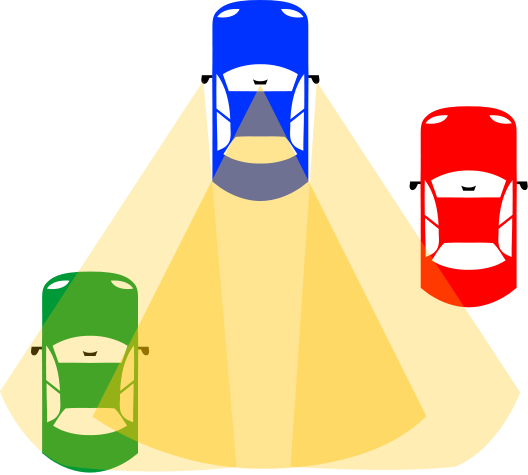
Incidentally, it seems mirrors are thought very differently in the US. It seems in the US a "blind spot free" arrangement is preferred, meanwhile in Germany the normal arrangement is preferred. Fun fact: The English Wikipedia has this image ( https://upload.wikimedia.org/wikipedia/commons/thumb/9/95/Bl... 9 ) as an example of incorrectly adjusted mirrors. The German Wikipedia uses the exact same image as an example of correctly adjusted mirrors.
The choice is not really between "blind spots" and "no blind spots" but between "one big blind spot on each side" and
"two smaller blind spots on each side". YMMV, depending on
whether you often drive on multi-lane roads and highways.
Whether a majority of US states adopt one standard or
the other is an open question. IMHO, getting USA drivers
to increase their roadway situational awareness, whether
by adjusting mirrors, reducing distractions, or other
means feels like a cause that was lost when cars got
radios and air conditioning, and drivers rolled up their windows.
American, I was taught the normal arrangement, but I've adopted the blind-spot free after nearly hitting more than a few drivers who were in my blind spot.


[1] German highway is called "Autobahn", and has some interesting traffic rules.