In 1993, Gelernter was critically injured opening a mailbomb sent by Theodore Kaczynski, who at that time was an unidentified but violent opponent of technology, dubbed by the press as "the Unabomber".[2] He recovered from his injuries but his right hand and eye were permanently damaged. He chronicled the ordeal in his 1997 book Drawing Life: Surviving the Unabomber.
He has also made some significant contributions to computer science — linda/tuple spaces in particular have been extremely influential in distributed computing. Not to mention his sci-fi works.
Personally, I find it outrageous for an academic to demand credit for "inventing" displaying files side by side, searching files by content, and archiving files by time. The Sumerians probably already did this.
Sure, they did it. But they didn't do it on a computer. Then on the internet. Then on a mobile device. They are all completely different issues, worthy of an extra patent or two.
I am just waiting for the next big thing, so I can patent everything all over again. Do you think iPads count as computers or a completely new device?
My first reaction was the same. However, I bet Apple tried to patent these things, too. So it would be sort of balancing justice - you want software patents, let them bite you...
I am glad the mobile world is blowing up in global thermo nuclear patent war. I hope that it will be so bloody that it leaves a bad taste in everyone mouth for a long time in regards to software patents. I am happy to see a little guy win who was actually trying to push software based on his patent rather than a patent troll or Apple but I would have rather he had not had a case due to software not being patentable. I think the mobile space highlights the damage that software patents do.
Apple might have lost this time. But the only winners are the big companies when it comes to patents. MS and others have a huge portfolios that crushes everyone who does anything like what they have a patent for. Why are you glad? Do you think patent laws will be overturned by this in the future? They're all just going to continue playing the same game.
No one can win at the game they are playing, it was always mutually assured destruction, when it came to the big players suing the big players. Apple made a move on HTC thinking that they where not a big enough fish to start a meltdown. Their analysis was wrong, it did. Now with the big fish not focusing on their core competency it gives others an opportunity in the market. The mobile patent wars has grown to big for any of them to control, now the only way they will be able to draw it to an end will be to lobby for patent reform. There is no doubt in my mind that these wars are close to boiling over into the desktop market. Until someone mistepped and started the unwinable war, it was a game stack against the little guy and a tool used exclusively on them. Now the weapon has been turned on the wielders, which was the logical first step that had to happen before any weight would be put behind reform.
You've just touched on why the 'release early, release often' mantra, in some cases, makes sense.
If he were in fact going to be beaten by Longhorn (who knows), it's likely that Apple would have gotten him anyway, but this proves that giving up on the rumor that Microsoft is swinging into your space is naive, pussy-footed thinking at its finest.
If, in fact, Longhorn WAS his only threat, he would have had what, 6 years in which to prosper, and possibly even dominate as a 'preferred' alternative to what Microsoft was offering.
He did just fine on his own, of course, so the conversation is moot.
The verdict would suggest, and it's a common misunderstanding to think that, the person who comes up with the idea first is more important for innovation than the person who executes it. This is encouraging talkers and discouraging doers.
Yes Gelernter may be the first person that came up with the "mirror world" idea (not to mention he has already made money from the books he sold), but instead of suing Apple for money, he should have praise Apple for making his vision a reality.
Again why? Apple did not praise Google for Android or Microsoft for windows, no they sued them, well in the case of Android they went after the handset makers because Google's portfolio would have done more damage to Apple than Apple's to Google. Under the rules of the current game why should this guy be any different? Because he is small, Why are the little guys to praise the big guys while the Big guys sue the little guys if they do the same.
If the world worked this way no one would innovate because the bigger players would start their copy machines every time someone with courage and a few great ideas sought to change the world.
If someone has a plan to rid us of the patent system and protect innovation I have yet to hear it...
We know that patent protection is not necessary for innovation. Patents are relatively new invention (1623 in UK per Wikipedia). And yet there were so many things invented before that, of much more fundamental nature than any software patent.
Second argument is an economic thought experiment. Let's say there is no word processing software yet and there's a million dollars to be made in word processing software. If we go by your "no innovation without monopoly" rule, no one will invent word processing out of fear that someone else will take part of the possible profits.
That's complete bollocks. If there's money in it, people will do it. Patents are more likely to be harmful because they limit competition and lack of competition hurts customers with higher prices for existing stuff and less possibility to build on stuff that has been done before. This case shows this well: the guy's idea might be swell, but do we really expect everyone to either not to anything similar in the future or pay him $625 million for the privilege? Does anyone really claims that given billions of educated people on the planet no one would come up with this idea independently even if this one guy kept it to himself?
Hence, by allowing inventors to secure a temporary patent monopoly, you greatly magnify the profit potential, encouraging risk and speculation that might not otherwise be worth the time and capital.
Patents are more likely to be harmful because they limit competition and lack of competition hurts customers with higher prices for existing stuff and less possibility to build on stuff that has been done before.
Nonsense. You're talking about turning everything into a commodity, which by definition means everything trends towards being the same. Sure, it drives prices down, but it makes improving the product a sucker's game.
Suppose your company can make 10,000 widgets a month. My company can make 7,500 widgets a month, but they're twice as good as your widgets because we invested more in widget R&D, and we are able to ask a higher price for them. Unfortunately, I'm not allowed to patent my improved widget, and you're smart enough to realize that my widgets are better, so you copy them. Now you're making the same widgets I am, but more of them. Damn, looks like investing in R&D was dumb.
The real world does not work that way, there is a lot of time, energy and risk put into success. The big players tend to opt for purchasing the little guy because the time, energy and risk have already been accounted for. Even the big guys fail at endeavors so many times it makes more sense to acquire the small guys who has mixed the formula correctly.
There's getting to be so many patents that it might be harder to determine if original software you've written is patented than actually developing it.
I am interested to see when a broader coalition against the existing patent system is forming. or even if ...
The world of patents has become perverted in recent years: patents are seen as valuable things in themselves – the more the merrier – irrespective of whether they do, truly, promote innovation. Worse: in the world of software, they are actually brakes on that innovation, particularly as they begin to interact and form impenetrable patent thickets.
a really bad thing about current patents (enforcement) is that it redistributes significant resources - time&money - from possibly productive purposes in an engineering company to [both sides] lawyers' pockets. A "40% patent layers tax". A parasitic drag if to speak aerodynamically.
Coverflow wasn't even developed in-house at Apple, they acquired it. According to wikipedia "Cover Flow was conceived by artist Andrew Coulter Enright[1] and originally implemented by an independent Macintosh developer, Jonathan del Strother. Enright later named the interaction style fliptych to distinguish it from the particular Cover Flow implementation.[2]"
I think Gerlernter is an important computer science visionary. There are still good ideas for today's interfaces in his 1993 book predating the web 'Mirror Worlds'.
But I also don't think he deserves $625 million for having patented some of his ideas/predictions about computer interfaces.
In his own writings, the tone is often prophetic: not "here's my nifty invention" but "this is the inevitable path we're on". Seeing what everyone else will see a few years early is a valuable skill; it's not so valuable it needs to be rewarded with a 20-year patent monopoly.
He may have tried, but his execution wasn't anywhere near Apple's. Instead of suing Apple for money, he should have praise Apple for making his vision a reality
You mean like Apple praised Google for Android? or Microsoft for Windows? I am sorry but Apple is one of the worst offenders when it comes to litigating copycats. I think we need to get rid of software patents all together but historically Apple has never praised copy cats of their original ideas why should this guy be any different? Because it is Apple?
Is Google's Android better than iOS? Is Microsoft's Windows better than Mac OS X? There are no obvious answers.
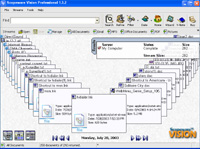
Now, compare some screenshots of Gelernter's Scopeware and Apple's CoverFlow. In this case it's obvious that Apple's implementation is a lot better, in its presentation as well as its ease of use.
There are dozens of cases where Apple took someone else's idea and improved on it, but I can't think of any good examples where the reverse happened.
I think you are missing the point, either copying ideas is right or wrong. The quality of the reproduction is irrelevant. The point is that Apple felt that copying their idea was wrong when Google and Microsoft did it, yet they did not feel that it was wrong when they did it to this guy, in fact every graphical OS from Lisa on was founded on Apple copying someones idea, there whole Mac and later IOS industry was founded when apple copied the Xerox Alto. It seems that Apples compass of right or wrong when it comes to copying depends on what side of the fence they are sitting on. Or are you saying that because Apple copies ideas better than others it is OK for them?
I am perfectly aware of the point you're trying to make. However, that was not what the grandparent, Tyng, was talking about. He suggested that, because Apple improved on Gelernter's idea, Gelernter should've just be grateful that Apple threw its R&D prowerss at it, making it what it is now. You then replied comparing the situation to Microsoft and Google copying Apple's work, which isn't exactly the same thing.
Yes it is, why should this guy be grateful, I don't understand why this guy should be grateful. I don't understand what is not clear about that. Apple was not grateful so why should this guy be grateful. I want to know why is their an acceptable double standard?
In my personal opinion he should not be anything, Apple should be free to implement anything on their system they want (as well as everyone else) but those are not the rules of engagement. So I want to know, under the current rules of engagement, why is it flattery when the little guy gets copied, but acceptable for the big guys to enforce that they can't be copied.
This kind of mentality reinforces the little guy getting victimized and I want to understand how someone comes to such a flawed conclusion. Whether right or wrong the big guys are using patents as a tool in their arsenal, so if those are the ground rules set out by the bigger players then why should a smaller player be flattered and give up advantage to a big company that has been known to use the same tools against others? If the shoe was on the other foot Apple would not consider it flattery (especially if it was superior), they have proved that and that is my point.
"I don't understand why this guy should be grateful."
I wasn't asserting that he should, Tyng was. And I don't want to get into a debate on the validity of software patents, because I'm still undecided on the matter.
Tyng stated that Apple improved on Gelernter's idea, and I don't think anyone will disagree with that. You compared the situation to Google and Microsoft copying Apple's ideas. I'm saying that isn't a fair comparison, because there is no consensus on whether Android is significantly better than iOS and whether Windows is significantly better than Mac OS.
"Apple was not grateful [for the creation of Windows and Android] so why should this guy be grateful."
I very much doubt that Apple saw the initial versions of Windows and Android as major improvements over their own OSes. Imitation can be the sincerest form of flattery, but doing it badly is simply insulting.
I think it's hard to tell what Apple would do if some company took Apple's ideas and made significant improvements to them, since I can't recall such an event ever happening. Well, maybe one: the Palm Pilot versus the Newton MessagePad. And I don't think Apple sued USRobotics over it.
I contend that it is, the suit was about software patents, not quality of reproduction, just like the cases before it. Bringing quality in is just a straw man argument and that is what I am trying to ferret out.
As for Palm, software patents did not exist until 95 in their current form, given that Palm was founded in 92. As well US Robotics existed well before that. There was no way to enforce a software patent.
I didn't, and wouldn't, use the words 'patent troll' for this case. My concern is more subtle.
Let's say I've got a novel idea right now of a wondrous invention, the Thneed. I'm the first in the world to conceive and refine the idea to implementability.
But, like everything else, it has precursors and dependencies, and will only be a hit if introduced at the right time. And, in our giant economy with lots of smart people, I was lucky to put the pieces together first.
If I were hit by a bus on the way to the patent office, two other people will come up with essentially the same Thneed idea next month. And if they meet each other, conspire to control the market, but then die from sharing a spoiled toxic Zagnut -- well, in two more months, four other people will independently arrive at the same idea. And by this time next year, hundreds will have independently realized it.
Further, the idea while wonderful may still, for hard-to-understand reasons, not be able to support a business for another 10 years. The infrastructure isn't there; the consumers need education; a critical mass of complementary products aren't yet available in enough places for economic production at scale. So my early conception isn't a boon to society, but only -- via either my speculation skills or a patent-granted monopoly -- a boon to me. By the time society needed my invention, it'd be 'obvious' to thousands of people.
Why grant patents in such a situation? They're not accelerating progress; they're arbitrarily reassigning the benefits of progress to a few lucky people. Patents may be retarding progress by encouraging overinvestment in prediction and speculative patent filing.
If these situations are rare, and situations where the patent incented a necessary invention are common, then patents are still net-worthwhile. But if these 'assign profits a little early' situations dominate, then even if patents sometimes incent valuable inventions, then patents are a net-loss.
With Gelernter, I haven't read his patents -- as engineers wiser than me have suggested that for software, lay coders reading patents can only get you in trouble. But I have read Gelernter's other writings -- essays and op-eds and book excerpts -- as he's a tenured professor. And the tone of those is: "here are my predictions". Or "this is right and inevitable". Even if his patents are intelligent refinements on what he saw as inevitable, that makes me think his inventive claims fall into the 'prescient but not economically necessary' category. It's wasteful for society to grant patent bonanzas for that level of insight. Those insights deserve accolades and tenure and investment-to-productize and consulting fees, but not a legal monopoly.
Or monkey see, monkey do - the huge companies might instead redouble their efforts to get their own patents. Years ago Microsoft got nailed by Stac for infringement of a patent on disk compression techniques (see http://en.wikipedia.org/wiki/Stac_Electronics#Microsoft_laws...), which seems to have spurred Microsoft into applying for patents of its own.
David Gelernter is an interesting guy; I remember hearing him on NPR's OnPoint talking about his book Judaism: A Way of Being. Link if anyone's interested: http://www.onpointradio.org/2009/12/david-gelernter
"Steven Jobs may be no inventor, but to his credit he recognized elegance when he saw it and understood its significance." -- David Gelernter, in his 1998 book Machine Beauty.
About ten pages after the above quote, Gelernter describes pretty much everything this suit was about in some detail, e.g. a use of the "time travel" metaphor very much like Time Machine's Finder interface, wherein the whole interface reverts to a previous state. Even if you don't agree with the verdict (or the damages, yikes) it's unthinkable after reexamining this book that folks at Apple didn't get some ideas from Gelernter's work, perhaps without even realizing it.
Incidentally, it is a great book that I highly recommend.
Sure they did, The iPhone was a eerily similar concept to a device patented in the late seventies or early eighties. I wish I could dig up the link, but man it looked like a wholesale copy of this patent. Multi-touch and everything. Someone at Apple is rifling through old patents for ideas.
Not exactly patented, but the concepts behind tablets, smartphones, and the PC itself can be traced directly to -> http://en.wikipedia.org/wiki/Dynabook
I'm curious to know how the technology is used after a patent suit like this. Do companies like Apple usually license the patented technology or do they remove the offending code?
I imagine there could be a lot more money involved if the appeals are shot down.
Gelernter isn't exactly what I think of when I read "entrepreneur". Technically, I suppose he is, but I just think of an entrepreneur as someone with more on the line.
It's like the old joke about the chicken and the pig and their commitment to breakfast.
He's the tenured chicken providing the idea eggs, not the pig providing the bacon and working to make a viable business.
The problem is with the patent system that allows getting monopoly for minor (however useful they might be) ideas and awards mind-boggling damages after long and costly trials.
Blaming actors in that system is not helpful because it changes focus from relevant (the patent system is broken) to irrelevant (motivations of people or companies that take advantage of the system).



From Wikipedia:
In 1993, Gelernter was critically injured opening a mailbomb sent by Theodore Kaczynski, who at that time was an unidentified but violent opponent of technology, dubbed by the press as "the Unabomber".[2] He recovered from his injuries but his right hand and eye were permanently damaged. He chronicled the ordeal in his 1997 book Drawing Life: Surviving the Unabomber.