Hacker Newsnew | past | comments | ask | show | jobs | submitlogin

I'm not sure how you would define the Fourier Transform geometrically without needing 4 spatial dimensions, at which point intuitive geometric reasoning is impossible.


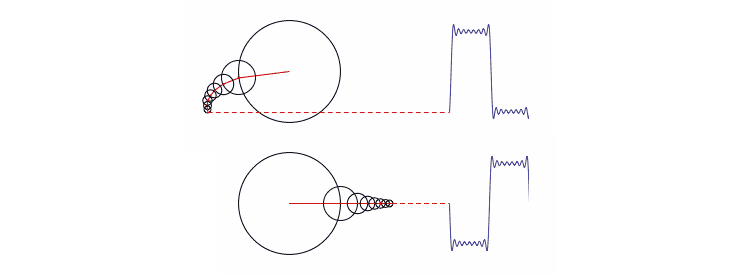
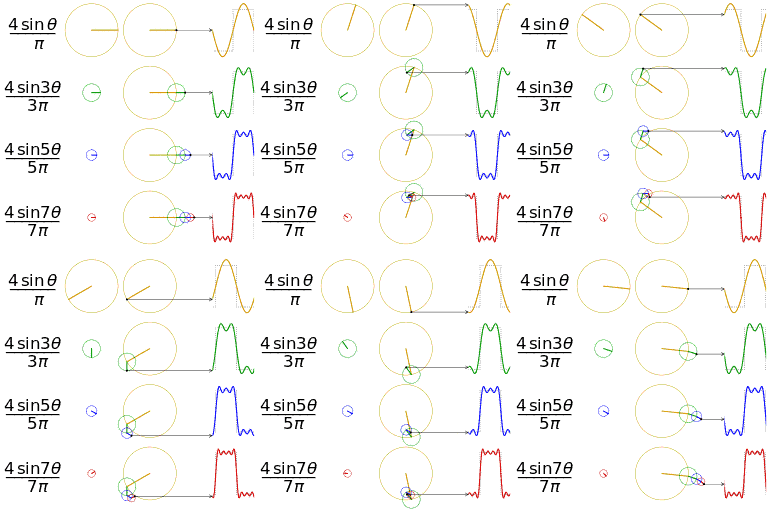
Far from impossible, it's even reasonably intutitive. Wikipedia has an excellent graphic https://en.wikipedia.org/wiki/File:Fourier_transform_time_an....

Then for people for which that's too abstract, I find this graphic helps a lot in explaining. http://static.nautil.us/1635_42a3964579017f3cb42b26605b9ae8e...

You picked a really bad example for the unintutiveness of mathematics.


Speaking in my capacity as a person who doesn't understand Fourier transforms, I'm afraid I have to say that your "intuitive" graphics are anything but. I can't even make sense of your second graphic.

Just a data point for you.


Fair enough, it works a lot better as a gif. Out of curiosity, does this clear things up, or just as confusing?

https://upload.wikimedia.org/wikipedia/commons/1/1a/Fourier_...


Oooh. Yes, actually; I think I have an idea about what's going on (and why they're so damn useful) now.

Thank you!


I'd suggest most of homological algebra as an example. It's called "abstract nonsense" for a reason.

Personally, my intuition gives up at spectral sequences.


Doing a Fourier transform is simply applying a set of inner products from the function, f, onto a set of orthonormal basis functions. Put a post in the ground, measure the length of the shadow cast by the sun. That's how to do an inner product. So you can at least describe the process using few dimensions. Then you can scale it up to higher dimensions from there.


Guidelines | FAQ | Lists | API | Security | Legal | Apply to YC | Contact

Search: