While kids may find arithmetic to be boring and demotivating, they're able to do it. It's when math gets symbolic that you get the permanent attrition. For instance, most people never get to calculus.
When you progress from arithmetic to abstract, it hardly gets easier.
Moreover, memorizing. You go from memorizing multiplication tables to other kinds of tables, like tables of equations giving various identities, rows of coefficients in series, and the like. Contents of various kinds of matrices.
The need to be precise and avoid mistakes never goes away. Manipulating a complex math equation is still a form of arithmetic. And it's harder because the underlying semantics means that something which is mechanically correct at the syntax level (easy to check) could actually be meaningless and wrong.
The simplistic notations used in math don't "keep up" with the increasing complexity of what is going on. They just get harder semantics. Notation which looks like multiplication or addition in such and such domain is just "sort of" like it, but, oh, here are the ways in which it isn't.
Disagree. Kids disengage from math for many different reasons. There is no single pattern to it. If it were that simple, it would not have remained an issue since schools were commonplace.
Minsky solidly makes the point that when math is taught as nothing more than an endless series of tedious drills with no purpose in sight, of course it demotivates kids. No one likes pointless Sisyphean tasks.
Many students, however, "rediscover" math when they get to their first class that involves theorems and proofs (often in high-school geometry) and when it starts being used in science coursework. It is then that they realize that math is a way of thinking and this can transform their opinion and motivation for math.
The best teachers find ways to relate mathematics to real life and real purpose. Yeah, it is always going to be challenging, but having a purpose creates motivation to get through the tedium.
> Kids disengage from math for many different reasons. There is no single pattern to it.
I agree with a lot of what you're saying, but not this. The pattern is depressingly clear. People are taught math by teachers who don't really understand it and didn't like it themselves; most of the students wind up in the same place, and so each generation poisons the next. Elementary school teachers especially tend to be drawn from the subset of the population that doesn't like math.
And it starts with the idea that math is all about rote memorization. I would go farther than Marvin did with the flash cards. I would say, for each fact, let's work it out by the standard algorithm, then see if we can find two or three more ways to arrive at it: by distributing multiplication over addition (e.g. 7 × 6 = (6 + 1) × 6 = 6 × 6 + 6 = 36 + 6) or by factoring one multiplicand and reassociating (e.g. 7 × 6 = 7 × 2 × 3 = (7 × 3) × 2 = 21 × 2, which is easy because you can double both digits of 21 without generating a number bigger than 10).
So when I read the reply of the "traditional teacher" to the 6-year-old who had a novel way of computing 15 + 15 -- "Your answer is right but your method was wrong" -- I think that if this was a real anecdote, the teacher should have been fired on the spot, for not understanding the first thing about mathematics! But sadly, no one could probably have been found to replace this teacher who wouldn't have suffered from the same fundamental misconception. It's not about knowing the "right" way: it's about knowing many ways.
This resonated a lot with me. I never memorized 6+7 nor 7+8, I couldn't bring myself to do it. Instead I found an easier alternative: make it 7+7 or 8+8 and substract 1.
Luckily I didn't say that out loud, otherwise they might have made me hate mathematics and I wouldn't love science now (:
It's just one anecdote, but this jibes with my personal experience. I hated algebra (high school algebra) because it was endless tedious, mechanical manipulations and there didn't seem to be any real elegance or beauty to it. It was just memorizing "stuff" like the quadratic formula, how to rationalize denominators, blah, blah, blah. But high-school geometry was actually interesting. Seeing how the various proofs were formed and built up from pieces, and how one thing followed logically from another, that was fun.
Needless to say, my geometry grade was much better than my algebra grade.
Then, in college, taking pre-calc/Trig, it was back to a lot of boring repetition (except trig, that was actually interesting). But then in Calc I, it was fun again. The idea behind derivatives was actually interesting, and hooked me early on in Calc I.
Anyway, I always found that, other than tedium, the biggest challenge I had with math was being put off by cryptic notation. I tend to want to read things to myself in my head as I look at them on a page, and when I'm looking at (new/unfamiliar) math notation, and I don't know how to "pronounce" it to myself, my mind wants to just blank out and skip it.
> the biggest challenge I had with math was being put off by cryptic notation. I tend to want to read things to myself in my head as I look at them on a page, and when I'm looking at (new/unfamiliar) math notation, and I don't know how to "pronounce" it to myself, my mind wants to just blank out and skip it.
Material that has an almost unnecessarily comprehensive vocabulary and notation practices guide at the beginning/end is the best kind.
Humanity as such absolutely loves pointless repetition, and abhors thinking about something hard, which involves focusing intensely on one subject in which where no repeatable progression of simple successes is taking place, leading to a mounting sense of discomfort.
Just look at various cultural traditions, popular (and even serious) music, crafts, sports, ... sneeze ligion. Mindless repetition is everywhere.
The same kid that hates doing arithmetic will play the same video game for hours in which a small variation on the same set of events happens over and over again.
The kids you're describing are the smart minority, of whom a portion will go on into STEM type fields. They too will hit their mathematics ceilings. Most will go as far as a couple of third year undergrad math courses and that's where it ends.
I think your assumptions are fundamentally wrong. The examples of repetition you describe are specifically designed, whether by a video game producer, a musician, or a priestly class- to feel important and be generally pleasant. Video game creators spend thousands of hours researching the best ways to turn their systems into Skinner Boxes, priestly sorts have spent untold amounts of time preparing sermons to instill a sense of the criticality of religious ritual- in other words, no, humanity doesn't like repetition in and of itself, but it designs repetitions that it does like.
Meanwhile, that dual sense- the pleasure the video game designer tries to create and the sense of importance the priest creates- these are fundamentally absent from our teaching methods in early arithmetic, which, at least in America, we call 'math,' not differentiating the symbolic thought processes from the repetitive arithmetic, incorporating little if any fun, and constantly failing to appropriately create a sense of importance (the most common teenage question in math classes is, "Why do I have to learn this? When am I ever going to use this?").
While there Do exist efforts to instill a video game's sense of fun to arithmetic exercises and a sense of near-religious importance to the symbolic thought of math, we are functionally applying a tourniquet to the mathematical understanding of the young by just force-feeding arithmetic drills and emphasizing mistake avoidance instead of proper thinking- and it's very little wonder that only some few students' mathematical passion survives the tourniquet.
Yes, of course people don't like repetition per se abstracted from the particulars of what it is that is repeating. Someone likes repeated palm-muted metal guitar riffs; but thinks that someone else who likes knitting sweaters, loop by loop, should get a life.
For myself, I found math difficult. Never understood, even now, the need to spend so much time memorizing multiplication tables.
That said, I started over in a community college, and finished up to trig. with ease. I found trigonometry, surprisingly straight forward. I went on to finish a year of physics. I didn't need calculus for my major, and heard it was really hard. Plus, I didn't want to ruin my grade point average with a class I didn't need. I now regret not taking calculus, but it's so much easier to learn something these days.
My struggle with math was two fold. I didn't care in high school, and I never had a firm grasp on basic math. I look back , and once I truly inderstood basic math, especially fractions, and percentages; it all became so easy.
I see a lot of kids still struggling with math. They get pushed along, and avoid any class that has math in it. I do blame our U.S. teaching system in this case. Keep teaching basic math until the kid can teach it to to their classmates.
Then, and only then move on to algebra, and trig? As to calculus, I didn't take it so I won't comment, but when I was applying to health professional schools, I didn't find one that required Calculus. Probally for good reason. My physics classmates biggest, silent stumbling block was they were horrid in math, and looking back--they just didn't know the basics, so every step up the ladder became more mysterious. Most of my classmates seemed to the solving problems in physics by memorizing the homework; not truly understanding the problems.
I now regret not taking calculus, but it's so much easier to learn something these days.
It's funny to hear you say that. I don't know how old you are, but lately I've been trying to teach myself some additional math that I never took before (like Linear Algebra) and refreshing on Calculus, and now - at the ripe old age of 42 - I swear I find it easier to learn this stuff than I did when I was in college 20 some odd years ago.
Maybe it's just a question of motivation, or maybe I have more context available now, or, hell, maybe I've gotten smarter... but whatever it is, I'm not going to complain, considering how you always hear about how our minds slow down as we age and things are supposed to get harder to learn.
For myself, I love math. I also never understood, even now, the need to spend so much time memorizing multiplication tables.
In fact, I've never learnt it. From time to time I still find myself multiplying on fingers; as a kid I used it a lot, now the table went into my head automatically simply from continued usage. The way to multiply two natural numbers from <6; 9> on fingers was one of the most important things my mom tought me :)
There's also a way as presented in the article (87 = 88-8), but I mostly use it when double checking, as I find it slightly more error-prone when doing it in head (and obviously very inefficient when done on paper). Works great for bigger numbers though.
Once in junior high school my math teacher caught me on multiplying on fingers and ordered me to learn the table for the next lession. Managed to pass it, but quickly forgot in following days. I never cared - I was always doing very fast and well on math classes anyway.
The kids I am describing are somewhat lucky for not having "checked out" before progressing beyond fractions. But they're not extraordinary, they're just kids who have been taught competently and who have been motivated in one way or another to get that far.
Kids are naturally curious and fighting against their curiosity can easily lead to losing their interest.
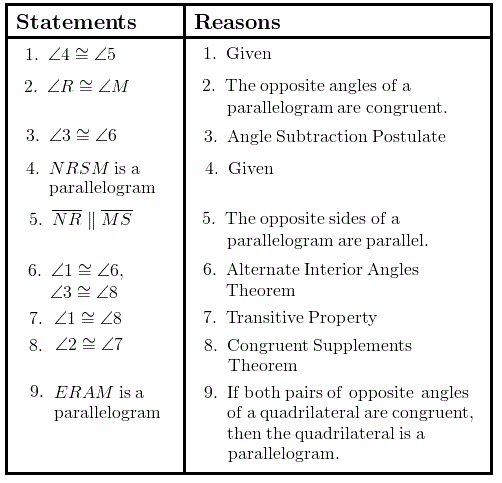
What's wrong with two column proofs? I think they're a great tool for getting into the absolutely rigorous mindset required for maths. Leslie Lamport even makes the case that professional mathematicians should use them to reduce publication errors [1].
My personal feeling (as a maths grad student) is that the utility of two column proofs depends on the field. For logic and algorithms sure but estimating integrals it becomes tedious quickly.
I have never met a mathematician who feels that two-column proofs is the right way to teach high school geometry. Considering that little math taught in high school beyond basic algebra uses anything close to 'absolute rigor,' introducing rigorous proofs should be left for college when one actually has a reason to learn proofs for advanced mathematics (set theory, analysis, etc).
Geometry is taught correctly when proofs are used as a tool to convey a deep intuition about a mathematical pattern. Check out Lockhart's book [1] if you want to see what it's like when done right, though there are many more examples. Two-column proofs are simply a tool for the lazy/unknowledgeable teachers to fill a geometry class.
I am aware of Lamport's work, and it's a specific tool for a specific subfield in which there is a plethora of false results. Ignoring the fact that most of theoretical computer science research and most of math research more does not fall into the category that Lamport is critical of (distributed computing), these temporary issues about rigor in academic publishing should have no effect on high school pedagogy. Instead, we should listen to the world's finest math teachers, who pretty much all agree that two-column proofs are awful. A quote from Lockhart [2]:
> Geometry class is by far the most mentally and emotionally destructive component of the entire K-12 mathematics curriculum. Other math courses may hide the beautiful bird, or put it in a cage, but in geometry class it is openly and cruelly tortured. What is happening is the systematic undermining of the student’s intuition. A proof, that is, a mathematical argument, is a work of fiction, a poem. Its goal is to satisfy. A beautiful proof should explain, and it should explain clearly, deeply, and elegantly. A well-written, well-crafted argument should feel like a splash of cool water, and be a beacon of light— it should refresh the spirit and illuminate the mind. And it should be charming. There is nothing charming about what passes for proof in geometry class. Students are presented a rigid and dogmatic format in which their so-called “proofs” are to be conducted— a format as unnecessary and inappropriate as insisting that children who wish to plant a garden refer to their flowers by genus and species.
There is no single construct or pedagogical technique which is responsible for kids not learning math. In the hands a good teacher 2 column proofs are just fine. Calling them "awful" is a bit hysterical.
Yes, and in the hands of a brilliant artist, mud and coffee stains can make a lovely painting. That does not mean art teachers should use mud and coffee as the only tool for teaching one how to paint.
Unfortunately, most high school math teachers are undertrained, underpaid, overworked, and pressured to focus on exams. The two-column proof is a crutch. It's not the only awful part of high school math education, nor is it the sole bane of a student's math education (I never said it was). But it is the most egregious example of bad math education.
I can't quite figure WORKING-STORAGE out from the docs I found, maybe because I'm not sure what a "run unit" is—I'm assuming something like a Linux process group/session?
To contrast, LOCAL-STORAGE seems like a regular global variable (.DATA/.BSS) segment. So is WORKING-STORAGE basically like a set of seeming global variables, that actually point into (the equivalent of) a shared mmap'ed file, such that other processes in the same session/pgroup end up mmap'ing the same file and thus sharing memory that way, without having to clone around the memory handle itself via forking/threading/IPC?
In this case, it sort of reminds me of the OS-level version of an anonymous Erlang ETS table held by a supervisor and passed to all the worker children to manipulate.
Ah, nothing that complicated :) It's a data structure with named fields. Each field can be a different type and they are in specific positions in the data structure so that it forms a pattern with strongly typed components.
COBOL's type definitions are also patterns really - for instance you declare a field to be of type 9(7) which means a numeric field of length 7 and so on.
The whole setup gives you very fine control over the structure of your data. For example, you can describe lines of a document to be printed out with strongly typed fields to be filled in by your program, so a form basically.
It's also used as a template for documents like VSAM files. Those are flat-file databases and the COBOL program's working storage imposes structure on them.
Here's a small example:
01 FILE-RECORD.
__03 WS-ACCOUNT_____PIC 9(10).
__03 WS-SEPARATOR1__PIC X.
__03 WS-NAME________PIC S(25).
__03 WS-SEPARATOR2__PIC X.
[Underscores are formatting only, not COBOL syntax]
That declares a structure called FILE-RECORD with four named fields, one of numeric type with length 10, one of alphabetic type with length 25 and two of alphanumeric type with length 1. So that's one record in your file structure and you can fill it in with data from VSAM files and the like, then print it out, with the separator fields for formatting.
It's a strange thing, low-level and high-level at the same time, in a very nice way. It kind of grows on you. Well, it's grown on me anyway. Of course, YMMMV.
Btw, the numbers (01, 03) make the hierarchical relation between the root of the data structure and each of its fields explicit; I won't say I'm in love with that sort of syntax :)
Also, I'm a total no0b still, so I might have made some mistake above, apologies in advance if that is the case.
I had those in high school and I hardly see any problem with them. It's just writing the proof neatly organized into a table, with the reasons for each step given.
It looks "unpleasant" out of context, but it is important to note that the proof is accompanied by a diagram of the parallelogram and the students who write this proof have been exposed to the reasoning behind the steps.
High school geometry introduces many students to the idea that math is a way of reasoning and this is _very_ different from the boring grind that they were used to.
Note that kids don't reach the formal operational development stage until they're ~11 on average. Until then, expecting them to do abstract (formal) reasoning will be about as successful as expecting a chimp to do so.
And, on the converse, in previous centuries, you'd often see people only start learning math from the beginning in their late teens or early twenties—the time when they first attended "university" without previously attending a grammar or seminary school. These 20-year-olds would be able to pick math all up quite quickly, proceeding from addition and multiplication to calculus and beyond within a year or two.
This suggests to me that what we think of as "mathematical aptitude" is far more a measure of developmental age than anything else. I think a large part of why kids hate math is that we try to cram concepts into their brains when those brains aren't yet the right "shape" to take in those concepts. I expect that offsetting every part of the mathematical curriculum at least two years upward—if not far more—would do wonders for attrition rates.
My belief is that we could even fit all the same curriculum in by the end of public high school: although you'd be "squishing" more of the learning into the later years, the stronger minds kids would have at a higher age would allow them to acquire each successive concept both more quickly and more thoroughly, serving as a better base for the learning going forward, which would in turn be accelerated by that base.
Kids are ready for formal operations when their earlier experience has prepared them for formal operations. In some places around the world, students in fifth grade--including below-average fifth-graders--are already learning algebra. In quite a few whole countries around the world (for example, Taiwan, where my wife grew up when Taiwan was still a developing country) all seventh graders study algebra and geometry as part of their regular school math lessons, yes, including the below-average seventh graders. (In Taiwan, they also learned enough of the International Phonetic Alphabet to transcribe General American English at that age, but now that skill, which most United States reading teachers lack entirely even with a college degree, has moved into the elementary school curriculum.) Good education at the beginning produces better results in the middle grades.[1]
"Learning algebra" doesn't necessarily imply understanding the abstract concepts of algebra. Without the developmental substrate, children instead lean mostly on rote memorization. This seems to "work" when the class is taught in terms of rote application of memorized formulae, but will fall over the moment that students are presented with a problem in a novel context, or expected to synthesize multiple component skills into a larger solution.
If you've ever tried to tutor someone who "struggles with word-problems", the majority of the time it's because they don't actually understand the things they've been "learning" at all.
Similarly, this tends to be the difference between people who "get" programming and people who don't. If you ever talked to someone who failed a programming course, it's usually clear from their approach that every new language or API they learned became, to them, another set of rote facts to burn into their mind, never coming together to paint a picture of what the formal act of "programming" is generally.
Instead of memorizing multiplication tables, you instead have to memorize derivative formulas, or the formulas for the Fourier and Laplace transforms, or the difference between a bijection and an injection, or all the conditions on an elliptic curve that make it suitable for cryptography. I could go on and on and on.
The stupid notations that mathematicians use doesn't help either. All math should be done using S expressions (and I'm pretty sure Minsky would have agreed!)
Math notation is actually pretty great and is a result of multiple iterations. Earlier forms were much worse. S-Expressions by themselves are obviously not enough, you have to introduce at least first-order logic notation, set notation, etc. It's not obvious that the end result will be anywhere near as readable as the current notation.
Current math notation may be the result of multiple iterations, but they all took place before the widespread availability of computers. Current math notation is optimized for hand-writing and manual rather than automated proof checking. It may be great for paper and pencil, but times have changed.
And BTW, the notation actually sucks for paper-and-pencil too because of its ambiguity. See:
When did Scheme get this "curried define": (define (((f x) y) z) blah)?
I'm sure that isn't in R5RS and I don't see it in R7RS. I found a description in the Racket manual.
In any case, I like how they are making the context explicit. In the regular math notation for the physics, you just say something like "the Lagrangian for the free particle" and then just spew out something with free variables sticking out of it, like velocity "v". The hacker in me of course asks, how the heck does that work if I have two particles? There is only one v? When we have two, we hand-wave in some subscripts: v1, v2, ... This system makes it explicit: it's the Lagrangian for a particle. So the particle appears as a parameter, and that parameter has accessors on it to retrieve its properties: velocity of the particle, etc.
It's definitely not perfect, but it's much better than any alternatives I have seen. Would love to take a look if there are any good proposals based on S-Expressions or other computer-era notations.
I failed math all through elementary school but somehow got into this industry despite that. The reality is I'm terrible at arithmetic, but fine at what most of CS is: logic in the form of boolean logic, symbolic stuff. As a kid I was much better with the symbolic than the arithmetic -- which I almost always got _wrong_. My brain stumbles over numbers. I'm terrible at it. I feel like my childhood education did a horrible disservice to me telling me I'm terrible at math, when I'm really just terrible (to the point of what I think might be a physical disability) with numbers.
Some academic mathematicians are terrible at arithmetic.
There's no correlation at all between being able to add up a grocery bill in your head and being good at abstraction.
My accountant is very good at mental arithmetic. I don't expect him to win the Fields Medal any time soon.
This is more relevant than it should be. Too many people leave school thinking math is mental arithmetic, and have no idea what symbolic manipulation is, or why it's useful.
Going from arithmetic to abstraction is difficult for some. One is word problems at about 5th grade. Its fairly simple to replace key words by symbols and operators to find the answer. But this confuses some people.
The next step is algebra at 8th or 9th grade. Letters and numbers confuses people too.
In my case I succumbed at Analysis. I like applied math, but dislike constructing proofs.
Potentially unpopular opinion: Maybe our math teachers just suck? If we all had Marvin as our professor I doubt attrition would be as high, whereas most High School math teachers are simply analytically inclined people who realized they had better job security teaching math than english
Actually, many high school math teachers in the US did not major in math, minor in math, or receive any teaching certification in math.
In high school it's not so bad -- only 28% of high school math didn't major in math, and only 12% of our total math teachers in high school have no qualifications whatsoever. [1] In middle school 55% of math teachers didn't major in math, and about 30% didn't major, minor, or get a certificate in math! [2]
If Richard Feynman taught our children physics that would be great too. Your bar is unrealistically high I feel. I'm pretty sure there's a large percentage of math teachers that want to teach math and enjoy teaching it. I'm not sure how much freedom they have to teach it their way though.
Obviously we can't all be taught by Feynman or Minksy, but given the most common answer to "What subject do you dislike the most" is "math" we probably need to do better. It's also a vicious cycle, we're raising our future math teachers to dislike math


When you progress from arithmetic to abstract, it hardly gets easier.
Moreover, memorizing. You go from memorizing multiplication tables to other kinds of tables, like tables of equations giving various identities, rows of coefficients in series, and the like. Contents of various kinds of matrices.
The need to be precise and avoid mistakes never goes away. Manipulating a complex math equation is still a form of arithmetic. And it's harder because the underlying semantics means that something which is mechanically correct at the syntax level (easy to check) could actually be meaningless and wrong.
The simplistic notations used in math don't "keep up" with the increasing complexity of what is going on. They just get harder semantics. Notation which looks like multiplication or addition in such and such domain is just "sort of" like it, but, oh, here are the ways in which it isn't.