Use a linter that can auto fix some of the problems and have an automatic formatter. Ruff can do both. It will decrease your cleanup workload.
Don't get too hanged up on typing. Pythons duck typing is a feature not a bug. It's ok to have loose types.
On duplicate code, in general you should see at least two examples of a pattern before trying to abstract it. Make sure the duplication/similarity is semantic and not incidental, if you abstract away incidental duplication, you will very quickly find yourself in a situation where the cases diverge and your abstraction will get in your way.
In general coding agents are technical debt printers. But you can still pay it off.
The value is in the reliability, not necessarily the speed. In most cases 24 hours are not enough for me to give you a full rundown of what I want done. You can make it 10k and a week and you will probably get better results. I say this with no actual knowledge but my intuition is that the overlap between people that will engage with a 24 hour turnaround promise and the people that have the authority to spend 5k is much smaller than the corresponding week/10k combination.
Having watched both. Yes the Incredibles are much much worse. Especially if we focus on the color palette. You could have not picked a worse example.
But for example Moana is not worse than Cinderella. Arguably it's better. But the algorithmic choices around perspectives, reflections, etc. Were not really automated. In both cases a lot of people where involved in each scene, and I am confident, they went over every frame, checking the result was what they wanted.
Additionally, hand-coloring wasn't necessarily a more pure creative choice anyway. It was dictated by material conditions such as the availability of pigments, studio constraints, time pressures, etc.
Put down the phone, close that youtube, tik tok or whatever tab.
Don't try to explain to your relatives which video is AI and which is not, explain to them that everything on the internet is bullshit and trolling, AI or not it does not matter it's all bullshit to sell ads.
Tell them they are better off watching TV, even Fox news.
My main point is that trying to educate people to spot AI videos is pointless, in a matter of months, years the output will be impossible to discern from real videos.
The central problem is the platforms and the wild west around disinformation campaigns. The AI is just an accelerant and we were on fire already.
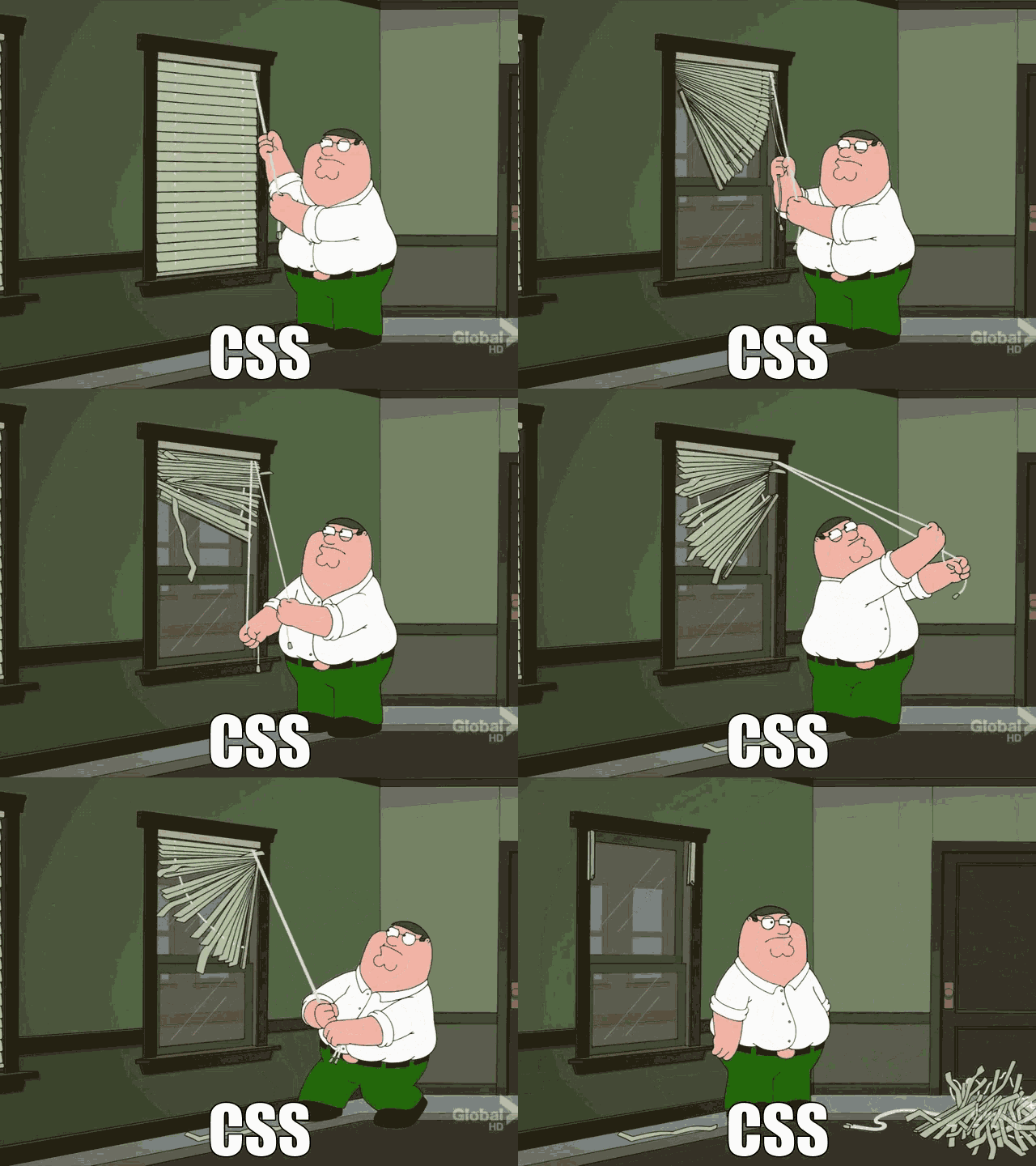
I know CSS and believe me it sucks. Sure grid layout and flexbox fix things. But a lot of it is hacks on top of hacks.
Why do you think the padding as a percentage is relative to the width of the parent? Do you think it was a happy accident? I don't think so, it was purposefully put there in the specs so that we could have boxes with fixed aspect ratios. This is just the tip of the iceberg.
The good thing is that all the hacks together make a working thing. And if you know them you can do a lot of stuff.
> 1. Many early web engines used `display: content-box`. So the padding was actually considered to be outside of the box itself.
IIRC this was actually the spec, and IE decided to ignore it and do something saner, while the box-sizing attribute to pick what you wanted came later. Designing for content-box and IE displaying using border-box (or whatever it did) was one of the reasons it got the nickname "internet exploder" - everything ended up positioned or sized wrong. Until box-sizing came along, it was common to use various hacks / bugs in the browsers' CSS parsers to make certain rules only apply to certain browsers to fix this.
> IIRC this was actually the spec, and IE decided to ignore it and do something saner
That's actually a little unfair on IE. This behaviour predates there even being a spec. IE and Netscape did it differently, and as a general rule Netscape's behaviour tended to be what ended up in the spec. This was mostly a good thing, but not so much in this case.
While that's true. They could have gone another way without breaking the dependency rules.
Padding top and bottom could be relative to parent height and padding left and right could be relative to parent width. They would not be the same. But it would still make sense. It would arguably be more logical than the selected behavior.
But the specific example does not even invalidate my point there is a whole website about css quirky behaviors and how to use them to your advantage, https://css-tricks.com/.
I know CSS, but also a few other displays and layout engines.
In my experience "CSS sucks" right up until you try to do a tenth of what it offers in something else. Cross-platform, device-neutral UI is hard. Then allow user-provided alterations?
Yeah, there's a good reason why I have a lot of criticisms about CSS and only some about, say, QT. It's because I spent the last 15+ years writing CSS in some way or another and one extended summer of hacking a side project in QT, abandoning it, and never looking back.
It depends on what you mean by "sucks". I don't think anyone here is denying that it's often the best tool for the job. You SHOULD learn CSS if you want to be an effective UI programmer simply because you'll encounter it everywhere. But the quality of the language should still be critique IMO.
That's the basis for my critique of CSS. There were plenty of other layout systems extant at the time CSS was cooked up. How CSS could have delivered such an incomplete and broken scheme is beyond me. To this day, it sucks harder than GridBagLayout from AWT of the 90s (and that one sucks a quite bit).
> Why do you think the padding as a percentage is relative to the width of the parent? Do you think it was a happy accident? I don't think so, it was purposefully put there in the specs so that we could have boxes with fixed aspect ratios. This is just the tip of the iceberg.
It’s because you cannot do a percentage of a height unless your parent’s height is fixed - something that happens naturally maybe 1% of the time. You’d be missing vertical borders in almost every case with your suggestion
Yeah. If you like programming exclusively with globals and no warning when you have conflicting variable names, then CSS is for you-- it's basically programming (almost) exclusively using global mutable state.
I understand why people hate Tailwind, but it largely solved this problem for me.
If you are thinking about CSS, in terms of state, mutability, variable names and programming, you are already down a very wrong path and you won't have a lot of luck.
CSS is about rules, selectors and cascading, hence Css.
Abstractions matter, and using procedural programming abstractions on a declarative styling language only gets in your way.
Absolutely agree, although CSS has slowly become more and more like a programming language over time, so it's understandable that people have this confusion.
CSS isn't "like" a programming language. It is a programming language.
It's just not one based on states, mutability, and variables. Even the things that use the `var` keyword are constants, not variables.
(But then, don't read that as being against scoped rules. The fact that all rules are global to the document is bad. We can emulate scopes with specific selectors, but that's the kind of thing a language is supposed to help with.)
I’m dumb and don’t understand the distinction you’re making.
elem.style.setProperty(‘—var-name’, newValue);
… will set a new value for the “constant”. The element will rerender with the new value. You can animate/automate these changes and the element will continue to rerebder with the updated value.
To me, that justifies the name “variable” from the perspective of the CSS.
We've heard that one before, haven't we? HTML was supposed to be a declarative language, not a vanilla programming one. And look where we are... the biggest mess of a programming language the world has ever seen.
What's the wisdom of randomly inserting cutesy "declarative" bits in a world infused with programming-oriented infrastructure... It doesn't make any sense.
For me the first-approximation litmus test of "is it a real programming language" is "does it have conditionals"? HTML itself does not have conditionals (at least in common use, if you don't count the contents of <canvas> and <noscript>, which I don't). So I don't see how HTML is a programming language, let alone a messy one. LaTeX is a programming language because it's built on TeX, which is a programming language, but HTML purely marks up text.
Granted, when you add CSS to the mix, HTML+CSS is programming if you get fancy about it.
HTML (Hyper-Text Markup Language) is a specific kind programming language, a markup language. It is nowhere close to a general purpose (Turing complete) programming language. Maybe you meant the web stack (HTML, JavaScript, CSS)?
It's a (computer) language, it is also a formal language. A programming language is a language in which you can write programs, which are descriptions of algorithms. You don't describe algorithms in HTML, hence it is not a programming language.
> Maybe you meant the web stack (HTML, JavaScript)
HTML5 doesn't refer specifically to HTML, rather it's "HTML + JavaScript + CSS". There's hardly a website nowadays that can be used without JS.
By using the name HTML5 as an umbrella name for a programming language API plus some declarative bits, the W3C tacitly admitted that the declarative push has been a mistake - I explained "why" in my previous comment.
HTML5 refers specifically to the latest, living version of HTML, the markup language. CSS and JavaScript have their own specifications, and version numbers. The term your looking for is the web platform [1].
On a technical forum in a post that contains, both the words "CSS" and "HTML"? Sorry, but no "HTML5" refers to the version 5 of the Hypertext Markup Language.
HTML5 is the HTML of today, that's what I meant originally. I'm not sure what you're afraid of, nobody is attacking you, I'm simply explaining what I had in mind, and why it's not unreasonable to use words in a more inclusive, close to contemporary practice meaning.
The fact is, JavaScript is ubiquitous in web programing and the web is unthinkable without it, it's so pervasive on the front end that it's been repurposed for backend use precisely because it makes a lot of sense to use one programming language for one project. Pure HTML is unsuitable for backend use and it sticks like a sore thumb in the front end.
Younger developers are likely missing on the history of the entire web endeavor but in order to get a feel for it, I'd recommend to focus on practical meaning rather than on trivial semantics.
The big point I was driving at is this: The damage has been done, instead of a clean rendering API we've got this hybrid monstrosity which locked us to a couple / triple browser rendering engines which, due to cutesy BS, are complex beyond comprehension, beyond security analysis or normal competition. This is what an obsession with fancy names leads to.
nah. the technical semantics is absolutely the point when we're talking about code. HTML is thing distinct from javascript and CSS and it's very useful to be precise about it in our context.
Sure but things like scoping and shadowing are still relevant to CSS. The fact that it's declarative doesn't give it an excuse for the poor scoping design.
In the initial conception pages have their own stylesheet, that solves the scoping issues.
It's our fault we pack all the rules in one file and ship it to all our pages.
"Shadowing" is on purpose it's the cascading part of the cascading style sheets. There are rules around which rule has priority read about selector specificity.
Class names are "global mutable state". You can declare a class in one file, and other file can 'mutate' it.
There are solutions/workarounds to this. First following a convention like BEM, then enforcing that at build time (CSS Modules), and now (potentially, i haven't checked in with it) the language supports @scope.
Class names and other selectors are more like a query language, because they don't do anything if you don't have an html element with that class or matching the selector.
on edit: a downvote on that, really. because I don't think class names are anything like a variable!
This doesn't make CSS classes mutable global state. CSS rules are applied according to specificity of selectors. You could maybe say that the overall style of a page is mutable state, but not the CSS classes themselves. A CSS class is assigned and that's it. Unless JS is involved, it also doesn't disappear or toggle.
I'm aware of browser defaults and how they work, yes. Just because someone does not agree with you does not make them uneducated.
Frankly I tend to find analogies not very useful, I don't think my analogy of CSS as a db is very good, but as bad as it is I feel it makes some sense as opposed to talk about classes as if they were global mutable variables.
I will take my analogy slightly farther.
I will say the browser ships with a DB system called CSS, and a toy DB called BrowserDefaults implemented in CSS, the same way MS Access used to ship with Northwind. The especially sucky thing about this system is that when you want to create your own DB you have to extend BrowserDefaults. This is why a lot of specific DBs have what are called resets that basically delete all of the BrowserDefaults setup so it is not messing with your DB.
The browser also ships with two languages with the ability to query CSS, one is JavaScript and that is a pretty straightforward language it can read and write to CSS using an API called the CSSOM. The other query language is a tree based query language called HTML (actually there is also another tree based language called XML in there but nobody talks about that anymore, let's just say it works almost the same as HTML only when you use it, it automatically clears all the data out of the base BrowserDefaults DB)
(We can see what I mean about analogies suck right about here)
This tree based query language is crazy as shit! Because it is not just a query language but also has some weird transformational capabilities.
And also the thing that is weird is that the HTML query language can be changed by the JavaScript language!
Let's look at an example
Let's suppose we have a tree structure like this
<div class="one"></div>
<div class="two"></div>
and the JavaScript holds a tree fragment <span class="myspan">text</span>
the JavaScript reading that fragment css properties will see that "color" = "green"
but placing it inside of the parts of the HTML tree gives different values for the color property. Some people will mistakenly claim at this point that the is mutation of the global state but that is obviously incorrect. The CSS state has not been mutated at all, what the HTML query has done essentially is run a transformation and output an object, the CSS state remains unchanged because JavaScript can use the CSSOM to query what the data in the myspan class is.
JavaScript can mutate the value of the CSS classes, but HTML cannot. HTML essentially copies all the classes, runs a transformation, and outputs the result.
This is actually a pretty interesting situation, I don't feel that there is any similar architecture anywhere. I don't feel it really fits with DSSL or Latex (because of how JavaScript works with HTML)
Now although I don't feel that I have ever really had the problems that other people of undoubtedly superior programming ability seem to have with this, I can see how this unique and somewhat accidentally arrived at architecture can be irritating to people.
Note - when I say I don't have any problems I mean sure, I can create bugs with this, I can find bugs impacting me with this, but I've never really had long running hard to resolve bugs due to CSS/HTML. Bugs that are generally hard to resolve I find are in the JS stack.
Going back to the browser defaults thing - again not really a good example of either of our analogies, more an example of how every programming language has its idiosyncratic and stupid things you just have to learn about it and keep in mind or they will bite you on the ass.
on edit: obviously I am not making any claims as to internal implementations in browsers and how they do it, I am just discussing the external experience of these languages working together and how to think about them.
I'll just note here that there are some obvious points about CSS custom properties here that might seem more like mutating state, although there it is not global state being mutated, but I can't really address all that here, as it is midnight and I need to get up early.
again here, in case someone wants to argue that the css itself has mutated the state, no it hasn't.
JS with CSSOM can read what the value .myspan, .one span and .two span all are.
because this is the point where CSS breaks down as a db holding properties, it is here that it is instructions for the HTML language on how it is to run transformations.
It ought to be possible to compose HTML documents the way Ted Nelson wanted to compose documents in Xanadu, it's a PITA to do because the classes are all in the same namespace although now we have Shadow DOM to manage this and you can even do it without JS with Declarative Shadow DOM.
It's a source of stress to add a class to the system with a simple, short and readable name and have to worry it is used someplace else. There is BEM but I despite it (not simple, not short, not readable)
I work on a React application that uses more than one plain-CSS framework and also Emotion and some other JS frameworks that generate more CSS properties. These are all leaky abstractions so if you aren't happy with the defaults the way I am with my boostrap-based RSS reader, you have to understand the abstractions of the framework and still understand the underlying CSS. Probably the worst time was when I had to get an application to run inside the Shadow DOM and vendorize some components to patch them accordingly.
One saving grace is that that LLMs are good at both coding CSS and answering questions about how it works.
> It's a source of stress to add a class to the system with a simple, short and readable name and have to worry it is used someplace else.
That is the whole point of CSS classes: re-use. A CSS class is not meant to be used in only one very specific place. For that, you can select an element's ID or an elements HTML path, to style just that one thing.
It bothers me that we're comparing logical languages versus compositional, and I think it's based on a clear misunderstanding of what CSS is supposed to do versus something like C++.
It's like saying Rego[1] should just be done in a procedural language when in fact it also wouldn't be useful in that context.
I've spent a LOT of time trying to learn it. I've read the O'Reilly book, CSS zen garden, Eric Meyer on CSS, and the spec itself... I still think it sucks.
That is my impression too. From my experience, the fact that I used it early on makes me use it in the "wrong" way as the fundamental concepts have changed a few times.
>> as the fundamental concepts have changed a few times.
This is what got me. I exited development about eight years ago. Came back and was like, "WTF is going on with CSS now?" Completely lost and took me a few years working as an accessibility engineer to find my way back.
Its very hard having people telling you constantly how to "properly" use CSS, then learning all those techniques and approaches. Using those for a few years, then suddenly you have to completely unlearn it, then relearn it "the right way" again a few years later.
Completely maddening where front-end development has gone and continues to go.
> "I don't think so, it was purposefully put there in the specs so that we could have boxes with fixed aspect ratios. This is just the tip of the iceberg."
I don't think that css evolved with specs, the HTML/CSS specs were descriptive rather than normative, and they came after the browser wars and the organic clusterfuck.
If the insects are fed naturally, it would probably be more cost effective to feed the chickens whatever you are feeding the insects. The only reason to introduce the insects would be if you were using something the chicken cannot eat, like wood.
This isn’t actually unsafe unless shared across threads right? Maybe the borrow checker needs to be more nuanced to differentiate this rather then outright banning it all together. It would increase the logic of the borrow checker by a lot though.
> This isn’t actually unsafe unless shared across threads right?
Multiple mutable borrows do not need multiple threads to cause UB. Consider the following:
    fn main() {
        let mut v = vec![0, 1, 2];
        let e = &mut v[0];
        v.push(3);
        *e = 4;
    }
rustc refuses to compile this code due to multiple mutable borrows of `v` [0]:
    error[E0499]: cannot borrow `v` as mutable more than once at a time
     --> <source>:4:5
      |
    3 |     let e = &mut v[0];
      |                  - first mutable borrow occurs here
    4 |     v.push(3);
      |     ^ second mutable borrow occurs here
    5 |     *e = 4;
      |     ------ first borrow later used here
If rustc allowed multiple mutable borrows here, `v.push(3)` would cause the underlying vec to reallocate, which invalidates `e`, and so `*e = 4` would cause UB.


Don't get too hanged up on typing. Pythons duck typing is a feature not a bug. It's ok to have loose types.
On duplicate code, in general you should see at least two examples of a pattern before trying to abstract it. Make sure the duplication/similarity is semantic and not incidental, if you abstract away incidental duplication, you will very quickly find yourself in a situation where the cases diverge and your abstraction will get in your way.
In general coding agents are technical debt printers. But you can still pay it off.
reply