Father of 3 here, first two were home births, the third had complications and ended up being a hospital birth. I was initially skeptical for the same reasons but the first meeting with the midwife convinced me that they were taking every precaution and had the training to deal with whatever might come up.
The majority of births are simple if you let them be and the midwives go to great lengths to make sure the conditions are right for a successful event. In the case of our third we hit some conditions leading up to the delivery date that disqualified us for a home birth so we seamlessly transitioned into the hospital system (where the midwife still delivered the baby)
The meteors leave a tail of ionized particles that people on the ground can bounce RF off of. Ham radio operators use this, e.g. the MSK-144 mode. Pretty cool to hear/see signals and know they were bounced off the tail of a meteor!
I didn't realize they licensed private tour guides. My son's scout troop went to Gettysburg and joined one of the NPS tours. The guy kept a whole lot of teenaged boys engaged and interested for what was at least 2 hours and several miles of walking. I've been on tours of other Civil War sites and that was by far the best.
How are the ergonomics of that key? Between the switch with the spring and having to hold that in your hand to use, I'm wondering how accurate the keying is? One suggestion might be a flat pad with a capacitive switch so you could just tap things out without even moving, but maybe the key works for you.
Absolutely awful! I'm very glad I didn't wire it straight into the pi but put a connector in the middle so I can replace it. It works and is silent to actuate but as you say the ergonomics are bad. I have to reach for it and it rattles around on the bedside table a bit (I've thought of maybe wrapping it in a piece of felt).
Your idea sounds great - can you give me a suggestion (e.g. a M-C/Mouser/Digikey part#)?
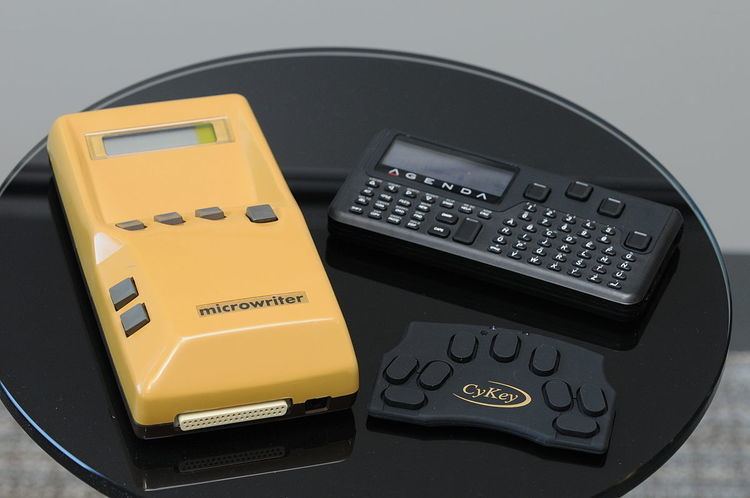
It's not Morse, but the CyKey[1] was a chording keyboard using the MicroWriter chords[2]; advantage that you can feel the keys without looking, and don't have to move your hands. The CyKey had no feedback, no click, silent operation rubbery buttons, IIRC. The CyKey use Infra Red so it would be difficult to use at night, but a similar device - five or six keys wired into an rPi could be very good for this sort of use case.
You do not even need anything special to build a capacitive pad with a Raspberry Pi Pico. Basically only an insulated pad and maybe a resistor (even though I think it is even possible to do without).
Here is an example of someone building a touch midi controller [0] with nothing more than a custom PCB and some resistors or a touch input device with varied inputs like sliders and buttons [1].
It's been working reliably for me for a few weeks now, 1 or 2 messages a night.
To be clear - I am not sending myself long emails! I am sending one or two words, like "TEMP PROB" or "MULCH" to jog my memory in the morning. And for that, it has worked flawlessly.
I would imagine that if you just had a switch connected to nowhere, in the morning you would remember what you Morse coded in any case just because it has raised your alertness
pipe that through an LLM and you will have a page full of word salad :-)
but seriously, this is a neat idea. and kudos to OP for building a full prototype -- this is the level of geekery I show up for.
I remember the days of T9 on the old Nokia phones. I was so good that I didn't have to look down at the screen.
My favorites were fixed in my phone. I knew how many down clicks on the button would land on the right friend/family member. I could literally send messages from my pocket.
And yes, I admit -- I did engage in texting while driving. And this is the part where I justify it -- "but I had eyes on the road the whole time!"
Oh! and there was old skits on late nite where people woudl compete with the old morse code guys.
Hams have privileges on 2200m, too! At those wavelengths people are using big loading coils. Saw a video last week of a guy in Alaska with a sizeable loop in the trees and was putting in about 1 KW to get 1W EIRP.
WSPR is all over the ham bands. There's people making relatively small, hydrogen filled balloons and trying to see how long they will stay alive. They're using WSPR on 20M to broadcast their telemetry (search for Traquito).
DX'ing and contesting. I enjoy making quick contacts with people all over the globe, and sometimes having to go to a map to find out where they are.
Contesting is also fun. There are a variety of modes. I got into RTTY contests lately. It's a bit of a thrill to work through a bunch of callers or to snag a rare multiplier.
I should also mention Parks on the Air. I like going to parks and within a few minutes have people calling me. Or to hunt for other people in parks. Almost like a contest and DXpedition rolled into one.
apologies, I'm ignorant when it comes to HAM but have always been interested in it: what does DX'ing and contesting mean? I'm assuming DX = talking to other HAMs, but I can't figure out what contesting would be.
Sorry... DX is short for a distance contact, so someone outside of your country. There are 340-odd "DX entities" defined, some of them incredibly rare (Bouvet Island, North Korea), and people spend their lives trying to get the ones they're missing. Other people will gather a group and raise funds to go to those places so that they get on the air.
Contesting is when there's an event, usually over a weekend with a set of rules and a point system for contacts. People get on the air and try and get the most points by making contacts. Big contests might have 10 or 20 thousand people all over the world participating and top competitors are running 2 or 3 radios simultaneously to get rates of over 400 contacts an hour. But there's also smaller contests such as QSO parties where a State tries to get people from every county on the air and people from across the country try to work them. Or silly ones like the Zombie Shuffle at the end of this month where people make up funny names and exchange them at low power, low speed Morse code just for fun. https://www.contestcalendar.com/ shows all the contests and gives you some idea of the variety.
Since some of the less popular countries tend to get active during the big contests, many DX'ers will enter contests just to find a few more.
It is cool and still gets updates. One thing to note is that almost all the information comes via a ClearSky API, so I'd often find that the data didn't line up to more official sources. Not egregiously so, but sometimes I'd go double check against sites like solarham.com or NOAA directly just to make sure (especially WRT R/S/G forecasts). Their spotting information is also super laggy, so you don't find out about how you're being spotted for around 5 minutes.
However, it is very nice looking and when I did have it up I did pay more attention to things like solar weather.


The majority of births are simple if you let them be and the midwives go to great lengths to make sure the conditions are right for a successful event. In the case of our third we hit some conditions leading up to the delivery date that disqualified us for a home birth so we seamlessly transitioned into the hospital system (where the midwife still delivered the baby)