Staking pools can be decentralized or centralized. For Eth2 to have a bright decentralized future, it's important that decentralized staking pools can emerge and thrive.
I remember when they were talking about launching PoS back in 2018. At this point it’s performing better than NASA’s SLS rocket but still significantly delayed
Despair over not talking about politics on work channels? Are they absolutely consumed with politics that they can’t focus on actual work tasks? I have worked with someone who insists on inserting a political topic or headline into every meeting and it’s distracting and exhausting
'not talking about politics' is a straw man for the actual issue. They have a list of funny names, got called out on it, and didn't like that. "politics" implies "we dont like Amy Klobuchar" or whatever, but it wasn't that.
It was about "what do we tolerate", "who do we welcome", "who are we as a company"? They didn't like their employees defining this for them, because it forced them to think things they didn't want to think about.
> They have a list of funny names, got called out on it, and didn't like that.
On the contrary, as far as I can tell (i.e., based on information released by founders and employees), they didn't object at all to being called out on it. Everybody at Basecamp, the founders included, thought the list was wrong and inappropriate.
What they did object to was the discussion being escalated to genocide and that there appear to have been employees who refused to climb down from that.
It does become impossible to have a constructive discussion, particularly about sensitive or controversial matters, when some people involved want to escalate to the most extreme position imaginable. It tends to mute other viewpoints.
that isn’t really a problem with politics though is it?
it feels like a problem with the discussions participants listening and speaking skills.
if someone immediately jumps to a negative extreme then its likely they feel quite emotionally distressed about the topic. if you notice someone is emotionally charged about a topic (either yourself or a participant) then we should seek to discover the shadow conversation that is being had. what is the true source of the emotional distress.
I don't disagree with you, but I can also see how that could become a huge problem in a workplace.
It can be pretty frustrating when people debate in this fashion about work-related matters. E.g., nowadays I find it particularly tiresome when people frame technical discussions (such as one database platform or front-end technology versus another) in moral terms. It's incredibly unhelpful.
It has the potential to be even more disruptive for non-work matters (though the original "Best names ever" discussion was very much work-related).
Still, whilst I'm not especially critical of the position DHH and JF have taken - though initially I found myself back and forth on it - I do of course wonder if a more nuanced resolution that alienated fewer people (I don't mean on twitter and other social media, which is mostly just noise: I mean at Basecamp) could have been found than something that feels like blanket ban, even though it's not really.
i would love to read an example of a technical discussion framed in moral terms. if you’ve got any off the top of your head, i’d appreciate you commenting them.
i suspect, a lot like becoming conscious of the impact the food we choose to eat has on things external to our local context (climate, animal welfare etc), technology decisions choices could be seen through such a lens.
as Frederic Bastiat wrote, there is “that which is seen and that which is not seen”.
You've honestly never heard a discussion between software developers where people label use of a particularly language, technology or technique X, "wrong", or said something like, "if you're doing Y, you're doing it wrong"? You've never seen the shade people throw at PHP?
Where do you work? Can I join?
More seriously, if you (have nothing better to do than) look through my comment history you'll find a discussion from a few weeks or months back where I chided somebody for saying (I paraphrase), "if you're patching directly in production you're doing it wrong." Granted doing so is far from ideal, and not something I've ever done with any kind of regularity, but occasionally it's the quickest way to resolve an issue whilst you follow proper process with a more involved investigation and fix.
I've found this varies a lot by company I've worked for: it doesn't happen where I work now much at all, but other companies I've worked at many technology choices are either "right" or "wrong". I just don't have the energy or patience for it these days.
ah, i took moral discussion to be code for political discussion, not actually moral (good vs bad) haha.
in that case, yes. people get dogmatic about the strangest things. depending on my level of give-a-fuck i sometimes dive in deeper, “why do you think this is bad?” etc.
sometimes theres a decent learning opp either for me, discovering a new way that something can cause problems or for them, learning to apply some nuance to their beliefs.
Absolutely. I definitely prefer for the discussion to start off dispassionately as opposed to having to drag it there, but I completely agree with you.
And that would perhaps be fair, although cryptocurrency discussions range far wider than technical concerns.
And that's quite a long way from what I'm talking about, which are technical discussions that are more day to day concerns for many software developers in the industries and types of application I've worked with (e.g., desktop software tools and web applications/services in sectors such as telecoms, life science, payment processing, retail systems, data analytics).
If that is the case, banning politics feels like the nuclear option. And regardless of the the intent I think the consequences will yield the result parent notes.
Other companies are able to handle peer conversations without making such a broad and vague category as politics taboo. Like you can enforce a code of conduct and treat speech of genocide as being in violation and issue a citation for a minor offense and terminate repeated or hard offenders. You can also enforce stricter speech standards on open channels and announcements while allowing workers to have free conversation in their own opt-in echo chambers.
Nuking all political dialogs just feels like a bad HR policy.
> You can also enforce stricter speech standards on open channels and announcements while allowing workers to have free conversation in their own opt-in echo chambers.
I think this is what the policy amounts to though, right? They're banning political discussion on their shared work Basecamp, but not anywhere else, and are even encouraging it in other private and opt-in channels, as well as employees' personal blogs, social media, etc.
And also banning any DEI initiatives, banning any and all committees, and a host of other changes that essentially boil down to "shut up and do what we tell you".
That's not actually what they've said though, is it? They're moving responsibility for DEI back into HR (they call it People Ops)[0]. I have pretty mixed feelings on HR as a company function[1] and choice of profession, but that's far from a ban on DEI initiatives.
(I don't dispute your comment that committees have been dissolved.)
> On the contrary, as far as I can tell (i.e., based on information released by founders and employees), they didn't object at all to being called out on it.
> What they did object to was the discussion being escalated to genocide and that there appear to have been employees who refused to climb down from that.
The topic brought up was the Pyramid of Hate, and I'm going to presume linking the list of names to one of the base levels of bias. DHH is the one who escalates that point to say, well this must be a fireable offense since it is on this pyramid with genocide on the top, which is really completely ignoring the point of the pyramid and not at all what employees probably said. An employee actually tries to explain this, that "dehumanizing behavior begins with very small actions". DHH ignores the point and completely unprofessionally and unethically (imagine the CEO of your company doing this) publicly shares some old chat log of the employee participating in making fun of the names, as if this employee wouldn't be aware of that and probably regretful of it.
So yes, an employee tried to explain what might be wrong with DHH's thinking and yes he did not like it at all and responded inappropriately and he was the one who wanted to "escalate to the most extreme position imaginable."
Here is the full-text from the article that described what happened:
"But Hansson went further, taking exception to the use of the pyramid of hate in a workplace discussion. He told me today that attempting to link the list of customer names to potential genocide represented a case of “catastrophizing” — one that made it impossible for any good-faith discussions to follow. Presumably, any employees who are found contributing to genocidal attitudes should be fired on the spot — and yet nobody involved seemed to think that contributing to or viewing the list was a fireable offense. If that’s the case, Hansson said, then the pyramid of hate had no place in the discussion. To him, it escalated employees’ emotions past the point of being productive.
Hansson wanted to acknowledge the situation as a failure and move on. But when employees who had been involved in the list wanted to continue talking about it, he grew exasperated. “You are the person you are complaining about,” he thought.
Employees took a different view. In a response to Hansson’s post, one employee noted that the way we treat names — especially foreign names — is deeply connected to social and racial hierarchies. Just a few weeks earlier, eight people had been killed in a shooting spree in Atlanta. Six of the victims were women of Asian descent, and their names had sometimes been mangled in press reports. (The Asian American Journalists Association responded by issuing a pronunciation guide.) The point was that dehumanizing behavior begins with very small actions, and it did not seem like too much to ask Basecamp’s founders to acknowledge that.
Hansson’s response to this employee took aback many of the workers I spoke with. He dug through old chat logs to find a time when the employee in question participated in a discussion about a customer with a funny-sounding name. Hansson posted the message — visible to the entire company — and dismissed the substance of the employee’s complaint."
I haven't seen the employees "escalation to genocide", but as I understand it, it was an employee sharing the ADL pyramid of hate -- that such attitudes such as stereotypes were foundational to further hate.
Well, obviously I can only comment based on information that's been released publicly by DHH, JF, and their employees (both current and former). What would you prefer we all evaluated the situation based on?
Some employees have been critical on social media of the policy changes. None of them has suggested that DHH or JF thought it was OK that the names list existed. Again, all available evidence suggests that nobody who is still at Basecamp or who was there formerly, including the founders, thinks the names list is OK.
What exactly are you questioning here?
Because you evidently don't know any more than I do yet, based on that same body of information, you seem willing to insinuate a much shakier conclusion though you lack the courage to state it explicitly (because I think you know that it's not backed up by any evidence). You're not adding anything to the discussion other than noise.
In theory no more or less informed than anyone else in the discussion. This is a discussion forum: we all have as much or as little right to comment here as anyone else taking part in this conversation.
> They have a list of funny names, got called out on it, and didn't like that
Not at all true - they dealt with it extensively internally, agreed it shouldn't have happened, etc. But folks kept analogizing the list of funny name to genocide.
Is this a quote that comes from somewhere? I see multiple people talking about this 'analogizing a list of funny names to genocide'.
I think its been properly debunked multiple times in the comments here to say its untrue. Just wondering where it comes from that people keep commenting it so strongly.
People making such a fuss over a list of funny names? Yes, that's office fun you wouldn't want your customers to know about, which I guess makes it a bit unprofessional. But still it's absolutely innocent fun. Whoever makes it into an existential political issue has lost it, seriously.
Yeah, I’m sure I’ve been on a few over time and yet still an inner drive towards pattern matching and spurious associations leads me to moments of light-heartedness tempered by not wanting to cause offense.
This is truly becoming an issue in the first world, soon the biggus dickus sketch from The Life of Brian will be censored not to offend Richards across the country
Making fun of ethnic names isn't 'innocent fun' when your company purports to be diverse, equal, and inclusive.
If you don't believe me, well, DHH himself agrees with this: it's a problem when you acknowledge the pyramid of hate, as he does.
What's at issue is that he acknowledges all of this, then refuses to recognize any wrongdoing, dresses down employees in public, and claims that "political talk" -- about the company, about whether these practices are correct, about whether this is an inclusive and equal place -- is banned.
The first list you posted has a bunch of "funny" East Asian names. That stuff was racist in "Sixteen Candles," there's no excuse for it in a modern workplace.
What basecamp did "represents a serious, collective, and repeated failure at Basecamp [...] counter to creating an inclusive workplace. Nobody should think that maintaining such a list is okay or sanctioned behavior here."[1]
Yes, and that's referred to a list of funny names. It's still not clear to me in what the "ground fact" (the list of funny names) is different from the links posted above.
I'll be frank- and I know that I'm risking the mistake of reading just what I want to read-, I think that those "counter to creating an inclusive workplace" and the general tone ("serious collective failure" etc.) are just nods to the social justice culture, and are meant to appease and concede some ground to the opponent. I don't think (also because it is clearly stated elsewhere in the same post) that there was anything intrinsically racist in that list, or anything that made it substantially different from those examples above. Apart from the obvious difference that these are customers, and it's not nice to secretly make fun of them.
I'm not sure where you read all this. In his post [1] DHH says:
1) that the list was a mistake and that they've learned and moved on.
2) that "I was dismayed to see the argument advanced in text and graphics on [Employee 1’s] post that this list should be considered part of a regime that eventually could lead to genocide. That's just not an appropriate or proportionate comparison to draw"
3) that "the vast majority" of the names in the list were in fact of Anglo-Saxon or white background.
So he acknowledges, apologises and de-escalates. And points out that there is nothing racial about the list. What should he have done more, or differently?
My take on what the disagreement is about is that while there is agreement that the "Best Names Ever" list was inappropriate, there is disagreement about _why_ it was inappropriate. The founders seem to think it was inappropriate because making fun of your customers behind their back is not nice, but that it was not racist. The other contingent seems to think that in addition to being disrespectful of their customers, it was also racist. That contingent feels that in order to work towards a less racist future it is important to acknowledge past acts of racism.
Two other details I find interesting:
  - In the post you linked to, DHH specifically talks about the Asian names on the list.

  - The only attributed statements I've seen from any non-founder employees are from Jane Yang.
My guess here is that Jane is Asian, that she is likely one of the most involved employees in this situation, and that she feels that the inclusion of Asian names on the list constitutes anti-Asian racism. DHH clearly disagrees about the last point. If I'm right, this is a case where a white man is telling an Asian woman that comments she believes reflect anti-Asian bias are not racist. In my observation, white men telling minorities what is and is not racist is one of the surest ways to enrage those who feel passionately about racial justice issues.
> In my observation, white men telling minorities what is and is not racist is one of the surest ways to enrage those who feel passionately about racial justice issues.
Might well be, and yet this doesn't mean the "white men" are always wrong. If the vast majority of the names in the list belong to Western whites, and only a few to Asians, does it make sense to claim the list is racist? I don't think so. And why should someone admit (and thus confirm) a non-existent but very serious moral failing, just to appease an angry employee? With all that it entails: once something has been confirmed to be a moral failing, the same judgement automatically applies to all similar instances. We're seeing where this is going.
Thanks for sharing that - I hadn't read that particular post and it's very thoughtful and well articulated, and facts there are indeed surprising, such as the vast majority of the list being Anglo-Saxon.
To your question, I think it is the consequences of closing such a discussion that he leaves unaddressed. Does the company still value your opinion? Do you matter?
I honestly think, as DHH hints, that being able to 'rehumanize' might avoid even having to ask these questions.
This all seems very absurd to me. I can't imagine working at a company where I'd even be notified if CS had kept a list of funny names, much less expect owners to weigh in, repeatedly, about the attendant moral issues.
It's unprofessional, shouldn't have been done, we're stopping it, if people recreate it that will have appropriate consequences. Done. What's the point of even mentioning this trivial thing again?
Power. The point is power. Step 1: note an issue. Step 2: show how the issue is on a direct path to genocide. Step 3: as the issue is now connected to genocides, it should never happen again. Obviously the best way to ensure that is to have someone special (or, say, a committee) in a position of power.
I'm not even saying it's a cynical play, it's extremely easy to forget to reflect on it and just think you're doing the right thing all along. The outcome is still the same though.
> I think it is the consequences of closing such a discussion that he leaves unaddressed. Does the company still value your opinion? Do you matter?
It seems he clearly proved that those opinions matter, if he recognized the mistake, recognized the validity of some of the points made, and apologised.
What I've observed in this and other well known instances of "social justice" protests (I hope it's the best neutral term to describe them) is that there seems to be no endgame accepted by the protesters. No apologies are ever accepted without an explicit or implicit transfer of power to them. An example of an explicit transfer of power is setting up some commission or bureaucratic structure where the protesters or people they trust will be enrolled; and resignations represent an implicit transfer of power (the recognized power to make someone lose their job, which is not a small one).
Compare this with normal workplace dynamics. You can complain inside your workplace for many work-related reasons (workload, bad management, pay, etc.). Your complaints can be openly discussed, legitimately rejected, or acted upon. But in any case a change in the hierarchy or in the company structure is not something you expect. It can happen (very rarely) or not, and you might be satisfied with the responses or the changes or not, and if you don't like the answers after a while you might decide to move somewhere else. You don't consider unacceptable that the company doesn't see or address your point of view. At some point the discussion ends and that's it. This is not what happens on social justice complaints, and I think it's toxic (in the workplace, but in general everywhere).
I can't really comment about other "social justice" protests because frankly I don't really care about them, but yes this absolutely is about power.
What DHH neglects to address is that he's claiming the power to silence. "we had to close down this channel" or "discussions are being moved".
I like your idea of comparing this to a normal workplace dynamic. What if you get the rare change you wanted to see, but in exchange there is a new policy: no more discussions like this? Yes, your ideas about devops or whatever were fine, we're making a change, and now please never discuss our product development process again.
At the very least, does the change you 'won' feel genuine?
I also don't get it. An NFT is basically a small piece of text on the blockchain saying that you own the thing at a given URL. It doesn't mean you have copyright over the relevant intelectual property. There's nothing stopping the URL from returning a 404 at some point. And anyone can create an nft of anything, even if they don't actually own the intelectual property.
It really is as crazy as it sounds. The closest real world analogy I've seen is that it's like the people who sell deeds for plots of land on the Moon.
As to NFTs themselves, you’ll have to understand Etherium smart contracts. This particular NFT is a Foundation NFT which implements the ERC-721 interface:
I’ll add that whilst I’ve provided a somewhat technical definition, as to the logical reason someone would pay that amount of money: no idea whatsoever.
I guess they’re hoping that these things retain and even increase in value. At some point in history we decided that ink on canvas could be immensely valuable based on scarcity (arguable also they’re nice to look at, unlike an NFT), and I’m guessing they hope the same for NFTs. I guess memes are highly recognizable works of art to some?
“as to the logical reason someone would pay that amount of money: no idea whatsoever.“
One possible motivation: they see themselves in a position to benefit from NFT trading "becoming a thing". Either because they already own stock, or they expect themselves to become extraordinarily successful in speculation, or they consider themselves future creators, or they own/run a market where they will be traded. No matter which it was, they'd have a very real interest in bootstrapping the market into existence.
Pass around ownership in an effectively zero sum series of transactions with exponentially growing price, get media attention, stop being zero sum as soon as the first outsider steps in.
Wouldn't that be fairly trivial to verify on the blockchain? I'd expect someone willing to spend millions would - or have someone - do some due diligence to confirm that the NFT they are buying is the first, unique NFT for this particular item.
I'm still a bit hazy on all this as well but I think that's the idea?
The NFT itself is basically some payload (any collection of bytes), a checksum of that payload, and some metadata. What's to stop someone from perturbing the payload by one byte and minting a second NFT? Nothing, really, other than "it's not the first". So yeah it's down to performing due diligence on the vendor and payload to make sure you aren't being snookered.
I think. I get the whole crypto aspect. I don't get the social/contract aspects.
I wonder how this compares to "limited edition" prints of classic artworks, which are also far more expensive than a "normal" print in exchange for being uniquely identifiable.
That's not what "fungible" means. The "non-fungibility" of NFTs means that each one is a unique token, it doesn't have an "exchange rate".
Fungible means "able to replace or be replaced by another identical item; mutually interchangeable," it doesn't have any meaning about the price of making a copy/reproduction/another instance.
An ordinary quarter is "fungible", if you're paying me a quarter for a piece of candy, it doesn't matter to each of us which quarter you use, they are all interchangeable. (and that doesn't mean either of us can make a copy of a quarter for free!) An ounce of gold is fungible. A bushel of the same kind of and age of wheat is fungible if you're a commodities trader.
Every bitcoin is worth the same as every other bitcoin, at any given time they have an exchange rate with other currency. That's what "fungible" means. An NFT is just a unique token on it's own, and is not worth the same as any another NFT.
(I don't actually think the market in NFT's makes any sense, not trying to explain it as something sane, just the word "fungible").
Bitcoin is technically non-fungible because the transaction history of a coin is public information (I imagine if someone got ahold of Satoshi's coins they would be worth more than regular Bitcoins -- even just in terms of sentimental value). But for most practical purposes it is basically fungible.
Sure, good clarification. And fungibility can definitely be contextual, depending on context and requirements. Fungibility is really always about "enough people think it's fungible for their purposes and have agreed to treat it as fungible, so it is."
So, if I understand correctly, it's just an evolution of the cryptocurrency itself? In the sense that instead of having a token you have an unique token? And going back to the currency analogy it just means you have a banknote with an autograph?
That sounds like people burning money. I have this vision of a large bonfire on a tranquil beach with people having soft casual conversations where that fire is burning large stacks of large denomination cash purely for aesthetics.
The owner of that address has the permission to interact with that smart contract, only he can transfer it. Basically a type of ownership written on the blockchain that is all.
There is an art market, people (dont ask me why) pay a lot of money for art and 'invest' in it, hoping things will go up. Originals have value - e.g. the original Mona Lisa will always be worth more than any copy, even if that copy was accurate down to the atomic level. Or an original banksy spray painted on a wall is worth lots of money ... if you took the exact same stencil he used, and sprayed your own version, it would be worth much less.
NFTs are an attempt to translate that into digital form. An artist will 'mint' an NFT (I think its based on a hash of the actual digital image/video whatever?) and then that 'minted' NFT is embedded in a blockchain and can be bought and sold. It is perceived to have value because its endorsed by the original artist.
Yes NFTs are weird but so is a lot of the real world art market, decades ago Yves Klein could paint a canvas pure uniform blue and people paid crazy money for that stuff.
I quite like the IKB canvases because they're outside the normal colour gamut; if you have an opportunity to see one in person you'll understand, because the colour cannot be accurately represented on screen or in a photograph. A neat trick. But I still can't see how it's worth millions.
  Alice pays Bob 500 000 USD. Alice owns Bob soul. Record checksum: 0x3345dfe3. Journal checksum: 0x3345dfe3
  Charlie pays Bob 500 USD. Charlie owns Bob meme. Record checksum: 0x1305eee5. Journal checksum: 0x995faac2
Imagine I have a bit of paper and I tell you in 3 years time, someone will want to buy this piece of paper for 10 million. I will sell it to you for 1 million now. If you believe me, it would be stupid to decline this offer.
> The would not know at that point whether the CM pilot had his spacesuit helmet on or not, so they wouldn't know until they opened the hatch whether they had just killed him.
There were windows on the command module to look in, and if they weren't sure if he was responsive/unresponsive, they could tap iron onto the command module to let Collins know they were there and spacewalking.
It's an interesting thought process though, and I would appreciate the source if you can find it
From the article, I was wrong about not knowing whether the CMP was alive:
"Unless there was a very serious issue with the CM’s communications systems, NASA would know of the CMP’s fate immediately. Every astronaut wears biomedical sensors at all times, as part of their constant-wear garment. This telemetry is sent to the flight surgeon."
"Probably the worst scenario would be for the CMP to be alive, but disabled and not in his spacesuit. There would be no way for the other astronauts to get to the CMP without depressurizing the CM, thus killing the CMP. It's an obvious choice between three astronauts stranded in lunar orbit, versus two getting home alive. Nonetheless, I can only imagine the regret that the astronaut who would have to depressurize the CM would have."
So it is even worse than the way I remembered it: the LM pilots would likely know that the CMP pilot was alive but incapacitated and they were about to kill him.
Apparently you can survive about 40 seconds in a vacuum. One option would be for one pilot to enter (as quickly as possible!) then put the CMP into a spacesuit, then re-admit the other astronaut. No clue if they could enter and re-pressurize the capsule within 30 seconds- sounds like a long-shot.
It takes about 45 minutes to don a modern spacesuit -- and that assumes the person donning the spacesuit is assisting with the process, not incapacitated.
Edit: This says it can actually be done in five minutes in an emergency if one's willing to skip every safety check, but getting an unresponsive person into one seems like surely it would be more of a challenge -- particularly if the "helper" was wearing a spacesuit himself. Those things are awfully restrictive! And I would wager it's not a scenario they practiced.
> - Help incapacitated astronaut into suit (temporarily removing own suit if necessary)
> - Once both suited up, open airlock again to admit remaining astronaut
These steps don't seem to be necessary. Since the CM can be opened from the inside towards the LM, the third astronaut could just wait in the LM and be let in that way.
I think the only question is really how quickly can you repressurize the CM.
It was basically a cone-shaped pressure vessel 3.23m tall and 3.91m wide, that's 51.71m^3 of volume. I'd estimate about 50% is taken up by machinery, so how fast can you repressurize 25m^3 to 1/3 sea level (which was apparently standard for the spacecraft)?
My guess would be it could be done pretty quickly, maybe 2 minutes?
Your insight suggests an even better solution: the spacewalking astronaut could open the internal hatch to the docked Lunar Module so its cabin air can instantly partially repressurize the Command Module
Maybe, IF the hatch can be opened when there is a pressure difference. It might be dangerous or even mechanically locked out in those cases. It may not, I have no idea.
I mean we're just guessing and spitballing here, and all of this assumes that whatever incapacitated the CMP is fixable by the other astronaut. But it does look like there may be a decent chance the CMP could survive this. Of course, he might have internal injuries or they might not be able to restart his heart. But seems like this procedure would be worth a try.
Opening the hatch was a huge pain. They'd have to disassemble the rather phallic docking mechanism (as Collins described it). Not being able to disassemble it was one of the fears Collins had about Apollo 11.
Similarly, Collins wrote a memo to the astronaut corps explaining that on the Mercury missions, if someone became incapacitated during EVA, they'd have to cut their life support cable and close the hatch and come home alone.
> Flight recorder data from the single cosmonaut outfitted with biomedical sensors showed cardiac arrest occurred within 40 seconds of pressure loss. […] The autopsies took place at Burdenko Military Hospital and found that the cause of death proper for the cosmonauts was hemorrhaging of the blood vessels in the brain, with lesser amounts of bleeding under their skin, in the inner ear, and in the nasal cavity, all of which occurred as exposure to a vacuum environment caused the oxygen and nitrogen in their bloodstreams to bubble and rupture vessels. Their blood was also found to contain heavy concentrations of lactic acid, a sign of extreme physiologic stress. Although they could have remained conscious for almost 40 seconds after decompression began, less than 20 seconds would have passed before the effects of oxygen starvation made it impossible for them to function.
I don’t know how fast they’d be able to enter and repressurize the capsule, but I suppose there’s a chance he could survive in that scenario. Though depending on why was incapacitated in the first place his chances may have even more diminished by whatever afflicted him.
According to Article 3 of GDPR, it applies to processing if any of three conditions are met:
1. Processing that takes place in the context of processors and controllers that are in the Union, regardless of whether or not the processing itself takes place in the Union.
2. Processing the data of subjects who are in the Union by controllers or processors who are not in the Union if the processing is related to offering goods or services to such subjects in the Union or the processing is related to monitoring the behavior of such subjects that takes place in the Union.
3. Processing of personal data by a controller not established in the Union, but in a place where Member State law applies by virtue of public international law.
If none of those cover an entity, that entity's processing is not covered by GDPR.
#2 would probably be the only relevant one for HN.
Is HN offering goods or services to subjects in the Union? Sure, people in the Union can access HN and even make accounts. But that might not be enough. One of the recitals for Article 3 elaborates:
> In order to determine whether such a controller or processor is offering goods or services to data subjects who are in the Union, it should be ascertained whether it is apparent that the controller or processor envisages offering services to data subjects in one or more Member States in the Union. Whereas the mere accessibility of the controller’s, processor’s or an intermediary’s website in the Union, of an email address or of other contact details, or the use of a language generally used in the third country where the controller is established, is insufficient to ascertain such intention, factors such as the use of a language or a currency generally used in one or more Member States with the possibility of ordering goods and services in that other language, or the mentioning of customers or users who are in the Union, may make it apparent that the controller envisages offering goods or services to data subjects in the Union.
Does HN envisage offering services in the Union, or is it simply a site that happens to work when accessed from the Union but was not envisaged to do so?
Another recital elaborates on the monitoring of behavior of subjects in the Union:
> In order to determine whether a processing activity can be considered to monitor the behaviour of data subjects, it should be ascertained whether natural persons are tracked on the internet including potential subsequent use of personal data processing techniques which consist of profiling a natural person, particularly in order to take decisions concerning her or him or for analysing or predicting her or his personal preferences, behaviours and attitudes.
HN seems to collect minimal data. It might not rise to the level of monitoring that would be needed to count as monitoring behaviour.
The following quotes are fairly interesting and ironic:
> Larry Page and Sergey Brin were originally pretty negative about search engines that sold ads. Appendix A in their original paper says:
>> "we expect that advertising-funded search engines will be inherently biased towards the advertisers and away from the needs of the consumers"
> and that
>> "we believe the issue of advertising causes enough mixed incentives that it is crucial to have a competitive search engine that is transparent and in the academic realm"
Wasn't this also the story of a dating site (whose name escapes me. OKCupid? PoF?)? Original owner wrote an article about how paying for a dating site is a bad idea. Money is offered, article disappears.
Why would a dating site have a 12-month plan, and why would a user of a dating site want a 12-month plan?
Not only would you hopefully want to be off the site within 12 months, as soon as you found someone compatible, you would hopefully delete the app, but you've unnecessarily paid for months you will (hopefully) never use. I don't understand why anything but month-to-month would make sense for dating, specifically.
I mean, if you are a dating app, you should be striving to get users to delete your app as fast as possible (for the right reason), not hang onto an annual subscription.
Month-to-month is just as bad. The ideal business model for a dating site, from the users' perspective, is a one-time advance payment. This puts the business into the situation where they have an incentive to get you satisfied as quickly as possible, so that they can spend as little time/money on you as possible, so that your value to them doesn't go negative from allowing you to spend too much of their time/money.
This is, as it happens, how professional matchmakers tend to charge.
> This puts the business into the situation where they have an incentive
If the payment is a one-time advance payment, I would imagine this disincentives the business to truly do their best, since they already have your money.
I would think, idealistically, maybe the best model would be an advance payment but with a money-back guarantee of say half the payment if you don't find a match through them.
Legally establishing that you don't find a match could be troublesome though, since the "couple" that actually liked each other could both claim they didn't match, get their 50% back, but you as a business would have no recourse if they got together and lived their lives happily ever after, behind your back. You don't have "rights" to their personal life together as a business.
Unless of course it was a government-run dating service that had marriage, housing, and financial records of everyone. That might work. And for many reasons it's in the best interest of the government to get as many people married as possible.
You don't need a refund. Just presume an efficient market of such companies, where the matchmakers who actually make matches have better reputations, and the ones who don't quickly go out of business. That's how most single-shot service-provider businesses work. (At least, the ones with clear success criteria. Psychics and the like never lose reputation, because there's no standard to measure their claims against.)
The one thing single-shot service-provider businesses (including professional human matchmakers) will do, though, is to calculate a quote for their service, corresponding to how much trouble they think your account is going to be for them. They don't usually bill more if it turns out to be even more of a challenge, but they do refine their quote process after each experience.
Though also, back to refunds: a refund guarantee doesn't need to be part of an explicit business-model, to be part of the effective business model. Dating sites charge people's credit cards. Large one-time charges from unknown companies you don't have an ongoing relationship with are exactly the type of thing that banks/credit-card companies are happy to do charge-backs for. Whether they offer refunds or not, the system will offer refunds for them — and kill their business by taking away its payment-processing if too many users ask for said refunds.
I’m talking about a game-theoretic dynamic that’s easily observed in real world professions (e.g. plumbers, cleaners, art conservators, etc.), and even in exactly the same industry (human professional matchmakers.) The “presumption” here isn’t really much of a stretch.
It just-so-happens that dating sites don’t currently follow this model, because an external force (Match Group) came in and explicitly chose to consolidate the market into a cartel, where 95% of “competing” dating sites are actually in collusion due to shared ownership. But there’s no reason to expect that situation to last forever, any more than there’s reason to expect the dominance of the currently-dominant social network (MySpace/Facebook/etc.) to last forever.
Actually one would expect the leverage of controlling the market to provide enough funds to pay emerging players multiple times their likely expected result of rolling the dice and trying to compete to continually fend off would be rivals. Absent interference in the market one would not be extremely shocked to see the same dominant players in social media and dating 20 years from now.
Here’s why: it assumes that the only form of power or leverage that exists is supply and demand. However there are all kinds of forms of leverage in the real world. There is legal power. Voting. Guns. Unions. Price fixing. Cultural norms. Marketing. Blackmail. All of these are forms of leverage and they are not special cases; rather, supply and demand is one special case which comprises a fraction of the total pressure on wages and prices and success or failure at any moment.
IMO the ideal business model from users' perspective could be pay-as-you-go, where you pay for each individual you want to send message to (e.g. $1.99).
There are a lot of dating sites at least in Scandinavia/central europe, where men pay per message (or usually buy message packs, it ends up being around 1€ a message IIRC).
The (mostly) men answering these messages, pretending to be women, get paid around 0.15€ per reply. And obviously writing messages where they try to prolong the conversation and turn down real life meetings or changing to other (free) messaging system "for now"
Because if you made women pay, the pool of women would shrink considerably and there would not be enough women for men to message to. Ideologies of gender equality aside, simple observation shows that dating is a women's market. Not even just with humans as biologically, women have a lot more to risk (risk of pregnancy, risks associated with being physically weaker etc.) so they choose while men present themselves and try to "woo" them. Of course not always, but it is a very stable base to build up on. If they made both sexes pay, I bet platform owners would earn a lot less as fewer messages would get exchanged overall.
... until the men who woefully find out that there aren't enough women get off the platform and find a ton of available women?
Or until the women find out that all the men are online and figure out that maybe they need to get an account too?
I mean, the numbers are still close to 1:1 so ultimately it should work out if you treat men and women equally.
If you make men pay you are only propagating stereotypes that men should always pay (and indirectly as a result) that men should get more pay, and that men should be leaders and women should be followers. Treat both equally and start we start eliminating these stereotypes. Women can and should be leaders as well in modern society, including in initiating relationships.
I mean, in cave people times, yes, men had roles and women had roles, but this is 2021, and we should be a whole lot more civilized than assuming roles based on gender, no?
Any online dating site that had the fantasy that women had to join their site to get a date would trivially and quickly be disabused of this delusion. The site is following not creating the gender dynamic this is especially true where multiple dating sites all cater to the existing dynamic.
If you're running a business things like actually pricing based on the market you've got rather than the one people idealistically wish you had start to make a lot of sense.
It might be because men unfortunately, as a group, disproportionately misbehave in these situations. Sending unwelcome dick pics, sending aggressive messages to people who don’t show any interest in them etc. I’ve wondered myself if charging us to send messages might rein in the antisocial behaviour a bit.
If you wanted to go down this route you would pay per date, otherwise what are you paying for? Sure, the algorithm may jinx it by sending you on more bad dates than you wanted, but it would get you further than just a message.
Maybe ideally yes, but that's assuming you only had the option to message them through the platform.
You could always message people for free outside the platform, considering any profile worthy of messaging probably lists enough information to find them on, say, LinkedIn or Facebook, and users likely often drop their personal websites or Instagram/Twitter IDs on their dating profiles.
Counter-intuitively this might be about hedging the incentives for the service provider - to avoid the moral hazard of pushing for indefinitely extending the subscription.
Just as you mention, successful finding a partner means as few "attempts" (apologies) as feasible, which in turn means two "lost customers" to the platform. That introduces a perverse incentive for the platform to "spoil" the dating to keep the customers. By making one long-spanning plan, the perverse incentive is lessened.
Assuming you're looking for one lifelong partner, which isn't true of everybody, is it normal to find somebody "compatible" that quickly? Without apps, I think it's common for people to go for years between serious relationships. I don't know why the timeline needs to be so compressed.
For me as a fairly awkward and introverted person, who didn't naturally generate a high volume of new social contacts, one of the things I liked about online dating was that I could make choices more like an extroverted person. I didn't have to think, holy shit, I actually met somebody I get along with, and she seems to like me, I can't afford to let this go or I'll probably be completely alone again for years until I meet the next person. Instead, I could think, this is okay, but is this person a really good match for me? Does she bring out the best in me? Are we going to have disagreements about big life things?
In other words, I could meet somebody I liked, enjoy spending time with them, and still decide not to marry them. And do that over and over again until I met somebody I was confident was a really good fit for me. Like regular people do!
Even when finally I met my wife, it didn't immediately mean the end of dating other people. She had just started dating after many years of focusing on her career. In fact, after having a big heart-to-heart over wine with a close friend one evening about how she needed to start dating again, her friend helped her install Tinder, and I was the second person she matched with. Obviously, after many years out of the dating pool, she was leery of falling for the first halfway decent guy she met, so she wanted to take her time and see what was out there and figure out what she waned. To avoid going insane while she was meeting other guys, I kept meeting new women. We didn't become exclusive until six months after we met.
I think, if I had a single friend who was starting online dating, if they were using a paid app, I would recommend a 6-month plan or 12-month plan, as a reminder that they can afford to be patient and shouldn't rush into things.
Maybe. But I would think that that also introduces a paradox of choice where you are constantly doubting the person you are currently dating, thinking that maybe there is someone that is a better fit for you.
The problem is I don't really think "fit" is an absolute thing. I think the reality is that there is a large set of people can be your best fit if you can grow together with them to be that best fit. A healthy relationship is about actually turning a local maximum into a global maximum by the function naturally and healthily changing to that effect, not assuming the function is constant and then hopping around looking for the global maximum and wondering whether you have reached it. One needs to find one of those people that they can grow with and commit to that growing, one where that local maximum is continually rising in prominence. Some degree of initial commitment and emotional investment without shopping around helps you see whether or not you can grow with that person. If growing together isn't possible, that's a big red flag and the relationship should end.
I agree with not committing after only 1 or 2 dates, but if the dates continue, I would sure hope for exclusivity a lot less than 12 months into it.
For me, doubt in my ability to know who I could be happy with rose dramatically with a little bit of experience and then fell as I accumulated more and more. Meeting more people made me more and more comfortable with my own judgment about other people and my understanding of what made me happy. I think people who find partners very early in life are very lucky in some ways, though. It's a trade-off, like so many other things. You can have X more years of experience with relationships and with yourself when you choose your partner, or you can have X more years of shared history with your partner.
I do think any doubts you can put to rest in six months or a year, the time is worth it. Couples who divorce take years to do it, and I think they're unhappy for at least half that time.
The problem is, for the _business_ the incentive is the opposite. You want the suckers who are willing to pay for your dating app to keep paying, so from a purely callous point of view you want to provide the absolute minimum benefit over the non-paying users that is required in order for them to not leave and try somewhere else. There is almost no incentive for them to _actually_ match you with someone, just string you along just enough to keep you coming back.
This is true, but I believe that the majority of users on "normal" dating sites are looking for single, long-term partners. As I understand, within the BDSM scene there are several websites including social networking sites and dedicated match making sites catering to the specifics of BDSM. I find it unlikely you'd use a "normal" dating site when you likely have pretty specific interests that likely (?) need specific UI/UX to cater to.
Just sort of overall, when your interest is in building a network, finding people to have casual sex/encounters with, a "stream of people to meet" as someone mentioned below, I think you'd want a different website/UI than these big dating sites seem to offer/encourage. That said, I've never used them, just speculating based on the ads I've seen over the years and how they paint themselves.
Dating sites that make you answer questionnaires and match based on answers are a really good way to get to know people with similar kinks and interests.
While there are specific sites for BDSM dating with more nuanced optoins, the ads for generic dating sites are all very "tame" and try to not deviate from the perceived norm too much (= "find a partner, have a happy family" type messaging)
The reason is that if you do, it's virtually impossible to get included in Ad networks and App Stores.
So you naturally see only dating ads catering to the very conservative viewer.
Example: A BDSM dating site got banned from Googles Play Store after including a background image of a simple leather whip. [1]
The incentive for the dating app is to keep you unsatisfied, but with some hope, to keep dating and failing over and over. Or I suppose the business models could be either “subscription” based where you keep using it forever or “contract” based where it’s a single fee.
I think the okcupid papers called out how free dating is better aligned with users because they wouldn’t have to compete with the natural tendency to want to make more money through ongoing subscriptions.
Of course, I know friends who are continuously dating and plan on staying that way.
That is true. At the same time this viewpoint makes me wonder, what about doctors? Isn't it in their interest to keep us sick so we keep on coming back? And the policemen and prison industry, if crime disappeared they would lose their business. And firefighters too.
Dating sites are not actually designed to help you find relationships.
They are designed to leave you constantly questioning the relationship you're in, knowing you could always find something better around the corner. They might get signups because people believe they can find a partner, but they keep customers because those people are addicted to the game of newer, "better" lovers.
It's another of many cases of businesses that claim to solve one problem, but really solve a different one that's not in the user's best interest.
I'm building a dating app, SwanLove (https://swan.love). It's still in MVP mode and centralized mode.
I'm thinking of pivoting into this kind of business model: B2B. So I make my dating app something like GitLab or WordPress. You can install it and host it yourself. You pay me every month if your users exceeds 100.
Say, you are a priest or a gym owner. You have a community. You want your people in the community (church, gym) to have a chance to find a romantic partner inside the community. Anyone who wants to register in your dating app needs to be a member of your community first (church, gym). This way, I don't even hold the data (avoiding becoming a honeypot for hackers). I just want the money (in an ethical way).
What do you think? Is this ethical business model for a dating startup?
For the centralized dating app, maybe the subscription package can help them foster their relationship. I don't know. I'm still thinking about it.
Or you can create a bounty in the dating app for someone who can introduce a wonderful person to you. Then if you get married, the dating startup gets a cut from the bounty. The problem is how you verify whether people get married or not. Can we do something like bootcamps offering ISA that can access their students' tax records?
This sounds perfectly ethical to me but it's not clear what value it provides. People who are part of the same church or gym already have the opportunity to get to know each other by being in the same physical community in the first place and don't need a website where they can interact with the same people but online. If they do want that, they're likely to just set up a Facebook group. While the obvious disadvantage there is now Facebook owns their data, but it's also free and most people are going to choose free.
Ironically, online venue for a real-world network limited to verified members of that network was what Facebook itself originally was, until they realized opening up to everyone was the difference between a novelty for college students and a multi-trillion dollar world eater.
Dating apps and websites depend on proprietary technology, network effects, economies of scale, and branding in order to lead. As such, they are very prone to becoming monopolies, and a market leader wouldn't be likely to use someone else's SaaS app. I'm just not sure there is the demand for 1000 semi-large dating apps unless tech isolationism somehow becomes the norm, and it that happens then it would include SaaS isolationism.
There are already white-label dating-site providers out there. Most of the "specialised" sites (e.g. uniform-wearers, "professionals") are running on them.
Yes, aspiring monogamists will fit your bill of people who "want to be off the site in 12 months" or sooner. That's one segment of your users, but it really isn't everyone by a long shot.
Plenty of users are signing up for the chance to meet ("get to know") a steady stream of people. We don't stigmatize people who subscribe to Netflix for many years so that they can keep watching different movies and shows. There's some segment of the dating-site world that has more of a Netflix model in mind.
> There's some segment of the dating-site world that has more of a Netflix model in mind
Although I'm sure those users exist, I'm sure they aren't the majority of the world, who would rather just be happily married and get on with life? And even if not, these users who have different expectations should not be matching with the former.
> And even if not, these users who have different expectations should not be matching with the former.
Actually, given the extreme social stigma worldwide (even in the most progressive western countries) against casual hookups and low-commitment dating, people looking for "more of a Netflix model" will still gravitate towards the same sites ostensibly servicing those "who would rather just be happily married and get on with life"[0], because these services offer the widest choice of possible partners, while giving everyone plausible deniability.
--
[0] - I think that, given aforementioned stigma, it's even hard to estimate how many people in a given age bracket want this, and how many just say they want this, because it's the only accepted thing to say out loud.
Bumble has a feature where you can indicate what you’re looking for, options are “something casual”, “don’t know yet”, “relationship” and “marriage”. You can also filter for this.
From experience: very few people have “something casual” set, but I know from female friends that there’s plenty of guys with “don’t know” or “relationship” set despite looking for something casual.
Those users don't have to be a majority to be money makers for the companies that put out the sites.
And even amongst people who want to settle down, a fair share of them probably also wanna do a fair amount of looking around in their late teens through some point in their 20s, and maybe even early 30s.
The cost of 12 months of a dating site is trivial compared to the benefits of finding the right person. If someone offered you a soulmate if you gave them a couple hundred dollars, you'd take it in a second, right? Paying ahead actually aligns your incentives better, because the site is no longer incentivized to drag you along single month after month to keep you paying.
This is bordering on logic like the following:
- Water is really important, why don't you buy this $100 bottle of water.
- The site has an incentive to improve your dating outcomes. No, it's primary objective is to maximise revenue, everything else is a side effect.
- Paying more for something means someone will commit/ follow through, somehow raise incentives. This is just a guess, not supported or disproven by reality.
I like to think defensively especially when it involves companies. What are they doing, and what do they stand to achieve?
These apps have not shown any value to their users, paywall their content and have an aggressive-long-term subscription model because they have optimised themselves straight into the garbage can, by thinking short term.
Effectively, you're not paying for "12 months" despite the label, you're paying for a significant chance at finding a soulmate? If that's the case, why not label it as such?
Kind of related: one of the dating platforms in Germany advertises with "every 10 minutes a single falls in love on XYZ" ... 1 year / 10 minutes = 52560 ... that's a pretty bad success rate for a platform that supposedly has millions of users.
The big spenders on dating sites are the ones there just to screw around. That's why they all mostly become toxic hell holes, because the economics incentivize catering to those assholes
If a dating platform fulfills its promise i.e. offers users only the best date with whom the user could potentially have a long-term relationship then the user gains but the platform would soon run out of the users(Chicken-and-Egg is most prevalent in dating platforms).
So these platforms are only optimized for - Choice overload, Doom scrolling based on physical attractiveness.
you described one user profile of a half dozen use cases of dating apps
no dating app is actually designed for that one use case, just like Cosmopolitan magazine, they are built on frustration and doing counterintuitive things designed for never reaching that kind of user's goal
Serial daters. Plenty of guys just using these apps for one-timer hookups or FWB. They stick around for a month then onto the next branch like a damn monkey.
I find there are mixed incentives. An evil paid dating site might try scammy things to get you to sign up. Some site I tried did this. Free to sign up and immediately got "too good to be true" matches that you could only access if you paid. But conversely, free sites I get lots clear predators either only looking for sex or scammers trying to get money. OTOH my experience on an actual paid site ($150-$400 a year) no free sign up, is that nearly everyone is seriously looking for long term relationship.
Or, maybe, "Everybody is altruistic until they have shareholders."
The idea that companies should only be beholden to shareholders that has taken firm hold over the past 50(+/-) years doesn't look to be a good one, in hindsight.
"It is not from the benevolence of the butcher, the brewer, or the baker that we expect our dinner, but from their regard to their own interest." - Adam Smith, 1776
I think Friedman's ideas are substantially different.
The quote from Smith is discussing tradesmen running a business in their own self interest.
In some ways, Friedman's point is the opposite. That the laborers perform in the self interest of the owner.
I don't know the full context of the Smith quote. I did a bit of digging for Smith's views on publicly traded companies, and came across this quote[0]:
>The directors of such [joint-stock] companies, however, being the managers rather of other people's money than of their own, it cannot well be expected, that they should watch over it with the same anxious vigilance with which the partners in a private copartnery frequently watch over their own.... Negligence and profusion, therefore, must always prevail, more or less, in the management of the affairs of such a company.
Surely that’s exactly the same thing Friedmam was saying. According to Friedman managers spending company money on social causes are spending other people’s money, the same phrase Smith used, when they had no business doing so. In saying that the firms responsibility is to its owners, Friedman was addressing precisely the concern that Smith was worried about.
Of course in Smith’s time joint stock companies were a relative novelty. We have a lot more experience of them now and have developed standards, checks and balances to try to maintain discipline in managers in the intervening centuries. Friedman was simply attempting to bolster that effort, but Smith was writing about exactly the same concern.
As it happens while I’m a big fan of both men, on this issue I think Friedman is too much of a purist. Some social spending can just be good business. It promotes the brand, buys political friends and can even reap commercial benefits down the line. Donating or subsidising computers in schools for a company like Apple for example.
The butcher and baker a) have to understand what it takes to produce quality meats and breads and b) stand face to face with the customer, so they have both professional and reputational stakes in the game. Their stakeholder brothers and sisters may or may not have the same knowledge or reputational risk, and so their self-interested measures may correlate more with what puts money in their pockets in the short term than what makes the business viable over the long term.
Shareholders don’t care about the reputation or quality of service of the company? That seems a stretch.
As I’ve commented elsewhere I don’t entirely agree with Friedman because I think some social spending can make commercial sense for a company, but I think what he’s saying is just a pretty direct refinement of the exact same points Smith made.
> Shareholders don’t care about the reputation or quality of service of the company? That seems a stretch.
Not a stretch at all. Proven time and time again that shareholders focus on short term gains over long term.
When hired CEOs pay is tied to equity (i.e. shareholder) they make decisions based on how it affects the share price during their tenure, not after. GM after Jack Welch left is a good example.
Shareholders can sell their shares anytime. They care about the horse winning current race more than the next because they can bet on another horse next time. So they only care about the horse as long as they are betting for it.
Given the hundreds of thousands of listed companies you can find examples of anything, but there's nothing inevitable about companies being run purely for short term concerns. Not every company is run that way, shareholder theory or no. Plenty of listed companies are capable of extremely long term investments.
The drive for the short term is one possible strategy and outcome, that's all. In a competitive environment sometimes it even makes sense. Even when it doesn't the existence of failure modes in a system doesn't invalidate the entire system. All systems have failure modes, they need to be evaluated as a whole.
> Shareholders don’t care about the reputation or quality of service of the company? That seems a stretch.
It is a stretch beyond what I am arguing. On the other hand, I don't think it is a stretch to say that you are arguing that every shareholder has quality and reputation concerns indistinguishable from that of the direct proprietor. I claim that that is what would be necessary for Friedman and Smith to be saying the same thing.
Smith had very few good things to say of joint-stock (shareholder-owned) corporations. They were comparatively scarce at the time. Most businesses of his time, including the "baker and butcher" line you quite, were sole proprietorships or family-owned and operated.
The interests he writes of are those of the butcher and baker to themselves. Not to their shareholders.
"Shareholder value" is a recent error attributed to Milton Friedman.
Psychology studies in the past showed people were altruistic. Then psychologist accounted for social capital/good will and worked to remove it from their altruism tests. People stopped being overly altruistic when it stopped benefitting them, likely meaning that what we see as altruism is really a failure to account for all the benefits a person expects to gain and all the negatives they expect to avoid when choosing to perform a certain action.
As for shareholders, I think that comes down to the incentive to avoid the negative outcome of being replaced. Those at the top optimize their actions to avoid being replaced which filters down through each level until it effects every level of a company. There is some variety that results from how a company chooses who to promote, but that is still an outcome of not wanting to be replaced. Promote people who you think will strengthen your own position and not those who will weaken it. This ends up being the primordial pool that spawns corporate culture.
The concept of altruism does not require it to be "pure" or entirely selfless. Altruism can have benefits but those benefits can exist outside of economy and into the realm of the personal, spiritual, social, etc.
In other words, that doesn't disprove altruism so much as it proves that economic self-interest is not our only motivator.
It's not some idea that came about from a vacuum. Put yourself in an investors shoes: you may have some investments that you do for the sake of charity or philanthropy, however, the majority of your investments are to increase your investment. It isn't surprising then, following this basic premise, that we have arrived at the current situation. Capitalism factors in greed for the general welfare of the most people. It just seems that we underestimated the upper bound of human greed.
It's not so much an underestimation as it is a systematic breakdown of constraints and personal responsibility for owners/directors of large corporations.
Sure there is. I don't know which motivation you'd have to bribe someone to promite your product, though. Would also be hard to sustain if intellectual property was decommodified.
Other, more pressing concerns have to be addressed, though.
Consider firms which are wholly owned by either 1) every single employee (worker-owned firm), 2) every employee and every customer who opts in (consumer co-op), or 3) literally every citizen of a government (publicly owned).
You own it in partnership with the other people who own it.
This is, in the strictest definition, the socialism that people are so scared of.
How much control do you have over the military of your government? Or even the DMV? Are these organizations behaving directly as a response to the majority will of the people? If not, how do you solve that problem before you add more organizations?
The best answer we have today, IMO, in terms of ethics of freedom and agency, is "representative democracy," which may be extended to "liquid democracy" to bridge the gap between small, direct-democracy-capable organizations and large, unwieldy ones.
Unfortunately, no solution will be perfect, but that doesn't mean some aren't better than others. The problem is in essence unsolvable. Politics and civilization is an exercise in minimizing harm rather than eliminating it, maximizing utility rather than spiking it.
I don't know how but I do know it is much harder to make something everyone involved thinks impossible than to make something everyone thought they already had.
Perhaps the problem is as simple as setting up a forum with sub forums for every government official - then throw money at it until it works.
In the sense first and foremost that you may produce and design it, especially if production is structured in a co-op way, in the sense that you use it, especially if it's a consumer/worker co-op but also in a worker co-op, and to a lesser extent in that you are part of the society which produces it.
because there aren't luxuries in that system. that creates a need, and from it a secondary market, which without titles[1], sees the exchange of power either via favors exchange or plain tribalism. bribery then becomes the norm for the influential, even if actual money doesn't change hand, favors and contraband do.
1: a catch all to include both money, 'quota cards' and the likes
Socialism, like capitalism, also has a zero day vulnerability by the name of mundane old “human corruption” that undermines its goals. Capitalism just works better because it pits people against each other, keeping the focus off authority and top level control.
People thought of this issue since 1870 and the solution they came up with is simply non-transferable rationing devices. In traditional Marxist terms this was labour vouchers but nowadays there are much better solutions. Marx himself wrote about this, in terms of primitive accumulation in socialism.
For sure there are a lot of issues, but this isn't one of them.
You could in theory have bribery in material terms, but this is much easier to trace than in money terms.
My argument was with the idea that money will be gone as a rationing device. You can come up with alternatives but it’s the human nature that is the problem not the technology we use to ration resources. Let me know when this bug is fixed.
Well, that's not the problem we were talking about, is it? We were talking about the issue of bribery, which is made possible by the fungible nature of money.
I didn’t respond to the bribery comment I responded to the patch comment saying to let me know when scarcity is solved. I think it may be you who has added a step there, friend.
Any device that is used to ration is money though, there are other means to ration (the three we learn in Econ are beauty, brute force and first come first serve) but any device is by definition money since money is just a rationing device.
No, modes of rationing and discovering preferential subjective values are necessary. That does not imply what is meant with money, which is infinitely durable, portable, fungible and uniform.
Already rationing systems which do not fit the definition of money are being employed. For example in the post-pandemic period the PBoC has issued consumption tokens with an expiration date.
You are simply confusing the idea of a scarce token with money. Money is in the former category but the former category is not money. The necessary function is to translate consumer preferences into numeric terms. For this fungibility and durability is not necessary.
I assume that this criticism is offered in good faith, and that you're in need of good, solid Wiki articles about the tens of millions of victims of Communist regimes--well, I'm happy to get you started!
Here's an article about the Soviet terror-famine (known as the Holodomor) which killed 4 million Ukranians. No worrisome notifications on this article, so I assume it meets your rigorous standards:
And here's one about the so-called 'Great Leap Forward', when the Chinese Communist Party's top-down modernization plans resulted in the accidental deaths of ~50 million human beings.
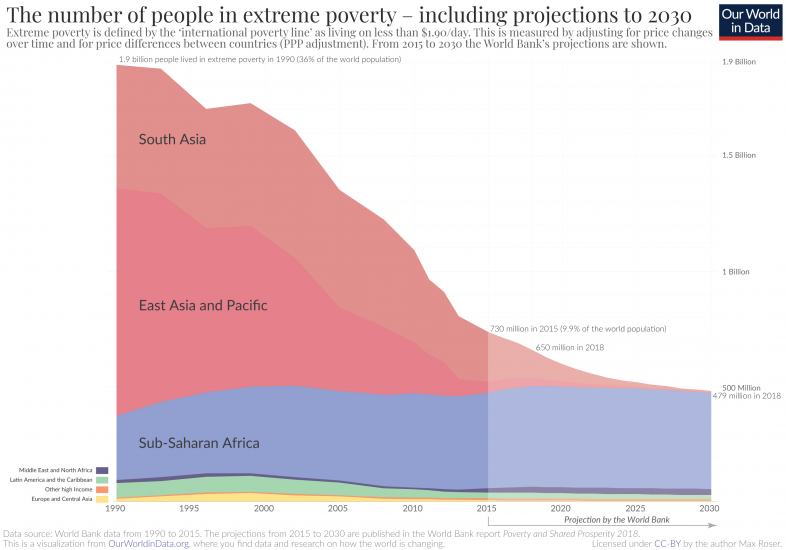
The fact that Capitalism has not (yet) solved the global issue of extreme poverty is hardly an argument against it. Particularly when it is the transition to capitalism which has done the most to solve the problem!
After all, it's a simple matter of fact that the accelerating decline of global poverty since 1990 was the result of the transition to capitalism in formerly Communist/Socialist countries in Asia, including the CCP's own particular flavor of state capitalism.[0]
I think comparing Capitalism and Socialism is a red herring. There is no "pure" Capitalism nor pure Socialism.
There are only countries with specific sets of laws governing them. The question is which system of laws is better and why and when and most importantly: Better for WHO?
Arguing that capitalism is the solution is like saying: Don't look here, we are better than socialist countries and therefore there is no need to improve anything in our country. Same for the other side too.
I'm not denying or excusing that historical atrocities occurred under socialist governments, but for perspective one should also look at the myriad atrocities that were and continue to be committed under capitalist governments. That doesn't excuse such actions, but neither side is innocent. I suggest reading The Wretched of the Earth* Chapter 1, "On Violence".
* Though I will object that it is unfair to attribute the actions of the Khmer Rouge to socialism. Like the Nazis they were socialist in name only, and in fact were supported by the United States in their war against the Socialist Republic of Vietnam.
The issue is that these atrocities were committed more specifically as a result of communism, whereas other attrocities are less closely attributable to capitalism since it has been the majority default throughout history.
EDIT:. I'm not saying what's normal is ok, I'm saying what's common is more likely to falsely correlate with anything. Whereas as the common factor for communism across the board has been a high statistical propensity for mass murder and genocide. This includes the nazi regime I might add (look it up)
I'm not really interested in having this argument anymore, but I'll leave you with this:
Just because something is the "default" option doesn't mean it is non-ideological. Ideology is a powerful tool for shaping people's actions. People will go along with insane and sometimes horrifying things just because they perceive them as "normal". Maybe expose yourself to some alternative ideology. You don't have to agree with it to learn something.
That's ahistorical considering almost all deaths attributed to communism were a result of industrialization, a process which was just as deadly under capitalism.
The only difference as a result of ideology was the timeframe. The USSR was forced to rapidly industrialize due to global pressure from foreign militaries and famines in China were exceedingly common long before communism.
History is not as simple as you're making it out to be.
Aside from the fact that mismanagement is not unique to communism, there have been many famines under capitalism.
I'm not a maoist, so I'm not about to defend his ineptitude, but it seems intellectually lazy to point to these problems as unique. In the 18th, 19th and 20th century, depending on what level of development a country was in, these problems were widespread across all ideologies.
Not unique, but some truly terrible leaders were inspired by Marxism in the 20th century. I'm not sure what the selling point is supposed to be if the rebuttal is that bad things happen under capitalism too.
That is the same thing as saying North Korea's failures are actually due to democracy. "The Democratic People's Republic of Korea"
Obviously the name of an organization doesn't mean jack compared to their actually implemented and enforced policies. The first things the Nazi's did when they gained power was kill all the socialists, communists, and unionists. They are anything but socialist.
This is a common rewriting of history in the last few years. Hitlers speeches are rife with rants against capitalism:
"We are socialists. We are the enemies of today’s capitalist system of exploitation … and we are determined to destroy this system under all conditions.”
~ Hitler
Literally the point you are replying to is that you can't take fascists at their word. You have to use their actions.
Communists were among the first inhabitants of Hitler's concentration camps. The Communist Part of Germany started the organization Antifaschistische Aktion, the direct precursor of what we now know as Antifa.
And please stop equating "anti-capitalist" and "communist". The two are not the same or even close.
Slavery is not a function of capitalism, though. Capitalism is being able to 1) firstly, own yourself and your body 2) thus sell your labour however you wish. It's the alternatives economic systems that prevent you from being free.
Putting emotions aside for a second, slavery is very inefficient in a free market. It is not a coincidence free countries are all capitalist (and vice versa).
When did markets cause famine? We are living in an age of wasted food because we have so much cheap crap (as well as high-quality) available. People are too fat because there's no barrier to over-consumption.
Whereas a socialist system causes famines due to central planning leads to poor decision making.
How would socialism have dealt with the first scenario? My understanding is there simply wasn't enough food to go around, and no economic system can fix that. Capitalism at least provides a profit motive to solve the problem (eventually).
The Bengal famine was a top down project specifically designed to profit. There is no "free market capitalism" in that scenario.
Oh yeah. The US is guilty as charged, but there's no such thing as a free country that's not capitalist, until we live in a post-scarcity society. Technologically we are many centuries away from that.
At this point, the snide dismissal of all things advertising is nothing short of boring.
To be sure there are many forms of advertising annoyance: auto-playing sound/video, remarketing (or what I like to call advertising a product I've already bought), interstitials, popups (to be fair, there are many non-advertising forms of these eg "sign up to our newsletter" dialogs) and so on.
But what made Google a money-printing machine is that search advertising is actually largely aligned with the interests of the user. That is, just by searching for something the user has shown an intent that other advertising doesn't have (where generally it's just attention thievery). Imagine I search for "how do I sleep on an airplane". Isn't a neck travel pillow an appropriate result here?
I get that it's popular to just hate on all advertising but that's just shallow.
As long as search results are marked as ads when they are ads and paying for ads doesn't improve your organic search ranking (aka the Yelp business model) then I'm completely fine with it.
There is a lot of crap in search results and this is a constant battle of whack-a-mole. At one point it was content farms. As someone who has search for a lot of home furnishing stuff recently I can tell you a big problem is affiliate link blogspam. There'll be some real-sounding domain like mattressreviews.com but it becomes pretty clear it's just mass-produced "content" to justify affiliate links.
Honestly, this will probably get to the point (I hope) where Google does the same thing it did to content farms and starts downranking sites with affiliate links (cough Pinterest cough).
> "Imagine I search for "how do I sleep on an airplane". Isn't a neck travel pillow an appropriate result here?"
No?
I mean, seen through the lens of extractive capitalism where "how do I X" is the same as "what product do I buy to do X", and "someone asking about X" is the same as "which product to shove in their face to make them stop asking and extract the most money out of them", maybe yes. Doesn't "information technology" suggest some alternatives? Like, information about sleeping in planes - noise reduction, positions people have found comfortable, stress reduction, light pollution, circadian rhythms, stretches that can be done in a small space or sitting down, etc?
> "As someone who has search for a lot of home furnishing stuff recently I can tell you a big problem is affiliate link blogspam. There'll be some real-sounding domain like mattressreviews.com but it becomes pretty clear it's just mass-produced "content" to justify affiliate links."
This seems to fly in the face of your previous paragraphs: you searched for home furnishing stuff, isn't some generic advertising of a mattress an appropriate result here? You want something better than that for yourself, but think other people don't deserve better and are shallow for complaining?
We know that paid advertising works, so it should not surprise us to discover that paid advertising on the Internet also works. But Google and other search engines seek to organize the world's information, not the world's commercial products and services. For a multi-multi-billion dollar company's core product, I'm somewhat surprised they cannot do a better job killing the blogspam. Given the resources at their disposal, I think most people just assume that they don't care about the blogspam.
"We know that paid advertising works" [citation needed]
I mean, the ad business of course likes to throw various metrics around. But as far as I'm aware there are no proper randomized controlled trials that show statistically significant positive ROI of online advertising versus no online advertising.
I mean, it would be really simple to do, right? To provide conclusive proof of the efficiency of ads? Pick a populous state in the US where people enjoy Soft Drink X. Randomly divide the households in the state into two groups. For the next full year, run normal amount of targeted online ads for Soft Drink X in Group 1, no targeted online ads whatsoever in Group 2. Did the sales in Group 2 decrease by more than what the cost of advertising to that group would be, yes or no?
1) Google is running many parallel ad campaigns, which may target the same individuals. This in some ways gives opportunities, because one can run 'natural experiments' on the effeciveness of advertising for X by simply selecting the people who never saw the ad for X. But there is also probably some legal peril; Google has to be careful about what promises it makes to people purchasing ads.
2) Google has very little incentive to release the results of any such studies, because -- whether or not advertising works -- they don't need their customers to have accurate side-info about the value of advertising.
Advertising has been about what 2? 5? percent of US GDP for more than one hundred years. The odds of advertising naysayers are probably infinitesimal at this point.
This is a thoughtful post. However, the issue is that these advertisements play into your hopes and fears to maximize the likelihood of getting a click from you. The fact that Google (especially) and other adtech companies are playing into your hopes and fears, by microtargeting and hoarding the most private and intimate details about your life is abusive.
I have to say that I am lucky that I have a print-related disability, because I almost never need to go websites with ads.
Services I get access to (no-ads):
* 975,000+ books for $50/year (Bookshare.org)
* 60,000+ professionally narrated audio books for free (US National Library Service)
* 80,000+ volunteer narrated audio books for $135/year (LearningAlly.org)
* Hundreds of Newspapers and Magazines for free (NFB Newsline)
* 99% of the books posted on OpenLibrary.org for free (even books currently "borrowed")
* Virtually all libraries for print-related disabilities around the world (sometimes free, sometimes paid) (I can get books in foreign languages easily)
Additionally, I use the paid audio apps Blinkist, Audm, and Curio, which everyone has access to. I find them to be super helpful. Blinkist in particular is almost 100% of the time a YouTube and TED talk replacement for me. I also use The Economist app, which has the entire weekly edition professionally narrated, along with the vast majority of the rest of its material.
My main problem with advertising and the technologies surround it, aside from the obvious privacy issues and their misuse, is that it seems to suck all the air out of the room.
The birth and dominance of the online advertising business model looks to be the greatest misallocation of engineering talent in the history of humanity.
This is a bit how I feel about advertising in general. Human beings' time is being taken and mouths are being fed not to increase overall output, and thus lifting the overall well being of members of society. Instead, Company A hires advertisers to convince the public to buy their product instead of a competing product to Company B. Value is created for Company A, but entirely at the expense of Company B. At no time in the economic... chain?... of events that is advertising is anything actually created, yet vast sums of money, and thus allocation of resources, is put here. It seems INSANELY wasteful.
>At no time in the economic... chain?... of events that is advertising is anything actually created, yet vast sums of money, and thus allocation of resources, is put here. It seems INSANELY wasteful.
You're forgetting something, companies start off completely unknown. How did they reach the point where the market has been fully saturated and the only real way to gain more customers is to take them from someone else? Oh right, it's because advertising increased the grow rate of your company to the point where there is barely any growth left.
Let's manufacture a completely artificial scenario to illustrate my point:
Person A: So, you're telling me you spent $5 billion on advertising and all you have to show for it is a 5% higher market share than your biggest competitor?
Founder: Yes, we used the advertising budget to grow our market share from less than 1% to 40%. Our next biggest competitor has a 35% market share.
Right, but there's a difference between connecting a business to a customer who wants the product (which is good!) and influencing the wants and needs of the customer, particularly against the long-term interests of the customer (which is bad).
[I think it's impossible to try and succeed at connecting people with businesses without somewhat influencing their wants and needs, but ideally we limit that.]
Modern ad tech is problematic because it has little regard for people's long-term interest and demonstrably affects people's wants, particularly in the context of searching and automatically-curated feeds: since the internet is so absurdly vast and searches/feeds are the windows to the world, you can partially control the reality in which users live.
but the advertising industry has almost alone managed to produce google. That's a trillion dollar company that has literally changed the world.
Some perspective is needed. What looks like an evil industry of insane waste is at the end of the day subsidising our most important tools for business, communicating, and relaxing. All thanks to the vast allocations of resources and money into advertising.
I agree with your point that there is a need for advertisements to inform consumers about available options. I'd generally fall in the "dismissal of all things advertising" box, but I would add a nuance to it that it really depends if it was requested vs. forced upon you.
In both instances you mention as being useful advertising, shopping for furniture or how to sleep on an airplane, you are asking for advertisements. That makes sense. You are looking to solve a problem by purchasing a product.
From my perspective, there are two issues with the current climate of ads: First, that the overwhelming majority of ads are forced upon you. They track you, distract you, and have generally turned the internet into a wasteland. Second, that a search engine/social network/news site is the place to view ads. I would prefer a site dedicated to this use case, not have the use case tacked on to unrelated sites constantly in the way.
I feel the same way about physical ads, too. I don't want uninvited people knocking on my door to sell me their ISP. I don't want those terrible mailers with coupons in them. Billboards are ugly and distracting.
> Imagine I search for "how do I sleep on an airplane". Isn't a neck travel pillow an appropriate result here?
Yes, but advertising doesn't do that. They do retargeting and only show you the most valuable ad for what they know about you. Sometimes that ad is just what the advertiser has paid to show you in particular, like "you left something in your Amazon cart".
> But what made Google a money-printing machine is that search advertising is actually largely aligned with the interests of the user. That is, just by searching for something the user has shown an intent that other advertising doesn't have (where generally it's just attention thievery). Imagine I search for "how do I sleep on an airplane". Isn't a neck travel pillow an appropriate result here?
This doesn't hold water. It's just being shown because someone paid for it to be, not because it's the best thing to be shown which is what algorithms would be tuned for if they were in the users interest.
> I get that it's popular to just hate on all advertising but that's just shallow.
That's pretty dismissive of all the thought that has gone into criticism of advertising and it's effects on products and services, without even giving a hint of an argument as to why you feel it's shallow.
> This doesn't hold water. It's just being shown because someone paid for it to be, not because it's the best thing to be shown which is what algorithms would be tuned for if they were in the users interest.
You are factually incorrect and this is part of the problem: a lot of proselytizing (and, honestly, virtue-signaling) by people who don't know how advertising actually works.
Display advertising works on a CPM basis (ie paying for the impression) so yes, that's pretty much a case of someone paying to show the ad and that's it. They may be paying for that based on contextual information (eg RTB) or not.
But search advertising, at least how Google does it, it sold on a CPC basis (ie paying for the click not the impression). This actually means Google is motivated to show you the search ads you're most likely to click on because that's some revenue vs just who bid the most.
> That's pretty dismissive of all the thought that has gone into criticism of advertising...
No offense but if you don't know how search advertising works at the highest level then either you haven't put much thought into it or you're simply parroting someone else (who also hasn't) because it fits your world view.
> "how do I sleep on an airplane". Isn't a neck travel pillow an appropriate result here?
Late to the party, but I want to say here the answer is "maybe". However, the idea that the solution to every problem or need is to buy something is pretty regressive and is kind of at the core of the problem with consumerism and rapacious capitalism.
For a person to buy something, that something has to have been manufactured, shipped, sold, shipped again, etc. All that is extractive and depends on externalities that are too-often finite.
Also, the person buying has to have money, which they made through some kind exchange for labor, possibly fairly, possibly not. For capitalism, incentivizing people to treat a want or need as an opportunity for a financial transaction is essential, even when there are other solutions. Remember, for example, that the Listerine company essentially "invented" bad breath as a problem requiring a product to solve. Not that people didn't legit deal with bad breath before, just that they weren't sold a pre-packaged "cure".
So the question "how do I sleep on an airplane" has many answers other than "buy something".
I don't see targeted search advertising as user friendly. A search engine should return the most valid results. As soon as you have sponsored results, there's a conflict of interest. What if the competitor to the neck pillow ad people actually have a better pillow? They should be the first result, but won't be since Google's interest is in helping advertisers, not the users of their search engine.
I don't think there's an argument where advertising is pro-user, since a service that focused on the user would return the best results for a search, not who paid for placement.
Systems work in funny and unexpected ways. When they started their company Brin and Page may have truly believed they could go in the non-profit direction. But the forces at play in late capitalism worked inexorably to extract value, and little by little, possibly before they realized it, Brin and Page were no longer in control of what they created.
I think this is largely misunderstood about Google. It seems like ads placed in search results only accounts for a small portion of their revenue. Not sure how much the targeting of ads by analyzing your search history actually contributes either. I think Google just figured out how to scale online ad sales really well.
It seems like ads placed in search results only accounts for a small portion of their revenue.
Do you have a source for that? Last time I checked (which granted was some years ago) my understanding was that over 90% of their revenue came from advertising, and I think most of that was driven by search results.
"Currently most search engine development has gone on at companies with little publication of technical details. This causes search engine technology to remain largely a black art and to be advertising oriented (see Section ?). With Google, we have a strong goal to push more development and understanding into the academic realm."
They never delivered on this "strong goal" to make web search an academic endeavour.
They managed to domainate web search but the endeavour is now 100% commercial. It is intentionally nontransparent (due to commercial incentives) and remains a "black art". Don't try this at home.
"Also, it is interesting to note that metadata efforts have largely failed with web search engines, because any text on the page which is not directly represented to the user is abused to "spam" search engines. There are even numerous companies which specialize in manipulating search engines for profit."
"Appendix A: Advertising and Mixed Motives
Currently, the predominant business model for commercial search engines is advertising. The goals of the advertising business model do not always correspond to providing quality search to users. For example, in our prototype search engine the top result for cellular phone is "The Effect of Cellular Phone Use Upon Driver Attention", a study which explains in great detail the distractions and risk associated with conversing on a cell phone while driving. This search result came up first because of its high importance as judged by the PageRank algorithm, an approximation of citation importance on the web [Page, 98]. It is clear that a search engine which was taking money for showing cellular phone ads would have difficulty justifying the page that our system returned to its paying advertisers. For this type of reason and historical experience with other media [Bagdikian 83], we expect that advertising funded search engines will be inherently biased towards the advertisers and away from the needs of the consumers. Since it is very difficult even for experts to evaluate search engines, search engine bias is particularly insidious. A good example was OpenText, which was reported to be selling companies the right to be listed at the top of the search results for particular queries. This type of bias is much more insidious than advertising, because it is not clear who "deserves" to be there, and who is willing to pay money to be listed. This business model resulted in an uproar, and OpenText has ceased to be a viable search engine. But less blatant bias are likely to be tolerated by the market. For example, a search engine could add a small factor to search results from "friendly" companies, and subtract a factor from results from competitors. This type of bias is very difficult to detect but could still have a significant effect on the market. Furthermore, advertising income often provides an incentive to provide poor quality search results. For example, we noticed a major search engine would not return a large airline's home page when the airline's name was given as a query. It so happened that the airline had placed an expensive ad, linked to the query that was its name. A better search engine would not have required this ad, and possibly resulted in the loss of the revenue from the airline. In general, it could be argued from the consumer point of view that the better the search engine is, the fewer advertisements will be needed for the consumer to find what they want. This of course erodes the advertising supported business model of the existing search engines. However, there will always be money from advertisers who want a customer to switch products, or have something that is genuinely new. But we believe the issue of advertising causes enough mixed incentives that it is crucial to have a competitive search engine that is transparent and in the academic realm."