All the recent politically oriented attacks on Bitcoin are completely devoid of logical analysis and steeped in establishment dogma. They use name calling tactics like "play money" and "beenie babies fad" and scare tactics like "bubble" and "cesspool of criminal activity".
What none of these arguments ever address is the massive gains in economic efficiency that Bitcoin can clearly provide. It cuts out parasitic elements of the financial system that have grown like a giant parasite over the entire society.
The author claims that Bitcoin is steeped in nerd paternalism, but what about the epic paternalism of banks and regulators? Paternalism is their entire argument against Bitcoin, which basically amounts to "if people gain economic freedom, they will hurt themselves".
>They use name calling tactics... It cuts out parasitic elements of the financial system that have grown like a giant parasite over the entire society.
I like your style, calling out the other side for using biased and loaded vocabulary and then you turn around and do exactly the same.
As the original article states, what some people view as a parasite on the system some people view as necessarily regulation and consumer protection. Just look at one of the other Coinbase stories currently on the front page [1]. Due to a mistake by Coinbase a customer was potentially looking at a loss in the five figures USD. The point of regulation is to make sure things like that don't happen and to have a course of action to correct them if they do happen. It isn't about "if people gain economic freedom, they will hurt themselves". It is about "if people gain too much economic freedom, they will hurt others".
Banking is the most heavily regulated industry there is. Regulators have offices inside banks, yet it didn't prevent 2008, HSBC and every other billion-dollar scandal.
Protections systems failing isn't a reason to completely get rid of them, it is a reason to reform them.
Using an analogy that has been mentioned elsewhere in this thread, think of your front door lock and your home. Would you get ride of all locks because someone robbed your house? Or would you invest in some other type of lock and security that might not have the same vulnerabilities?
Even the media is complicit in this. NPR had a short story on Bitcoin this morning and made a point to say transactions were untraceable. One of the KEY points of Bitcoin is the public ledger. I'm amazed that as a journalist, you can get that so badly wrong.
Having said that, I think there are serious hurdles to overcome with Bitcoin, and the hype cycle and speculators are doing very little for the credibility of Bitcoin.
Bitcoin doesn't need credibility. It just needs to work. Hype and speculators are a natural product of the energy gathering around the massive technical innovation and corresponding social movement that is Bitcoin.
> Bitcoin doesn't need credibility. It just needs to work.
What currencies need to work, more than anything else, is for people to believe they will work -- i.e., credibility.
That's what, ultimately, discussions of supposedly "intrinsic" value (which are somewhat dubious taken literally, value is, arguably, inherently extrinsic) of commodity currency and the reliability of the particular governments backing fiat currencies are about -- credibility. Because, ultimately, a currency like anything else is worth exactly what people are convinced that its worth.
Fair enough, I see your point and completely agree that all currencies are based on belief. I guess that why I am all over the internet all day long trying to convince bitcoin is worth a shot.
It's kind of naive to say that currencies are entirely based on belief, and I think you had it more right with your initial statement.
The only big distinction between the US Dollar and Bitcoin, from a practical perspective, is that Bitcoin doesn't have any armies willing to defend its status as legal tender. Even if everybody stopped 'believing' in the dollar, its buying power might tank, but it's still legally required to be accepted as payment for all debts, public and private. That legality is implemented through force of law, not good natured belief.
Consider wire transfers. Those undeniably work, but their reputation has been tarnished to the point that most people who do business online will run the other direction if the other party so much as mentions the concept (see: craigslist).
Bitcoin does need credibility. Not in the abstract 'if everyone believes it is worth something then it is worth something' way, but in the sense that for Bitcoin to survive, it needs to be usable at a wide variety of merchants. Merchants aren't going to adopt some clown-car currency where a dozen or so flawed rumors come piling out whenever you mention the word Bitcoin to somebody.
I could get into my house faster at night if I didn't go through the trouble of locking and unlocking, too. Every security measure has overhead. "Massive gains in economic efficiency"? What's the tradeoff for this? If it's reduced security, then most people will say, "No thank you".
People should have the freedom to make those security choices for themselves. People who are scared by the security issues of Bitcoin can avoid it, or only use it when the efficiency benefits are advantageous to them.
It's because Bitcoin is truly a massive political issue, with the potential to completely overhaul existing power dynamics. It is Establishment Leftism vs everyone else, and the battle lines are being drawn.
Bitcoin is a much different investment than stock in established companies or national currencies. It is much similar to high risk / high reward investments in uncertain technology ventures, like angel and VC investing. What it also has in common with those types of investments is the potential for very high returns that make taking on a high level of risk completely justified.
This type of risk profile lends itself to volatility. We don't get to see this with startup investments because their stock is rarely traded, and when it is it is done privately. The public doesn't get to see stock fluctuations in high tech companies until after the IPO, at which point the companies are clearly established and much of the volatility has been eliminated.
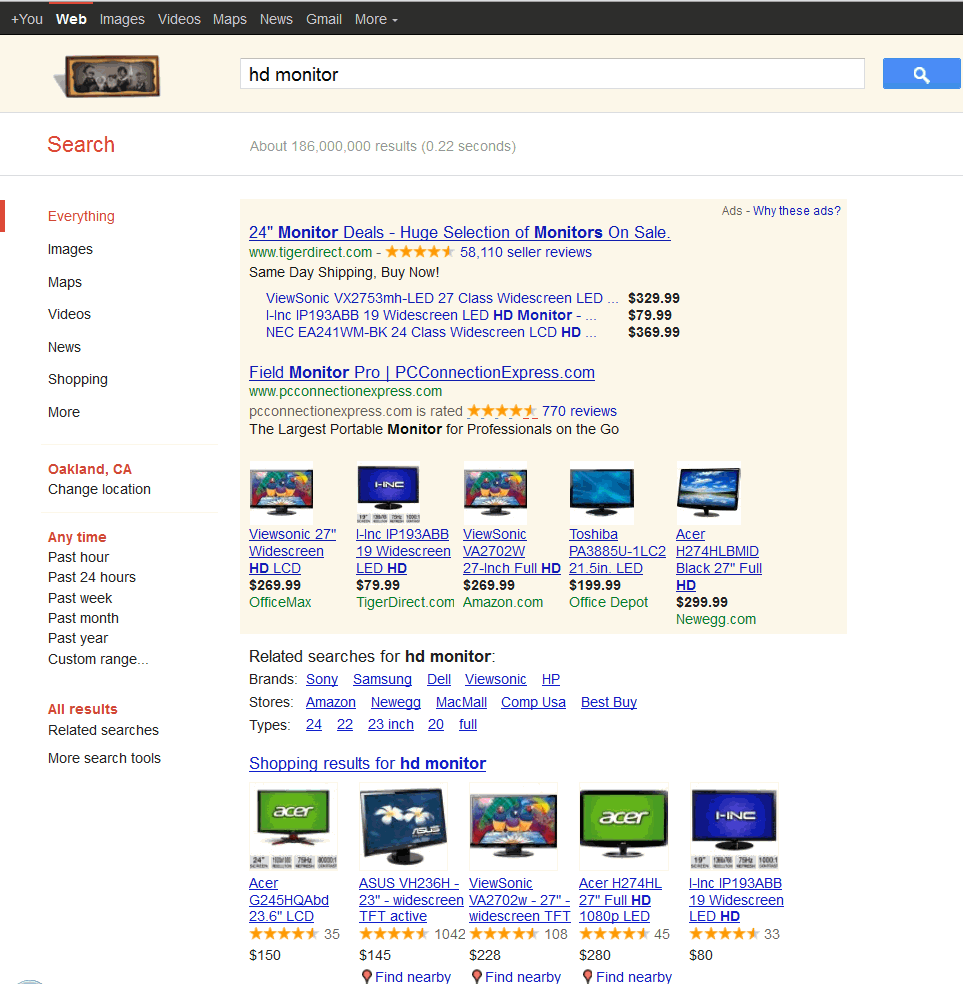
If anything Google has gained some share since then. The biggest change has been that it continues to suck more and more traffic away with ads, YouTube listings, Google Places listings, shopping results, Google's in house affiliate ads, Google Books, and anything else that pays Google or keeps traffic on Google sites. It's gotten so bad that in many verticals it is impossible to find an organic result without scrolling. Like this for example:
I wonder why I don't get any ads above the "Related searches..." at all when I use the same query. I do use https://encrypted.google.com/ instead of plain google.com, maybe that affects the ads?
In fact, I've just searched for a bunch of queries that I assume would have plenty of bidders (NFL, football, harry potter, ipad) and none of them had any ads box.
I hate to be that guy, but are you sure you don't have adblock on? I'm logged in, tried encrypted.google.com, and saw the expected ad results for all of those queries.
I would guess 500 or so. I think people still have a lot of enthusiasm, but camping out and taking care of all the practical details is exhausting and that is starting to show. I think it's extremely important that this movement gets moved online and finds a way to exist permanently. The camping at City Hall will eventually end, but I don't think that will be any type of failure of the movement. This is something that will take years to fully manifest itself.
It's hard to say. There were definitely representatives from every part of that spectrum. I think the important thing to grasp is that this movement transcends ideologies. The main commonality is that people believe the system is broken and want to break the stranglehold of monied interests over the government.
I was there mainly as a spectator, but did get on the mic for about a minute to share a few thoughts. My main goal was to converse with people on a individual level.
My personal goal is to wake people up to the brokenness of our political system and to inspire everyone to change it together. This is only a start but I'm very optimistic.
I will definitely attend more events, but more importantly, I plan on talking to people I know and care about to understand what they think and to help them see why I believe this is so important.
That's why Google is rolling out flat rate click pricing in many local verticals. They take the conversion data from advertisers using website optimizer and use it to help less sophisticated businesses compete against them.
You really need to refine the concept of exactly what your product does and the language you use to communicate that to users. Spending a few minutes on the site, I can tell it's for education but not much more than that. I get the idea you are trying to be all things to all people. You would probably be better off being the exact right fit for a specific segment of the market. By trying to be for businesses, educators, and amateurs you end up being not quite right for any of those groups. You should decide to be either for the mass consumer market or for businesses and educational institutions and develop your product and pricing accordingly.
Thanks for the feedback! One of the reasons why opened up to the public (before that we only offered our solution to the enterprise market) was to learn who will use our product in what way and then focus on that group (customer dev basically)...that's why its so vague at this point.
You are disappointed in Mixergy because of your own short attention span? Why is that a problem with Mixergy. If you looked around you would also notice there are transcripts and text summaries. What I like to do is put it on in the background when I'm doing semi-menial work and then focus on it when something catches my attention. Of course talk video has it's shortcomings but Andrew is doing the best startup interviews anywhere.


What none of these arguments ever address is the massive gains in economic efficiency that Bitcoin can clearly provide. It cuts out parasitic elements of the financial system that have grown like a giant parasite over the entire society.
The author claims that Bitcoin is steeped in nerd paternalism, but what about the epic paternalism of banks and regulators? Paternalism is their entire argument against Bitcoin, which basically amounts to "if people gain economic freedom, they will hurt themselves".