Despite what people may think based on his "style", he's always come across as a really nice guy to me. Reminds me of one of my best friends actually, seems like an arsehole but is one of the most genuine and caring people I know. Funny how that can be the case :)
Instead of choosing one over the other, why not choose both? I specialise in both PHP and Python. For web projects on commodity hardware, nothing beats PHP, especially when used with powerful frameworks such as Zend, Yii or Drupal. For installable programs or scripting, Python works well with wxPython.
>> Quoted from article: "It was around this point that I decided I'd rather be an unemployed Pythonist than an employed LAMP developer."
Sorry man, I'd rather be an employed LAMP developer, but with a few side projects in Python. It's just a programming language, not a religion. :D
I'm the author of the blog post. If the question is related to why I dropped PHP it's because I was getting a lot more done in Django and Tornado so I could finish projects quicker and take on more work.
There were so many clients in need of Pythonists in London in 2011-2013 when I was working there that I didn't have the time of day to take care of PHP ones. Also, PHP rates were dying and there weren't a lot of people competing for the Python work so I could keep my day rates nice and juicy.
I can think of a lot of things that beat Zend, Yii and Drupal in terms of code management, security, DRYness of code that's implemented, flexibility, the list goes on.
As a fully employed Drupal developer who's currently spending every free minute working with Rails, it's vastly more about working with tools that I like working with, and PHP and Drupal do not currently give me that.
I can play a little piano, but I'm way better at the bass because it's more fun. I can get work done on a PC, but I get way more done on a Mac because it's easier for me to work with. I can cook with a dull knife, but it's never as much fun as using a good one.
I think it's okay for people who don't really like PHP to publicly admit that, but it often seems to be taken as a religious attack by those on the other end of the spectrum.
Original link is down, probably got hit by the HN DDoS. Here's the contents of that link, retrieved from Google Cache.
===============================
Goodbye academia, I get a life.
===============================
One of my first memories is myself, 5 years old, going to my mother and declare to her, as serious as only children can be: “I will be a scientist.”
Yesterday night I was in my office in the Department of Chemistry at the University of Cambridge packing my stuff, resolved to not go back to research again -at least not in the shortcoming future.
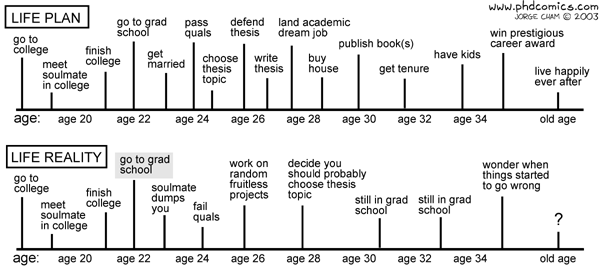
[ Diagram quote: Not exactly my pathway (I finished Ph.D. quite well), but well, you get the meaning. ]
---
I could write in detail what was horribly wrong with my project, and for sure having a lousy project played a big part in deciding to stop and change my path. You for sure want to change your path if you find yourself in a mosquito-ridden swamp.
But if this was the only problem, I would have simply switched to another lab. That’s what I thought until not too long ago (even if the idea of quitting was really in my mind since a lot of time). But the problem is the practice of science itself.
Don’t get me wrong. Every scientist goes on to do science for a single reason: the love of science. Science doesn’t make you rich, it doesn’t make you famous (can you tell me the last 5 Nobel Prizes for chemistry without looking on Wikipedia? I can’t either) and doesn’t make you comfortable. The only sane reason for starting to do science is the dispassionate love of science itself. And I loved science. Like nothing else. Since I was 5 years old. And I still love it.
But one thing is to love science; a completely different one is doing it. Like the proverbial sausage, you don’t want to know how it’s done.
Actually, doing science per se is great. Doing experiments, analyzing data, making calculations, programming code: I loved it all immensely.
However, with the partial exception of mathematics and theoretical physics, you can’t be a lone wolf in science. You need funding, you need instruments, you need resources. You need other people. And here’s where the problems lie. You basically face two choices.
[ Diagram quote: No, it's not a satire or an exaggeration. ]
---
The first is going for the sky: doing great science in a first-class place, make a great curriculum and look for a tenured position in the end. The problem is that a lot of clever people want to go for the sky, and there is much more people who want the sky compared to the available positions. In general, science career is a race, where three people go to the podium and all the others sooner or later will go back home (See also this article from the Economist on the problem). The competition for funding and positions means that not only the hopes of getting a job are really lousy, but that people become nasty. Like, really nasty.
I know of people that have given a purportedly crippled software to a collegue to sabotage his project. I’ve been violently attacked verbally for having dared talking with my supervisor of a project I was collaborating with, because she feared that I wanted to “steal” her credit. I’ve seen more than once people “helped” during a project, only to find all credit for their work taken by the nice and smiling people who scammed them by “helping” them. There are endless horror stories like that. Everywhere. Now, do you want to work in a place full of insanely clever people who are also insanely cynical and determined to do everything to get on top of you? If so, you can do top level science.
It’s not all, of course. Top level science requires also an absolutely mind-boggling determination and, overall, confidence in yourself. To properly do science you must be absolutely sure that, whatever you have in mind, you will do it, no matter what, and that you’re doing it right, to the point of almost self-delusion. This is so important that who wins in science is regularly not the most brilliant but the most determined (I’ve seen Nobel prizes speaking and half of the times they didn’t look much more brilliant than your average professor. Most of them were just lucky, and overall were incredibly, monolithically determined). Combined with the above, this means working 24/7, basically leaving behind everything in your life, without any doubt on your skills and abilities and most importantly on your project, while fencing off a competition of equally tough, confident and skilled guys.
[ Diagram quote: A friendly post-doctoral scientist in your group asking for a scientific collaboration. ]
---
The ones I’ve seen thriving in Cambridge, apart from geniuses (there are a few), are the guys who cling to a simple ecological tenet: Find your niche, where you are indispensable, and keep it in your claws at all costs. This means basically that these people do always the same thing, over and over again, simply because it’s the lowest-risk option. I could have done the same (I was pretty skilled during my Ph.D. in a quite obscure but interesting biophysics experimental technique) but I thought that doing science properly was also about learning and broadening your expertise. How wrong I was.
You can imagine yourself what does it mean also for research in general: Nobody takes risks anymore. Nobody young jumps and tries totally new things, because it’s almost surely a noble way to suicide your career.
There is a second option, which is bare survival. You go from postdoc to postdoc, perhaps end up as a long-term researcher somewhere in some tiny university or irrelevant research center and basically spend your time with a low pay, working on boring projects, crippled by lack of funding and without any hope of a reasonable career (because the career path is taken over by the hawks above described), nor any hope of stability in your life.
Notice that, again, both paths do not offer you any guarantee of sort. You can arrive to tenure track (itself an achievement) and being kicked out after a few years, thus ending up as a jobless 40-year something, with a family probably, too old to compete in the market of real jobs. And bare survival is not easy as well.
---
So basically, if you are not cut for this kind of life, your chances are zero. I tried, believe me. I tried hard. What happened during my research career is that I spent 6 months on antidepressants, I got a permanent gastritis, I wasted at least two important sentimental relationships, and I found all my interests and social life going down the drain.
All of this for having a couple papers about modeling obscure aspects of protein behaviour, papers that will be probably lost within the literally thousands of papers that come out every day? Until not so long, I thought that it was worth it. It was something that I had never questioned so far. I wanted to be a scientist since when I was five. I had done everything to become a scientist. I was a scientist in one of the top universities of the world, in one of the top five research groups on the subject. I had won a personal fellowship to fund myself. Most of my self-esteem, of my very concept of self-realization, relied on myself being a scientist. The very idea of quitting academia was a synonim of personal failure.
---
It has been long and painful to discover that it was just an illusion. When I found that academia was not working for me, I got immediately depressed -my whole worldview was crumbling. Then I remembered that I had a life. I liked my life. I had a billion things that I loved to do. I want to do them again. Quitting and reclaiming back your life is not failing. It is waking up and winning.
A week ago I was with friends, talking about my job, and I found myself comparing science to a drug addiction. Being a scientist, from the brain chemicals point of view, is one week of adrenaline rush when you’re finally on to something and pieces go together -followed by six months (if you are lucky) of pain and suffering, only to get again that adrenaline shot.
Well, noble addiction as it is, it is toxic the same. The next month I’ll be 30. It’s really time to get my life back.
This reminds me of the question, "Do we live to eat, or eat to live?" To a business, money is like food. Without food, you can't live. But is eating the primary goal of your life?
Similarly, a business (but especially a startup) exists primarily to change the world, to disrupt an industry, or simply to do something in a better way. To do that, it needs to make money. Sometimes due to its pioneering nature, it makes an extraordinary amount of money. But its primary goal isn't to make money.
But I agree with the article that startup founders shouldn't be shy about making money. Startups should be realistic - without making money, they can't achieve their goals.
Agree with you that the market isn't able to pick out value, especially value that isn't easily exchangeable for money. Social work is of indispensable value from a particular perspective, and social workers are in short supply in many countries including my own (Singapore).
However the market does not exist by itself, it exists in a structure put in place by governments, with many other players such as non-profits, interest groups, etc. At this point in time, social workers, teachers, etc. have to be supported by funding from governments and donors.
Short of having a more enlightened economic system, what we can hope for right now is for governments to better reward professions that provide such value.
+1 for CodeIgniter. Easy to learn and easy to hack, as it's very transparent about what goes under the hood.
Despite (or because of) its simplicity, I moved on to other frameworks after about 2-3 projects. But nothing beats CodeIgniter for its newbie-friendliness.
The Russians have said he's applying to 15 countries for asylum.
He's trying to gain public support and put pressure on the US government, while at the same time persuading countries to give him asylum. Releasing a statement will help him to do this.
I'm a full-stack web developer, strong on the front end, focusing on Drupal and Python. I'm normally based in London but will be in Singapore from 4th Jul 2013 for a month or so. Would like to take on about a month's worth of work, in Singapore or remotely.
About me: Experienced Drupal/PHP lead developer and team manager, with portfolio of high-traffic enterprise-level websites for UK clients. Excellent communicator comfortable in various roles such as mentor and client/project manager. Solid cloud computing (IaaS) and server management skills relating to DNS, AWS EC2/EBS and the LAMP stack. Speaks fluent English and Mandarin, studied French.
It seems that the grooves pointing towards the centre of the platform make for an unnatural walking gait. At the start of a step, the foot will move inwards towards the line of travel. As the foot crosses the torso, it will move outwards again.
Whereas in a natural gait, each foot moves parallel to the line of travel.
See 2:10 of the video for how the shoes fit into the grooves using plunger pins, and how they move on the platform.
Note that at no point in the movement the torso moves up or down, so the forces on the joints/back are much lighter. So wouldn't that make the movement a light unnatural movement like swimming is? Do people get many knee injuries from swimming? (I had a knee injury that flared up when swimming, but I don't think it caused it)