I had the pleasure of meeting Ben in real life and watch him work — he's just really good at what he does, and his experience with ClojureScript is deep and wide.
One thing that sets him apart from myself and other engineers I've seen is *speed*: while I'm still thinking about a problem, Ben has implemented multiple prototypes, learned more about the problem and picked the best solution.
I'm looking for more patterns like that, mainly to explore how to make them work in the terminal and see whether that actually has an impact on everyday actions people perform in the terminal many times per day.
The goal is not to save time, but to reduce mental friction.
> It is not a good idea to use the backslash as the trigger key since it is the traditional line continuation and escape character on UNIX.
Well it is also the default key binding for VIM's leader key and placed on the home row on US keyboards which makes it really accessible.
What is not shown in the demo screencast is that leader detects whether the cursor is inside a quoted string and in that case doesn't present a menu but tells the shell to insert a literal backspace at the current cursor position.
For continuing lines on an interactive shell the user would have to press Ctrl+V followed by a backslash to insert a literal backslash. In my experience this is rarely necessary in an interactive terminal so the extra utility gained by having leader on the home row outweighs the extra key press necessary for continuing a line.
> Furthermore it is not a good idea to replace the command line with a menu since that limits what is possible in UNIX.
That is true. Leader is not _replacing_ the command line, the command line still works as usual, the only difference is that you can launch a menu by typing backslash to quickly run a command.
All the pictures on the website seem to be taken in arid climates. Does anyone know how well Superadobe is suited to more humid/cold climates (e.g. Scandinavia)?
Adding layers of insulation on the inside seems non-trivial, given the dome shape and the already thick walls.
Although generally and historically associated with arid, desert climates, earth architecture and specifically super-adobe construction is as suited to cold and wet climates as any other type of construction. With regard to water issues it is necessary to properly waterproof the building and this is achieved in a multi-elemental approach which is discussed and demonstrated in detail during our workshops and training sessions. The question of water is not so much how do we protect the building from water but rather how do we harvest the resource of water from the building!
I'd also suspect, generally, that drainage and humidity control would be issues in moister / wetter climates. Cold ones also, as condensation from warm interiors onto cold surfaces will likely be an issue.
> The question of water is not so much how do we protect the building from water but rather how do we harvest the resource of water from the building!
"Harvesting" water from the building is certainly an interesting idea!
> as condensation from warm interiors onto cold surfaces will likely be an issue
That's a good point.
What's your opinion on the feasibility of this building technique for urban areas (in say, Western Europe)? I can imagine it to be hard to get a permit for building such a dome, as it doesn't blend in with the surrounding structures. Other than that, the low cost make it very attractive.
I really don't see the method as appropriate for dense urban construction. It seems far better suited to rural spaces with little access to modern building materials. Though this really isn't my bailiwick.
There's a design for dense modern urban areas: it's brick-and-timber multi-story construction. You'll find it evident throughout Europe, with basic designs largely established by the 19th century if not before. The advantage of such construction is that it greatly minimizes land use, and hence transportation, a major concern for urban lifestyles. Designs which require large areas, aren't amenable to dense and multistory construction, and whose construction itselft is disruptive to adjacent properties (digging for earth fill in this case) strike me as a poor fit.
In rural areas it might work, though again issues of moisture and cool climates would concern me.
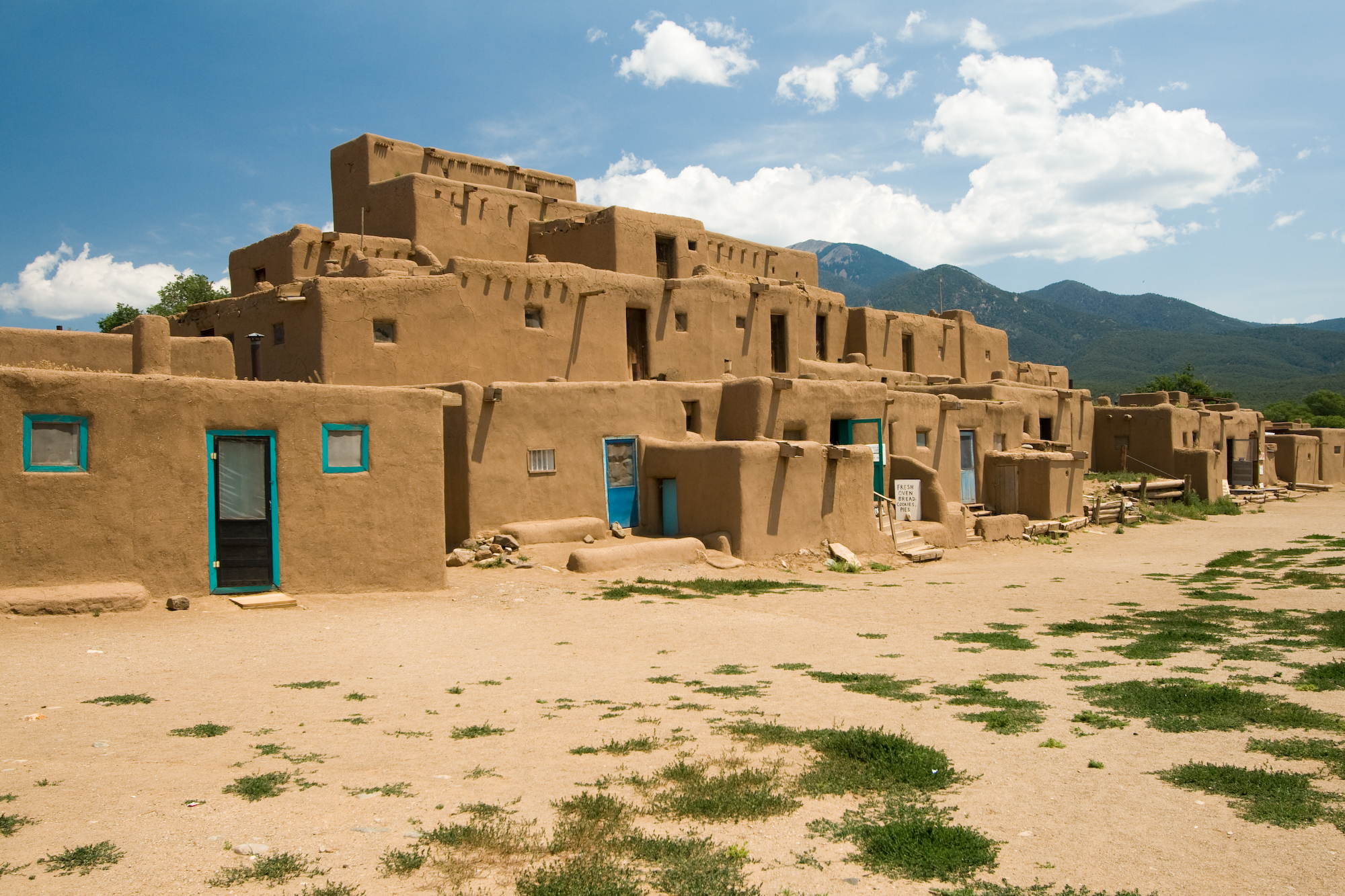
There's also an existing high-density earth-based construction model, the pueblo:
I believe that a common method of insulating mud-built buildings in cooler climates is mixing straw with the mud. There's probably some method of incorporating something similar either inside the bags or as an external layer. This wouldn't have to be straw, it could be something longer lasting with similar thermal properties.
The plastic bags are only intended to be exposed temporarily. If the structure is intended to be permanent, the plastic bags are plastered over (from the article):
> For permanent structures, the synthetic bags are plastered over to provide an erosion resisting layer, or they can be removed when the stabilized earthen filler is cured.
I think the big difference is that they come with the OSes that those types of people are likely to use. And being stores, they provide software that package managers are unlikely to provide.
I think package managers becomes less useful to average users when you can't expect all of your software to be there.
On Android they sometimes do install OS level stuff (libraries, etc). I think he has a good point.
The biggest difference I see is that package managers on most Linux distributions are designed to be extensible to support other sources. Application stores generally are not.