25% of foster kids end up homeless after aging out of the system. Direct cash transfer value is mostly proven from a social work/benefit perspective. Sure, coaching and counseling through social services must also be provided to help underprivileged humans take care of themselves and reach their full potential, but cash benefits help, full stop. The moral hazard argument needs to die. There is a difference between struggle you can overcome to grow and plain ol’ suffering that will kill you, or cause you to kill yourself.
No they have a point and you're covering your eyes and ears to the problems you make. I received $20k when I was 16 for reasons related to my mothers death. I did not spend that money wisely at all (literally drugs). It's one thing when we're talking about fully developed adults (the 25yo kind, not the 18 ones) getting a UBI and another when we're talking about kids in bad environments with poor mentors.
I wish someone would have taken that money from me and put it in college fund or IRA at the very least. Likewise this is a wellfare program for kids and we should ensure it's spent on their wellfare.
>Two hundred randomly selected former DCFS foster youth across the county between 21 and 23 years of age will now receive $1,000 a month for the next two years
Both literally and in terms of maturity, 21 is closer to 25 than it is 16.
Also one lump sum payment is much easier to waste than an ongoing monthly payment.
If I spent that $20k on drugs at once I would have been dead. Instead it supported years of poor decision making and avoiding building my future. I started getting my act together at 19 (money was long gone) and it wasn't until 23 that I stopped making really poor decisions.
The best thing I did with it was use a couple thousand to buy a used car. The money should have gone into a trust with someone guaranteeing I used the money on food, clothes, school, etc. What I needed the most was someone that cared enough to guide me. The money by itself set me back.
I'm not discounting your own experience, but in your anecdote you acknowledge that got you act together 2 years before anyone in this program would get the money. An example of a 16-19 year old being immature is not a good argument that 21-23 year olds aren't mature.
There's no point getting this in the details of my personal experience but I _started_ the path at 19 because I ran out of money. I was still doing incredibly dumb and destructive things until 23.
I really do think this program will help a lot of foster kids. I just wish we could acknowledge that stipulating how the money is used will prevent worse outcomes for some. Free money will give some of these kids the resources to destroy their lives because the money isn't their main problem yet. Both groups of people matter and I want to see programs that don't ignore the negative side effects of free money.
Means testing absolutism doesn't need to be the hill people die on. First we need take care of the people, and then we can figure out the most efficient way to administer it.
you were 16 and coping with the death of your mother. nobody should be given that kind of responsibility to set up their finances. how much did they teach you about finances by 16? if that money was set up in a trust for you that dispersed income over time or directly paid rent then that probably would have been very helpful.
The parent merely stated that they don't think they could have handled $1k/m. That's fine. They aren't in the group that will receive.
As for the second question, is the implication that former foster kids are "unreliable" and we should instead be investing somewhere else?
Why don't you address the "25% of former foster kids find themselves homeless" stat? Are these kids just getting too much assistance to be driven to... work fast food?
> Would you rather invest $10k into someone who has shown you they're reliable, or someone who has shown you they are unreliable?
Since the goal is to produce functioning members of society that produce a net benefit, I'd invest the money in making the unreliable one more reliable.
You're ignoring mental health and addiction just as much though. Both are complex and interrelated. Poverty is incredibly stressful; my mental health was never as bad as it was when I was homeless.
Harm reduction is effective. I literally got off the street because someone gave me a garage to sleep (and use drugs!) in and $14k. Having a private space meant I stopped getting arrested for using, didn't risk losing all my possessions every time I went to a job interview. Allowed me to think about a future farther than 30 hours away. I could afford (and store) weed and beer instead of vodka and crack. I didn't have to be obliterated to sleep through the cold & noise of the highway under the bridge.
The first small steps were only possible because no one held me to the sort of standard you're advocating for.
I have invested more than that in both cohorts, and would do it again. Everything is luck, the money buys dice rolls. Some dice are weighted towards success more than others. I like to gamble on people, it’s a worthy cause and brings me happiness.
With regards to mental health and addiction, I support Medicare for All and robust access to mental health and addiction treatment for those in need. We have the means, we simply choose not to implement efficiently. Set the tax rate at whatever is necessary. There will never be perfection, never the perfect time for policy components. Implement what you can when you can and accept good enough is all that can be done.
1. Perhaps GP is just exceptionally sensitive to bad mental states or addiction. I know the social "sciences" have an entirely well-deserved bad reputation, but it isn't good science to extrapolate from n=1 either. Pilot programs like this one are useful.
2. The obvious answer to your rhetorical question is the second one, but in this case it is irrelevant; the program is targeted at a random set of applicants, their reliability is unknown.
2) Developing a means test, applying the means test, setting up a system for verification that people meet the means, distributing the money to the people that match the criteria.
I mean I can't tell you because there are dependent variables on what those means are. But two cheap options are #1 and #2 with a means that is so high that you don't pay anyone out but instead have that structure where we're still paying people (we could adequately call it a jobs program at that point).
But let's think about this from a different point of view that I don't think many here are, despite that this is an engineering perspective: failure modes. #1's failure mode is that people that don't need the money will get the money (we'll include things like drug addicts and irresponsible people here for simplicity's sake), #2's failure mode is that people that need the money won't get the money while minimizing the number of people who take advantage of the system (non-zero number).
Truth is we need to balance these two: cost and failure modes. From the high level perspective that this entire thread is at and really the entire comment (and basically every conversation had on this subject) is nowhere near the resolution where we can remotely say that 1 or 2 is better. All we can say is #1 is easier to implement. #2 is undefined because its parameters are undefined. Having a conversation at this level is just idiotic. There's very little for us to reasonably discuss and impossible for any real definitive answer to be made. The way these discussions are being framed can only lead to fighting because there is no means of determining better and there can't be (until we define and get more detail).
Good reason to screen out people with mental health and addiction issues, at least in a trial, and if it’s successful then when you do start incorporating people with those issues you can come up with a plan to address that as well.
If the goal is to reduce the rate of negative outcomes for youth aging out of foster care, though, aren't the ones with mental health or addiction problems exactly the ones who would need help the most?
> Direct cash transfer value is mostly proven from a social work/benefit perspective.
There is basically nothing in social sciences that are a consistently reproducible fact. “Mostly proven” is Orwellian double speak akin to “the science is settled”
Regardless of what you see as an exaggeration on his part, the evidence is he's referring to is surely better than the individual anecdote of the parent post.
> Direct cash transfer programs are supported by a vast international evidence
base (Baird et al., 2013). Globally, they are among the most well-evaluated interventions for addressing poverty,
boosting well-being, increasing educational attainment, and improving health outcomes and employment (Baird et al.,
2013; Pega et al., 2017). In the U.S. and Canada, numerous programs offer examples of how DCTs have have reduced childhood
obesity, improved health outcomes, reduced hospitalization rates, increased savings, and supported economic security. These
include the maintenance income experiments of the late 1960s in Denver, Seattle, New Jersey, Iowa, and Indiana, the Canadian
‘Mincome’ Experiment, and the ongoing Alaska Permanent Fund Dividend (Forget, 2011; Guettabi, 2019; Office of the
Assistant Secretary for Planning and Evaluation, 1983).
> Counter to common public narratives, numerous studies show that offering
DCTs to people experiencing poverty and adversity do not result in money
poorly spent, increased substance use, or reduced motivation to work (Evans &
Popova, 2017; Morton et al., 2020). Instead, cash is primarily spent on basic needs--food, utilities, other goods--as
evidenced in the early report on the Stockton Economic Empowerment Demonstration (West et al., 2020). The Child Tax
Credit further illuminated that regular unconditional cash contributes to reductions in food insecurity and overall poverty
(Parolin et al., 2022; Shafer et al., 2022). Furthermore, in Canada, a randomized trial of DCTs to adults experiencing
homelessness also found improvements in the speed of exiting homelessness, reductions in the amount of time spent in
homelessness, and reductions in spending on alcohol, cigarettes, and drugs among DCT program participants
(Foundations for Social Change, 2020).
Right. Social systems and the effects various interventions have are very complicated. The idea that some intervention is proven or disproven is, in all but the simplest cases, ridiculous.
Even with research, the results are going to be hard to understand and apply without unintended consequences, and whatever intervention is going to have mixed results even if the overall effect is positive.
And pilot programs are to a great extent research.
Let’s do this thing and see what happens in a small enough setting that we can intervene if something really goes off the rails and even if it does the impact is minimal.
You should check out the movie reversal of fortune. It follows a homeless dude that was given 100k no strings attached. He was specially chosen as he did not have any substance abuse issues. Despite that the story has a sad ending but it does humanize the struggle as you grow to like and empathize with the guy while the slow rolling train wreck carries on
I commented elsewhere that this happened to me. I might be an anecdote to you but I'm living out a case study from my perspective. I actually fully support things like a UBI but we can't ignore the problems it creates and damage it will cause. I know a huge point of the UBI is a lack of means testing but even Andrew Yang's proposal included an basic age cutoff.
Personally I think we need to accept that there should be some means testing but it just dictates whether the individual has control of the funds today or whether it goes into a trust that can only be used on specific things (food, shelter, recovery programs, etc.) and becomes completely available after some conditions are met (like a retirement fund).
The idea that $12k is enough to allow you to be lazy and not work in Los Angeles is completely ignorant of the cost of the city. That is a third of a full time minimum wage job. That money is going to stop a lot more people from being homeless than it will cause people to quit their job.
I agree that that's the hope. One also has to consider, though, that instead of transitioning from homeless to housed, the infusion of money might transition some folks from homeless to homeless with a budget to fuel addictions.
I believe its frowned upon for people of all social classes, but there's less discussion about those who "don't have to work" because taxpayers are not funding their lives.
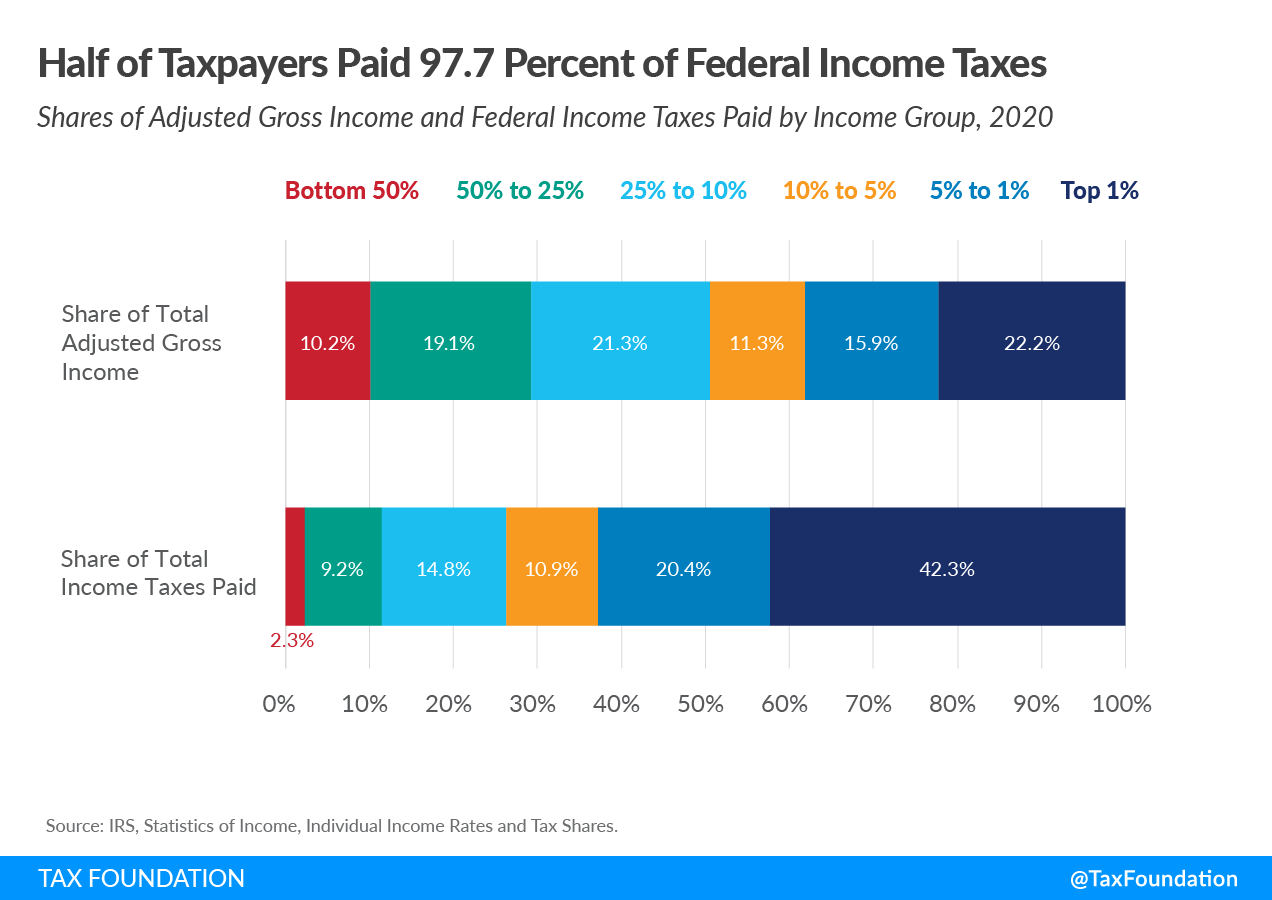
Limiting it to federal income taxes gives an incredibly skewed picture.
It's basically equivalent to saying: "If you exclude all the taxes that the poor pay, then the rich pay the most taxes".
Federal income taxes aren't the only taxes. They aren't even the only federal taxes on income. FICA taxes are regressive with the rich paying a lower rate on income. State and local taxes also tend to be regressive with the poor paying a larger portion of their income than the rich.
Thats why its dumb to wait until people are already basically formed before we introduce them to adult things like paying bills, having a budget, using a good forecasting app to be able to understand how each choice affects you and being able to see the bigger picture that arises from all the discrete small transactions. That last one is more my thing but I honestly don't know how anyone functions without it regardless of how well they're doing.
Would a $1,000 raise at your job have been as devastating?
Surely you're not implying $12k/year in Los Angeles (a county with c. $3k/month median rent) is going to create a class of willfully unemployed former foster-kids with no drive?
Should we also ban parents sending their kids money for the same reason? Or are foster kids uniquely prone to laziness?
>Go give 1k to a homeless guy...he'll still be homeless, and probably dead thanks to what you enabled.
I'm sorry for the double reply, but I really ma horrified.
It's amazing how we live in a country where shelter prices have increased by 50% since 2009 (vs. c.40% for all other items), and yet we still desperately hold onto this idea that homeless people are universally immoral drug addicts.
Beyond that point, we are talking about foster kids here. Everyone immediately jumped to homelessness for whatever reason (they seem to be the social scapegoat du jour).
I think it is completely reasonable for the government to fight inequality by giving people who we know are not receiving any support from their parents a boost in their critical career forming years.
Honestly, $1k/ month could be the difference between going to school part time vs. working full-time. Why does nobody's mind go to this? Why is the assumption that foster kids would never make that choice?
>Go give 1k to a homeless guy...he'll still be homeless, and probably dead thanks to what you enabled.
Why do people assume that every homeless person is both an idiot and an addict? Especially in cities in which real estate is as expensive as Los Angeles, the overwhelming majority of homeless people aren't there because of addiction issues. All the numbers I have seen suggest that only a quarter of LA's homeless population has addiction issues and even still the causal relationship isn't clear. When you live on the streets, the momentary escape of drugs is pretty alluring, but probably not as alluring as getting off the streets.
Yes, the definitions are part of my point if you read between the lines of my comment.
The definition of homeless I am using is literally "a person without a home". The person I responded to is using an incorrect definition.
That leaves two options. They knew this and they don't actually care about the problem of people not having homes. Or they didn't know that the "visibly homeless" are only a minority of all "homeless" in which case they can learn from this conversation.
>those who literally are living on the streets absolutely do have some sort of addiction or mental illness.
I don't know how you can say this as definitively as you are.
Surely the difference between a $1,000/month raise at your job and a government stipend of $1,000 is that to continue to receive the extra $1k from your employer you cannot drink and smoke yourself into oblivion? While with the government stipend you can, which I believe is what the commenter you are replying to was getting at.
I'm surprised you and so many others are coming at this from such a negative point of view.
Why are you so certain foster kids are just going to drink themselves to death? What about not having a parent makes someone immediately at risk for that?
I appreciate your point, but would have 1k/month have actually changed your struggle or motivation? Or to put another way, why weren't you spending all the money you did make on weed and whiskey?
> $1k per month without working or struggle would have destroyed me.
Are you claiming that most 21-year-old L.A. residents would be destroyed by $1000/month? I've lived in L.A. for more than 20 years, so I somewhat know the culture. My guess is the overwhelming majority would use the $1000 for a car payment and insurance. And I'd bet serious money on it.
It was your idea. He suggested it was a universal temptation, you suggested it was a personal problem. If it's personal, there is a community of people with that same problem.
Since we're talking about people receiving public funds, I think it's correct that the recipient has to prove that they can handle it, not the other way around.
if only idiocy like your comment recognized that dumb ass margaret thatcher reagen esque measuring of who gets aid and who doesn't costs more than just fucking giving people the money. How are you idiots actually rehashing 90's austerity shit. Wtf?
look no further than healthcare for all by every study[0], showing it would SAVE money. Hey idiots, turns out hiring a bunch of people to decide who is allowed to get a checkup costs more than the checkup. Not to mention the money you save from the whole "ounce of prevention vs a pound of cure" math.
Ridiculous, brazenly unscientific, and extremely cruel sentiment.
Please tone down the rhetoric if you want to have a productive, rational discussion. It's disappointing to come across comments like yours on HN.
> look no further than healthcare for all by every study[0], showing it would SAVE money
Your source lists, among others, a "study by the Koch-funded Mercatus Center"[0], which presumably would be the strongest argument against their position that "Medicare for All" would save money. It claims that even the aforementioned study found that M4A "would save around $2 trillion over a 10-year period", which they arrived at by the cumulative 10-year estimated savings on national healthcare expenditures, but fails to mention it also estimates that an additional $32T will need to be raised over the same time period to pay for it.
The UMass Amherst study[1], presumably more favorably inclined to M4A, estimates that an additional $20T will be needed over 10 years to finance it.
So all of those studies are really just saying that in the aggregate, we would spend less on the direct healthcare expenses through a combination of better drug pricing, removing redundant administration (both private and public), and paying providers less, but at the cost of needing to raise much more in taxes than we would save on those direct healthcare expenses. Which makes sense, since a lot more people would be covered under M4A than currently, and you may very well argue that that is an admirable goal; but it's a verbal sleight of hand to say that somehow the nation as a whole would save money. It's just shifting where the money is counted and who pays for what.
At the individual level, sure, some people may come out ahead, especially those not targeted by the burden of the additional required taxation.
Over the past 10 years, the health insurance industry as a whole made about $15B in profits per year[2] and spends another $81B a year on administration (salaries for workers, etc). Let's round that up to an even $100B a year and call it a "parasitic expense" that the for-profit health insurance industry charges on society as a whole and still leaves some people uninsured. If we remove that $100B and add the $2-3.2T a year that M4A would require, what happens? Your source says it'll save 68k lives a year, which would come at a cost of (taking $2.5T as the midpoint of the estimates) $36.8M per life. Fantastic! It's estimated that there are 27.6 million people who don't have health insurance currently. Great, now they will be insured at a cost of $90k a year. But of course, at least nobody would have to pay a dime out of pocket.
M4A is not a magic wand to be waved that will produce more and better healthcare for free. Honestly, a federally-funded mandatory fat camp would lower total health expenditures a lot more for a lot less money.
And more broadly speaking, welfare benefits in general also are not things that will improve society as a whole at no cost. When we're talking about the public's money, the costs and benefits have to be weighed carefully.
You're right, sorry about the rhetoric, i was extremely angry at such "welfare queen" rhetoric.
I've calmed down and read your comment twice.
Of course it's not magic. Of course it shifts the burden elsewhere (9 people own more wealth than 3.6 billion combined, there's plenty of burden that need be fricken shifted). Of course it would require new taxes (mostly on the rich, most people end up paying less for care, i'll pay 500 in taxes over 1k in premiums any day of the week). We will spend more on healthcare either way as you note, this is the cheapest way through the storm with the best allocation of the tax burden.
I also completely agree with the prophylactic notion of reducing medical burden by increasing healthiness. Idk about fat camp specifically but shit like better healthier foods in schools and killing food deserts and reducing poverty would all go a great extend to help. Like you are agreeing with me in a different form, "an ounce of prevention is worth a pound of cure" and early healthcare before problems get bad is part of that.
>And more broadly speaking, welfare benefits in general also are not things that will improve society as a whole at no cost.
Who said they would do it at no cost? I think i simply noted it would be cheaper than the inhumane way we do it now. So it's more humane AND the math is better. Literally the only reason to think like that crab in a bucket i replied to does is if you're a meanie who wants the poor to suffer instead of accepting a poor might get some healthcare or not starve on their tax dime. that's what made me so mad. I am still sorry for commenting in the manner as I did. I was fully prepared to be quickly flagged lol.
Re welfare benefits, they produce some of the best return of dollars spent by the government. Like besides the irs, (quick search shows 400$ in revenue per 1$ spent on irs, 6:1 $ gain if we spent more on enforcement) nothing comes back quicker per dollar spent than giving poor people money. It goes straight in to the economy.