Wait until you find out about the grift that the billionaires you don't hear so much about have been pulling. I agree with your concerns around turbulence, but the audits of these shady government agencies needs to be done.
This may come off as defamatory, however does anyone else feel like Sam Altman has slowly been heading towards an impending reputation disaster hilariously adjacent to that of Sam Bankman-Fried? I've seen this perspective expressed on twitter/X several times as well.
I would assume that many US labs are also attempting to replicate it, but are just not as public as the wikipedia listed attempts. Also US government agencies/labs are probably working around the clock to make and test this stuff but in secrecy.
Can you go into more detail? So you're saying that at a 200 P/E ratio NVDA there isn't even enough wafer supply for NVDA to grow into that valuation even over 5 years?
I mean, you've got the gist of it. I pulled some reports on silicon production, silicon waver prices and price trends, current fab capacity etc..
My back of the napkin basically suggested that silicon production would need to 4x and fab capacity 4x (neither of which are happening) and NVDA with would have to capture all of that to justify their current price. I didn't bother writing it up, just looked at it mostly because I was on the wrong side of that play. It's something worth considering for sure.
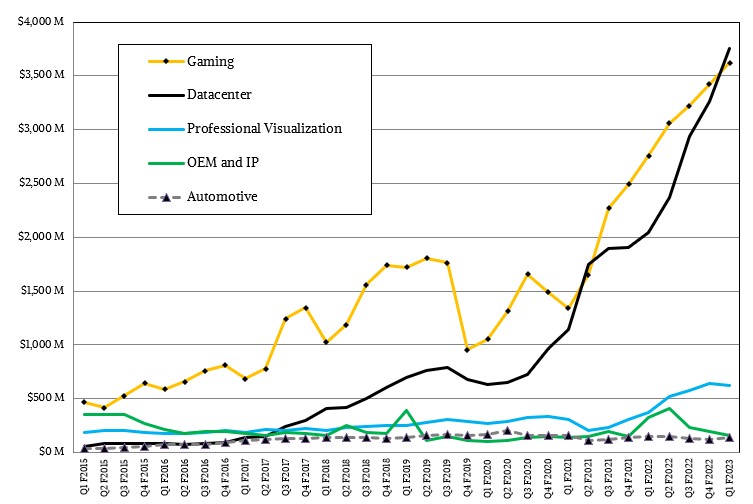
Wouldn't NVDA just focus more on high margin datacenter products in order to grow into those higher earnings but with the the wafer limitation? Datacenter focused products are already starting to surpass gaming which is their second largest revenue source: http://www.nextplatform.com/wp-content/uploads/2022/05/nvidi...
It seems to me that yes while a 200 P/E may be high, they certainly could keep increasing the prices on the already high margin datacenter products, of which get quickly gobbled up by companies no matter what price they are because of the immense demand.
We're probably ~3 years out from all of those fabs gov'ts funded coming online, right?
(n.b. that's really good work on your end and I agree with your conclusion, just idly musing about the thing that bugs me, what the heck all these non-leading edge fabs are going to do)
It's org mode in emacs with the org-roam plugin. If I wasn't using emacs I would probably have a folder full of markdown files instead and leverage a project-based grep to search it. The real power in the system is that it's close to your editor and personal so you can iteratively build up your knowledge.
In particular, every GitHub wiki belonging to an organization or a public project itself is a git repo of markdown files that you can clone and commit to. I probably would use that for per project documentation w/ a separate folder for managing broader notes. I think it's important to separate the markdown from a project's code because otherwise you can have important markdown updates trapped in a branch that hasn't been merged yet and because git works by line rather than by word you can get into complicated merge conflicts by features that touch similar business concepts.
Org mode happens to add some niceties on top in that you can have an example code block (roughly comparable to a triple back-tick code block in markdown) that also can be executed. The example code block can take some arguments like what interpreter to use and will paste the output into another code block underneath the source code block.
Because org mode is also used for organizing tasks it is easy to use it as a scratch pad as you grind through tasks and if something turns out to be useful you can promote it to a top level note (or org-roam node). And even if it's not obvious that it's a note candidate, just thinking through problems 'out loud' in org means you can search and find it later when the same or an adjacent problem comes up.
Another favorite feature I like in org mode is that in any code at any time I can tap out 'SPC n l' and it will capture a reference to the file and the line in the file and allow me to link to it in my notes. It doesn't capture by line number but by copying the literal line, which means that as feature updates push the line number up and down, it still will be able to find exactly the right file in exactly the right line as long as the line's content hasn't changed. It also serves as a rather nice canary because if the docs link to a line that no longer exists, then the documentation has probably gone stale.
The last major win with org mode vs markdown is with org-roam, which borrows the ideas from the standalone program Roam Research (which also is very similar to notion). Every 'node' you make initially is a file and you can fill it in as a wiki type structure. Everything is flat on the filesystem and has a unique id prepended to it so you can't overwrite it with another node of the same name. There's also a UUID associated with each node so if you move from one place to another, none of the links need to be updated. Contrast that with a regular wiki or markdown where when you move a file to a new folder you either have to leave a redirect behind or go through and update all of the back links.
You can also start a node as a subheading and later on promote it to a full file with all the backlinks still working correctly.
I started using org mode years ago with spacemacs, got frustrated with spacemacs, and gave up until earlier this year when I found doom emacs and gave it another spin. I wish I had a better recommendation for an alternative but after looking for 4-5 years for something as good as org mode, I could never find anything. Notion seems like a popular alternative but there's also a lot of shiny bells and whistles in it that can cause 'productivity procrastination' where you spend time configuring and turning knobs instead of actually using the system. Ironically, the second best tool I found was plain pen and paper using a minimal bullet journal technique and taking special care to do indexing. Of course, you can't share plain pen and paper in that way, but the name of the game for personal use is low friction and ready access. The better a system scores on those two in term of note-taking the more useful it will be.
I feel like it would be more beneficial for students to move directly from Scratch to a normal programming environment (ie. editor + terminal on a unix OS). The learning curve & difficulty would absolutely be a challenge at first, but learning is best done through struggling, and trial & error. Plus, for young students, becoming familiar & comfortable with the terminal & editor in their most neuroplastic years would set them up to be very strong engineers.