Edit: that doesn't seem to be importable. Give me a minute and I'll check manually.
Edit 2: I am unable to figure out a fix to the problem, sorry! My feed works fine for me in Tiny Tiny RSS, so I am tempted to say that it's caused by a very strict feed parser.
OK, I found the problem. I hadn't imported the proper RSS namespace thingy to provide the `<dc:creator>` tag. I've fixed that now, so you should be able to read my feed in Thunderbird!
It's cool, nice work! And thank you for sharing it.
This is just spitballing, you've already solved problem you set out to and get full marks.
There are always many different ways to do things with bash/shell. Here, you could probably do the entire thing in AWK, which you seem to already be aware of. This might be more readable or it might not.
If this were a script someone wrote for more general usage, I'd recommend to use the unofficial "bash strict mode"[0], and make sure to check that the awk/sed calls succeed. Shell has a nasty habit of limping along as far as it can if something goes wrong along the way and it's very easy to just end up with bad output and not notice until it's too late.
Another thing I only recently discovered is envsubst, a tool that's commonly available and tailor-made for substituting variables. You could pipe a template string or pile into that instead of the repetitive calls to echo. What you have here is fine and instantly readable, but if it were three times as long it might not be so nice. Here you could use awk to extract the variables and envsubst to put them into your template.
Honestly I don't think shell is a good language for writing perfect, robust things anyway. But it's good for exactly what you're doing, though, writing something for yourself that solves a problem without spending too much time on it (although it's fine to spend a lot of time on it if you're learning and/or just enjoying yourself).
Thanks for the feedback. I haven't heard of "bash strict mode" before. Haven't heard of envsubst either. I'll make a better rss script as I learn more about scripting.
Thanks for the links, it’s cool to see a video showing how the gliders could have looked liked if they were real. I haven’t heard of that film project.
There is also a tendency, especially in America, to reduce everything to discussing the baddies of ww2, or at the very least, to not separate scientific discussions from political discussions.
I really doubt that humanity will make trip to earth from mars in the next 50 years. It already takes a huge amount of fuel to land on Mars -- its not economical to launch enough fuel for a return trip (even if some of the fuel could stay in orbit like with the moon landings). Much better idea to find the few people that are fine living and dying on mars. Humanity has not returned a single sample from mars even though we've been landing spacecraft on mars for 50 years.
It's only not economical with our current mostly disposable rockets and lack of experience with ISRU and long term management and transfer of cryogenic fuels in space. Luckily we're working towards gaining experience on all those fronts.
While generating sufficient Methane is probably too big of an ask without involving extensive infrastructure, in methalox rockets (which many next gen rockets are), the larger mass is the LOX (iirc ~75% of propellant mass on Starship is LOX), which is a lot easier to devise automated methods for ISRU. Thus the problem becomes a lot more solvable. You send ahead a system to collect and store LOX, then you bring enough Methane for the return trip, and you also spend the 2 years till the return window collecting LOX.
Although, if you're sending stuff ahead of time and have the expected economics of Starship (ie down from hundreds of millions per ton to the Martian surface to millions per ton), you really can afford to just send ahead enough propellants for at least a round trip.
I remember something similar. The stoichiometric mix is 80% oxygen, but the actual mix is fuel rich, because CH4 is a light molecule, and the end result is a higher specific impulse.
Still, one could imagine that you could run the rocket in oxygen rich mode; you give up some specific impulse, but you might need to carry less CH4 with you for the return trip.
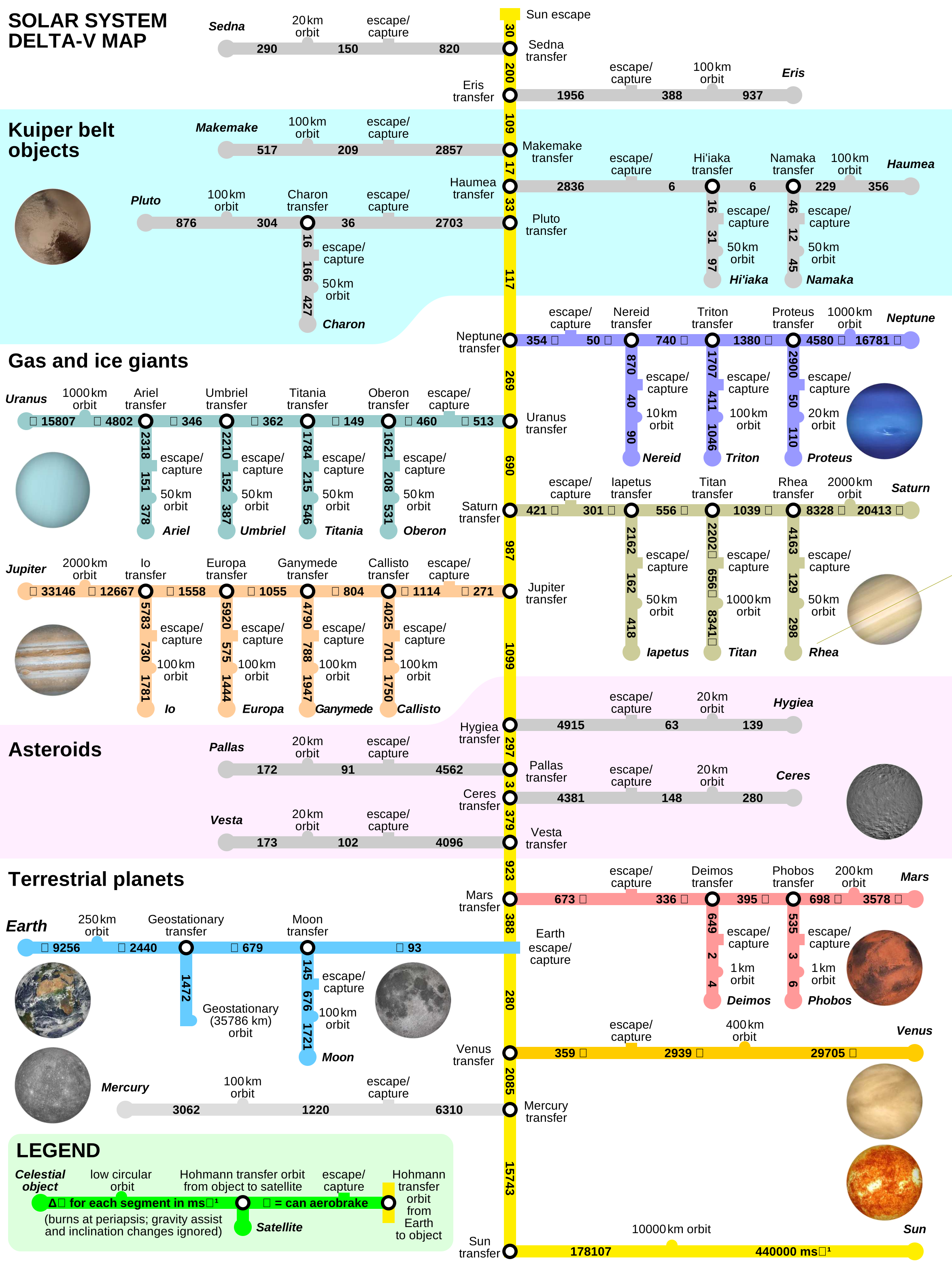
All that said, I just run the numbers, and I had a huge surprise: if I didn't make any mistakes, the Starship has enough fuel for the return trip, without any need for fancy refueling in Mars orbit. According to the wikipedia delta-v map [1], the delta-v needed to go from GST orbit to the Mars transfer orbit is only 1.16 km/s (yes, not a mistake). Then from there to low Mars orbit it's a further 2.1 km/s, but aerobraking is possible. Also out of the 1.16 km/s from Mars transfer to GST, 0.77 km/s can be done with aerobraking on the return trip. But let's be conservative and ignore all the assistance from aerobraking (although the Starship was designed specifically with that in mind). We end up with a total of 3.26 km/s for one way, and 6.52 km/s for both ways.
The exhaust velocity of the Starship is 3.56 km/s [2], which leads to a ratio of delta-v to exhaust velocity of 1.83, the exponential of which is 6.24. So you can have a ratio of initial mass to final mass of 6.24. The ratio of the Starship gross mass to dry mass is 1300/100 = 13, so more than twice the minimum. Of course, the delta-v map assumes the most economical routes, and for human travel you might need to splurge a bit, to get up there faster. Still, 13 vs 6.24 seems like a good margin to me.
I suspect that this capability, and the earth orbit refuelling going with it, was designed specifically so that it would be able to return in this way. The first few trips almost certainly won't have the opportunity to do ISRU, and until there's a lot of redundancy it would be betting the farm with each manned mission if they didn't have an unassisted return capability.
I haven't kept track much on how feasible the Starship rocket is. Maybe it's not that hard to make fuel on mars. Maybe humanity is making good progress figuring out how to transfer fuel in space. You sound much more educated than me on the advancements being made.
I still think it would way more feasible to just to find 5-6 guys in the 25-30 year range to send on a one-way expedition. Instead of spending all of their time maintaining a factory making fuel these guys could be spending time exploring the planet and doing experiments. In return humanity would memorialize them and try to send them stuff to stay alive. After a few years we would try to send another crew to join the first crew to make more progress on the planet and build from there.
Some people are accused and convicted of a crime, know they are at fault, and even want to be sentenced for their crime. EG, they knew they were negligent, made a mistake they should not have, etc.
Such types could potentially feel almost relief with such exile, if their personalities aligned with that of an explorer. And if they truly desire censure, punishment, "doing their time" on Mars, instead of rotting in a jail cell, may seem very good to them.
Of course, lots of profiling would need to be done -- but, that is already done for such missions.
I don’t think it would be an issue finding people for a one-way mars mission. Guys already sign themselves to fight in wars that they don’t expect to return from. Being memorialized and known is enough (especially for the case for men) for some people to go on one-way missions. Being part of something greater than themselves is enough for some people.
Are you familiar with Mars Direct? I don’t think any current plans to go to Mars envision bringing all their return fuel with them to Mars orbit (much less to the surface).
NASA and DARPA have been funding studies for a new generation of fission-powered rockets.[1][2] They talk about launching a demo in 2027. BWXT (good old Babcock and Wilcox, makers of hundreds of submarine nuclear power plants) and Lockheed-Martin are the primary contractors.[3]
But the big bucks are still going into the Senate Launch System.
I haven't heard of Mars Direct, but from reading the link you gave me it sounds like a plan to start automated fuel production plants on mars to make fuel for trips back to earth. It requires the transportation of a small nuclear power-plant to mars as well as hydrogen to synthesize methane from the carbon dioxide already in the atmosphere. Off the bat I would say that hydrogen would be a pain to transport to mars (hydrogen has a high energy density by weight but not by volume) but don't know much else to think about the project.
Electrolyzing water would also give hydrogen which would make the transpiration of materials easier. I’m guessing that it would require a large amount of electricity to get enough hydrogen/oxygen from the water (they really would need a miniature nuclear reactor).
Edit: for my last comment (which I can’t edit now) I meant to say that hydrogen has a high energy content by mass but not by volume. So 1kg of the stuff has a huge amount of energy but also takes up a lot of physical space.
The bigger question in my mind is that in 50 years, will we need to even land humans on mars, or will be able to build space-faring robots where we can upload our consciousness and send that instead.
Humans, or generally all complex life on this planet is well ... adapted to this planet. Space is very hostile to us.
There's a reason why Mars has had six rovers, with opportunity working for 15 years.
Distance to Moon (384,400km) is 0.0017 of that to Mars (225,000,000,000km).
To me the whole concept of this exploration is to first find good base building and fuel materials while lowering the cost of travel. Once that happens it will be very quick paced race to those materials.
Like in any other business venture this mars/interstellar is a bet, so doubts of success are natural.
This year was supposed to be the year they finally go, but surprisingly it did not work out somehow, maybe because the company only knew how to do good looking 3D models and no real hardware. But they did make the proof, that there is no shortage of willing people to make a one way trip.
And in general I am more optimistic, I am pretty sure there will be humans on Mars in the next 50 years. I am not a fan of the guy in general, but I do believe Elon Musk is serious about going there and I can imagine him still dreaming of being the first on Mars (and then build his kingdom there). And the chinese might start a new space race. Then there is India, Brazil, .. lots of ambitions and national pride and egos. Or crowdfunding goes really mainstream and we organize a pure scientific mars mission at some point? 50 years are a long time and the rate of change right is crazy. It does not have to go all in a bad direction. In either way, rocket starts became something very normal. At some point it is just about doing enough of then, for the fuel and supplies. And we can do that. Also robots have come far, who can be send ahead.
> Much better idea to find the few people that are fine living and dying on mars
What would be the point, though? Besides live streaming someone slowly dying from radiation poisoning?
It’s not like a human can really do anything that a sufficiently complex robot wouldn’t be able to. Also I always assumed that the whole point of going there (or to the moon for that matter) was to show that we can successfully get humans there and back rather than anything else.
That’s fair enough. If the goal itself was to get people there and back for the technical challenge/knowledge then a one-way mission does not make much sense.
But if the point was to start a long-term colony on mars then it would make sense to first send people that would not expect to come back. Robots are cool, but I’m guessing that us humans with our arms and fingers will be able to do general tasks better than robots will for a long while. Humans have ability to fix things, reach things, and to improvise which robots generally lack. Construction or factories on mars will require people on the ground managing those projects.
There would also be a scientific benefit understanding how people age and how long-term social relations can last on mars.
There will never be a long-term colony on Mars. Mars is not a habitable planet.
Compared to Earth, Mars has no atmosphere. (100k pascals vs 600 pascals.)
Mars has no magnetic field.
Mars has 1/3rd the gravity of Earth. We know low gravity has deleterious health effects.
Anybody who lived on Mars would have to live inside a pressurized building at all times. Stepping outside would be lethal. If we're able to to build sustainable colonies in these conditions then we might as well focus on colonizing the Moon first. There would be nothing special about Mars, we might as well just live in space habitats. If there is a future of Martian colonization it involves extensive genetic engineering and massive terraforming projects we can only dream of now.
Sure. But the real issue is both of them are absolutely lethal and uninhabitable environments. There is no plan or even real dream to change that. Stepping outside on Mars will kill you just as dead as it will on the Moon. If you're going to force colonizing one of them for some bizarre reason and at huge expense you may as well pick the closer one. It's much more feasible to just build a bunch of habitats using rotation to generate artificial gravity than to plonk yourself down in a gravity well that is totally hostile to human life, and even that stretches the bounds of possibility, let alone practicality or desirability.
We all watched Star [Trek|Wars] growing up, I get it. Mars is not a viable colonization project. The best you could ever hope for would be, at tremendous expense, an Antarctic-style research station.
Also, the psychology of spending hundreds of billions to build a colony that becomes a tomb is probably too creepy for politicians and voters to contemplate.
Many cultures have a concept of sanctity of the grave, or right of sepulchre. From that point of view, what happens to the Mars habitat where those people died? Does it become a mausoleum forever? Anything else seems very fraught.
It would be a bizarre spectacle to send another trillion-dollar crew whose first task is to clear out the corpses...
> How many European colonies failed in the new world?
In at least one case the failure of the colony resulted in the country which founded it being forced into a slightly one-sided merger with its nearest neighbour, which is why the British flag now has blue in it.
Modern nations may be mindful of this and wish to avoid repeating the mistake. On the other hand, they may have a case of the FOMOs after looking at how successful the USA became… at least if they convince themselves their new space colony won't also declare independence just like the USA did.
> Modern nations may be mindful of this and wish to avoid repeating the mistake
Considering that colonies on Mars are extremely unlikely to ever be self-sustainable that’s hardly a concern (in fact the opposite might be preferable).
Comparing the US (or any country or place that’s inhabited on Earth, besides maybe Antarctica but even that is not even remotely close) to a potential colony on Mars is beyond absurd.
When you say "extremely unlikely" and "beyond absurd", the mistake you're clearly making is to assume tech doesn't change much if at all.
"The ability to colonise Mars does not currently exist" is true, but tells us next to nothing about what will be possible if we put effort into the attempt, just as the fact that the ability to achieve the goal of "landing a man on the Moon and returning him safely to the Earth" did not exist on May 25, 1961, but the attempt taught us many things including that (and how) we could.
Likewise for colonies, when Columbus set sail everyone knew the world was round, and almost everyone even knew how big it was (except, ironically, Columbus). What nobody knew was that America existed, and if America had not existed then none of the ships that existed at that time could make it all the way to where Columbus thought he was going.
It's the unknowns that hold us back from Mars, but at the moment the only reasons I have to suspect a Mars colony would fail are the black swans, not the problems currently being worked on.
It’s not about technology, it’s about incentives. Unless the cost of settling and living in Mars becomes extremely low there will be no rational reason to invest into any large scale Martian colony.
Why don’t you move to Antarctica? We have the technology that would allow use to settle millions of people there. We don’t, because it’s cold, there is nothing to do there and there much nicer places to live further north. In the case for Mars multiply all of that including the cost by (idk) 1000? 10000 times?
> Likewise for colonies
I don’t see the analogy here at all. Yes Columbus took a risk, he did that because he and his investor expected to make a lot of money just like the Portuguese going around Africa did. How is that relevant?
Europeans colonized America because it was green, warm, full of resources and otherwise about as nice as Europe (just with a lot less people due to various reason). OTH nobody colonized Antarctica or the northern half of Greenland etc. due to obvious reasons..
I'd agree about the economics; when Musk suggests people getting out a loan to make the trip, what bank would grant that loan? How would they collect on it? What's Mars going to sell to Earth, which it needs to in order for a bank on Earth to accept a repayment? When he says "People will want to create the first pizza joint [on Mars], the first iron ore factory", that makes me cringe — the former because it's the kind of low-income role that needs food stamps in California (or at least, I know someone, n=1, where that was the case) and can't possibly afford that trip even with his price optimism, and the latter because if that's not already fully automated before you arrive, you probably can't build the colony in the first place.
I do however expect that there's enough psychological draw from "the final frontier" to get a million people spending $100k USD for the trip. Can he get that cheap? No idea.
> I don’t see the analogy here at all. Yes Columbus took a risk, he did that because he and his investor expected to make a lot of money just like the Portuguese going around Africa did. How is that relevant?
Because what he was actually aiming for wasn't possible, he just got lucky there was a (just about possible) alternative that he happened to find purely by coincidence.
What I'm expecting, is that we get von Neumann replicators before a Mars colony reaches the current population of Greenland (56k), let alone a million, and also that a lot of people will prefer the Moon instead (the ways in which the Moon is harder are not ones I expect to be important compared to the difficulty of either). But I also expect that some random thing which gets invented specifically as a result of the attempt to colonise Mars to prove really useful in some impossible to predict way.
- Sailing to New England didn’t cost a trillion dollars.
- The expedition wasn’t live-streamed to every pocket back in England.
- People didn’t know what could be found in America. There was a sense of adventure. In contrast, we know what’s on Mars and the answer is basically “nothing”.
No single journey to New England cost a trillion dollars but neither does a single manned trip to Mars. Over time hundreds of ships brought thousands of people to dozens of colonies. Ships kept bringing people even after the colonies were self-sustaining. How much did european colonization of the east coast cost?
History is full of people selling everything and taking a one way trip into a new frontier.
> How much did european colonization of the east coast cost?
Not a lot. People actually paid to move there because it resulted in a significant improvement in living conditions/income/etc. on average (besides the few earliest attempts). Colonization and exploration was almost entirely driven by profit union at least the 1800s or so.
Colonizing Mars wouldn’t be even remotely comparable in almost any way to what happened in the Americas/Australia/etc.
> selling everything and taking a one way trip into a new frontier.
Yeah, because there was a lot of free land there/natural resources/high demand for labor etc.
> People didn’t know what could be found in America. There was a sense of adventure
To be fair they kind of did. Or rather they never expected to finding anything extremely different to what they have experienced in Europe (besides very low population density and all the benefits resulting from that).
How is that relevant at all? The only thing that comes close to mars are mostly self-sustainable colonies (not a thing) in Antarctica (which is still a more habitable place than Mars by several magnitudes).
> we did the last time we explored a new frontier
Because the cost was relatively extremely low and there were practical reasons to do that?
I would imagine that people willing to go to Mars permanently would be among the more scientifically minded and they wouldn't be stopped by concerns about what happens with dead matter left after them. The very last one could be cremated and buried by automatons. We have bodies laying frozen on Mount Everest today.
But I expect that either civilization would be able to resupply them with people or even connect them back eventually, or alternatively (if we do decline) too much stuff would be happening on Earth for people to really notice the fate of Martians.
> "The very last one could be cremated and buried by automatons."
But then, if we can send automatons that are able to operate a station to such a high degree that they could be trusted to cremate the humans, why send the humans at all...?
The point is to sustain human life on another planet. That’s incredibly challenging and the quality of life will be poor for the first generations. Human history is full of people who have done exactly this.
That’s not even remotely comparable. North America etc. turned out to be effectively more “habitable” than the old world due the abundance of fertile land and other resources relative to population. That can never happen on Mars.
> Human history is full of people who have done exactly this.
Are there any self-sustainable colonies in Antarctica (which is more habitable than Mars by at least several magnitudes)? So not humans have never done anything even remotely close to what colonizing Mars would require.
Sure, Humans going to Mars and back would be cool. Attempting to establish any permanent presence there let a lone a colony with more than a dozen or so people there would be an inconceivable massive waste of resources.
Something that nobody should be allowed to even try to do in the foreseeable future even id that person managed to get enough resources for that.
In your opinion what would it take to make it worthwhile?
Eg. If you scale out to a 10,000 year timeframe and this is step 1 leading to a self-sufficient backup for Earth, then one day some event seriously threatened to take out our home planet, suddenly the ~whole population would feel the expense was worth it whatever the magnitude.
I don’t really feel capable of giving a reasonable answer to that question. The ability to terraform it?
> If you scale out to a 10,000 year timeframe
AFAIK there were no events at last several hundred million years that had a realistic chance of making the Earth less habitable that Mars. So unless we had a ways to cheaply transport millions of people to Mars (maybe space station or the moon would be a better option though?) focusing on building infrastructure that would allow us to minimize the impact of meteorites or massive volcanic eruptions as much as possible.
What’s missing from your calculation is the current Mars plans from SpaceX or others. They plan on building a colony of millions of people. In order to do that, costs must be dramatically lower and return trips must be possible.
So all the current Mars-capable rockets are being developed with the idea that there will be return trips every synod.
Maybe those ideas will fail. But there are billions of dollars going toward this goal today, and more in the future. So I would bet very much that a return trip is likely within a decade.
A 7-digit colony is a very distant thing, despite of Musk's nutty ideas. Guy can barely get his car things or his HLS things right, not sure why people trust him to lead on Mars colonization. His plans are not serious.
At current levels of technology and investment, colonization won't happen in our lifetimes. I'd wager we'll get, at best, a few very very dangerous and expensive crewed missions and some very basic infrastructure.
Not to minimize what SpaceX has done, but building reusable, reliable, relatively-inexpensive rockets is a far cry from building a sustainable colony on another planet.
Musk may be able to eventually manage the latter, but I don't think success at the former is a reliable indicator of that.
I also don't expect Musk to be able to build a sustainable colony on another planet, what I do expect is for him to be able to build the transport infrastructure that enables someone else to be able to build it[0].
And even then, most likely with a layer of indirection that puts Starship in the role of space truck which enables the infrastructure be built, but which isn't the main mode of transport itself: To really make a Mars colony viable, I think both Earth and Mars (for different reasons) would probably want a non-rocket launch system such as an orbital ring, which Starship could help build.
[0] assuming the von Neumann replicators don't eat us all first. He is literally building a bunch of general purpose humanoid robots and suggesting they may take on factory roles… and Tesla/Optimus isn't the only such robot under development.
Reliable would be a strong word, but SpaceX has certainly demonstrated its ability to innovate and reduce expenses at the same time, which is a necessary condition to even entertain the idea of interplanetary flights.
They also seem to be fairly concentrated on development of new vehicles and don't distract themselves with anything else.
All of his projects have stalled at a middle ground where they are profitable.
Boring Company is actually just Boring. No Hyperloops.
Tesla isnt producing enough cars to really lower the barrier to entry for electrics. Makes a desirable luxury car tho.
Space X has nailed the orbital supply industry, but its space exploration days are still far in the future.
Starlink is an amazing tool for rural areas but has very predictable congestion issues when pointed at urban areas. Planned upgrades will reduce the networks redundancy as he slots in larger middle man nodes. Even then, theres only so much you can do.
Before a musk fanboy comes in here and says he is a futurist a lot of his hard firm dates were years that sounded like "2017".
Starlink? It was always aimed at the Rural markets. Have you seen anything official claiming otherwise? You know there's a launch/hiring video in Seattle from ages ago?
Middle man nodes? Do you know how satellite Internet works at all?
That sounds like some serious "aim for the stars and you'll only hit the moon" kind of problem.
Every major auto manufacturer is scrambling to build an EV because Tesla left them sitting without any potential market in 5-10 years if they don't. Tesla's goal, stated clearly from the beginning, was to accelerate the adoption of electric vehicles. In this it has definitely succeeded. Yeah, it hasn't moved downmarket as quickly as people hoped. But as long as the more expensive models are being sold faster than produced, that's a capitalism problem not a Tesla problem.
SpaceX launches more commercial payloads than every other launch provider combined. They are investing heavily in next-gen launch capability despite being blocked by lots of red tape for environmental issues tha, a few miles away over the border, nobody cares about.
Starlink - what exactly did you expect here? It was never going to compete with urban FTTH.
Boring company - yeah not sure what you expected either. IMO this is more about having something that can build habitats on Mars. Hyperloop works on Mars without active vacuum systems or airtight sealing.
And no I'm not a fanboy. I think he's very anti-labour for example, which isn't the way to build a stable society. But from a tech standpoint I don't think these are valid criticisms.
Yes you are. And the problem with musk, is that we have one guy. We could have, with a normal, not oligarchy concentrated enconomy, several Elons in competition. What he does, used to be the normal thing, if you were enterprising.
I agree this used to be more normal, but I disagree with the fact that it isn't normal anymore somehow being his fault.
There are plenty of people who made more money than him in the dot-com booms and just whittered the money away on building Facebook for Cats or some zero-commercial-application deep tech project nobody will ever hear about.
In the end we wouldn't be talking about him if the Falcon 1 had a single additional failed launch.
Within the decade? I wish I was that optimistic. There are only so many windows in the next decade where it's economical to send/receive rockets to mars. The planets have to literally align for it can be economical to send/receive people.
I'd say 50/50 on the launch (but not landing on Mars let alone returning to Earth) of a manned Mars mission this decade; Musk is famously over-optimistic, but his companies do tend to actually arrive at the destination.
Things always take longer than expected. So I would bet that a return trip is possible within 50 years, but won't actually be done within 10 years from now.
Call me a cynic but I have zero trust for a man who becomes the wealthiest on the planet and, rather than have a little gratitude and actual try to give back, is then consumed by getting the f out of here before the crowd with pitchforks arrive.
And, no, personally I don’t think Tesla or SpaceX count as giving back.
Why can’t our billionaires at least just slink off to the lovely beaches of some island somewhere. Oh wait, egos…
But Mars? Mars? How does that sound enjoyable? I actually hope he makes it there.
And millions of people? I’m no expert but are there even anywhere near enough launch windows for that? And I’m guessing even just figuring out the cost of the fuel to reach escape velocity would show how this a non-starter for more than Musk himself and a few companions.
Much as I can appreciate the sentiment, and find problems of my own with the man, his wealth is mostly in the form of "how much money other people want to pay for the marginal cost of a ticket to ride on his coat-tails". Tesla and SpaceX have their valuations because of the things his teams did being valued by those who have money to spend on the investments; which isn't him directly doing those things (which is a general issue with corporate organisation), but it is the result of the choices he made that other leaders didn't make[0].
> And I’m guessing even just figuring out the cost of the fuel to reach escape velocity would show how this a non-starter for more than Musk himself and a few companions.
You'd definitely be wrong about that. Fuel costs specifically are very obviously fine, the hard parts are (1) "can they make the superheavy/starship combo as reusable as they hope?" (2) "solve in-orbit refuelling", and (3), "kiloton/year Sabatier process ISRU without human supervision or maintenance, growing to megaton/year when humans become available for such tasks".
[0] Which is also why a criticism I see others making, "Musk didn't found Tesla!", isn't a big deal. It's true, but also Tesla had delivered no more than 147 individual cars by the time Tesla took over as CEO.
> I have zero trust for a man who becomes the wealthiest on the planet and, rather than have a little gratitude and actual try to give back, is then consumed by getting the f out of here
But that is not actually the order things happened. He was talking about mars colonies before he become the wealthiest on the planet.
> Mars? Mars? How does that sound enjoyable?
Nobody said they want to do it because it is enjoyable. Where are you getting this?
> millions of people? I’m no expert but are there even anywhere near enough launch windows for that?
In what way do you think the number of launch windows constrain the number of colonist?
> I’m guessing even just figuring out the cost of the fuel to reach escape velocity would show how this a non-starter
> And, no, personally I don’t think Tesla or SpaceX count as giving back.
Yeah, well, that’s just, like, your opinion, man. Say what you will about the tenets of Muskianism but at least it’s an ethos.
> Why can’t our billionaires at least just slink off to the lovely beaches of some island somewhere. Oh wait, egos…
One person’s egotism is another’s genuine belief. I’m personally not surprised someone who had the ambition and luck to be a billionaire would continue doing things they believe in. I’m not even convinced it would be beneficial for them to disappear. What happens to the immense amount of capital they control?
> But Mars? Mars? How does that sound enjoyable? I actually hope he makes it there.
Does he actually want to go to Mars personally? I thought the idea was that he wants humanity to be multi-planetary.
> They plan on building a colony of millions of people
Right. Sounds cool, maybe they could commission someone to make a scifi tv show but that’s about it.
Why would you want millions of people on Mars? What purpose that would achieve? There is no way this colony could be self sustainable… (also good luck raising the inconceivable high amount of money required to get them there in the first place)
It would literally be the most wasteful and poi thing humans have accomplished (on purpose at least) ever.
"Why?" is given as a backup against a global catastrophe on earth.
Myself I doubt this, there's very few which would affect all of and only Earth. Gamma ray burst? Also Mars. Paperclip optimiser? Probably also Mars. Pandemic? If you're moving stuff between planets, probably also Mars.
Nuclear war and climate change combined won't leave this planet anything like as uninhabitable as Mars, though of course the converse is that the capacity to colonise Mars means the middle of the Sahara, the middle of Antarctica, all superfund cleanup sites, and the top of Mount Everest, all become easy to turn into friendly and pleasant cities you'd be happy to live in.
I hear this and understand the human need to think this is logical. I don't see this as a reasonably back-up plan. The chances of a catastrophe on Mars is even greater considering the environment is not fit for humans.
The amount of ingenuity and co-operation needed to go to Mars may be greater than the amount needed to maintain Earth.
I don't see on Mars is safer than just an orbiting space station. Needing to go to Mars or anywhere other than Earth adds complexity to the issue.
Getting a million people to Mars, assuming Musk's price optimism is accurate, is somewhere around 10% of the upgrade costs Earth's electricity grids already need, or about half the material (not land, not planning, not political) cost of building a new circumglobal 1Ω TW-scale power grid from aluminium.
I would (if I had a say in the matter) go for the Moon over Mars or an orbital space station. An orbital space station (or collection of them) for a million people would be very hard, because we don't have a convenient small asteroid to mine for building materials and therefore can't ISRU. I'd pick the Moon because it's close enough that when the inevitable black swan catastrophe happens, it's only a few days travel so we'd have a chance of saving almost everyone's lives if all the water or food was lost to depressurisation/the outside environment/surprise mould.
Mars, to rephrase what I wrote before, is less hospitable than all the worst environmental disasters we can experience on Earth, even if those disasters were combined. Being able to colonise it means we can fix basically anything that goes wrong here.
Probably not? Besides potential mining and resource extraction whatever we do to Earth it’s still almost guaranteed to remain more habitable than any other place in the solar system. Also exponential population growth seems not a real threat anymore so it’s not likely we can ever run out of space.
I wonder what's the math on trying to use a huge rail gun on Mars to shoot things into orbit. I know that people have talked about using rail guns on the moon to shoot and other materials ore back to earth (or even to mars) -- but the moon has less of an atmosphere and less of a gravitational pull than mars.
The escape velocity for Earth is 11 km/s. The escape velocity for mars is 5 km/s. The situation for a ground launched projectile is of course worse because of air resistance losses.
It's still really difficult to accelerate something to 5 km/s. (It's 2.5 km/s on the moon)
Wikipedia says there are prototype railguns that can shoot at 3km/s now (wording: "can regulary exceed 3km/s")... are we at a point now where I could put a rail gun and a bunch of solar panels and batteries on the moon and just shoot (tiny) stuff into orbit?
Not like the rocks on the moon are that useful for anything, but....
This is one of my old blog posts I wanted to share. I moved the site it was on this morning to a new domain so I'm thinking the cache is messed up somewhere. I had an issue resolving the new domain on my phone ― but after I switched networks the redirects and certs went fine.
You are right that we should not got back from html. I find .txt file publishing interesting anyhow because the files can be rendered in everything. A .txt file can be viewed in a browser, rss reader, any text editor, in the terminal, etc. .With a html document you are limiting yourself to viewing the information in a browser or an email/rss client the supports html rendering. There is more redundancy with publishing through .txt files
HTML isn't some arcane binary format or compressed or something. You can view it anywhere you can view a text file. If as a publisher you want your HTML to be readable in a text viewer it's trivial to run tidy (or whatever linter you prefer) on it. You'll get nicely indented text blocks perfectly readable in a text viewer. The output is no less readable than "plain text" marked up with a bunch of faux page layout like hard line breaks and lines of dashes under headings and the like.
The JavaScripter über alles crowd generates some downright abusive HTML and CSS even when generated as a static document but there's no intrinsic reason for that. HTML can be a fairly lightweight markup on top of text. Even while being lightweight it can bring significant enhancement over plain text by being able to carry metadata, encoding information, semantic information, and even provenance through comment tags.