Also check out zerotier. I've been using it because it has a lot more features that tailscale (although it's been 4-5 years that I have the zerotier network set up).
Pretty damn useful to connect to services in my internal network wherever I go. I have it set up on my router, so I don't need to install it on every single server in the house :D
ZeroTier is definitely very good. I came very close to using it instead of Tailscale at work. One of the big reasons I didn't was I had asked sales a question about redundancy and they said "we've never gone down", so I quoted a tweet from them saying "Our control plane is coming back after the outage" and asked about it, and never got a reply.
I'm looking at setting up a VPN for my services at home and am considering ZeroTier or Nebula. Tailscale is out because I already have a tailnet and you can only have one (you have to switch networks if you have multiple).
I kind of regret not having used Nebula instead of Tailscale, because it gets rid of the control plane and it has less "magic" to it. Though Nebula seems to be moving much slower as far as improvements. I also checked out defined.net for nebula hosting, but at that time they were just starting to work on their API and I absolutely needed that because we have hosts that respin and join our net every night.
Given that my father was born and raised in Crete, I've visited the island numerous times.
This place is deep, I always have a very weird feeling when I'm there, it's like starring in those movies, where everyone is happy and joyful, however you know that something mysterious is lurking below all of this.
There are places that still are called by their Minoan names.
If you ever get there, don't miss the archaeological museum in Heraklion. Here is a small sample:
I didn't go to that museum, but i went to the one in Chania. The thing i remember most clearly is the little pull-along toy, substantially the same as one you might buy in a bougie toyshop today, that's getting on for three thousand years old:
Sorry if I'm just spreading factoids and platitudes, but isn't this the point at which some people say "it's not the wheel that was the hard part; it was the axle and bearings."? So a wheel for a child's toy would almost not even be a wheel.
I think you are confused with the idea "the romans invented the steam engine but only used it as a toy" which semi-misleadingly refers to the Aeolipile.
My girlfriend was conceived in Crete, by her Greek father and her Italian mother.
She tells me that the feeling you get in Crete and the way Cretans think of life and death (what you call "something mysterious is lurking below") can be explained by the story of the Arkadi Monastery [1]: during the Cretan Revolt against the Ottoman empire in 1866 943 Greeks, mostly women and children, sought refuge in the monastery. After three days of battle and under orders from the hegumen (abbot) of the monastery, the Cretans blew up barrels of gunpowder, choosing to sacrifice themselves rather than surrender.
I'm doing some work on a website that compares boardgame prices. I scrape about 10 boardgame stores in Greece and save them in a database that I've got in a raspberry pi. Then I try to associate the listings with games that are on boardgamegeek.com and then I put them online.
This has a couple of interesting problems. E.g. scraping data, associating scraped data to a basepoint, so that I can group them with the data from other stores, how to save the data in a website that is basically serverless, etc.
However, setting up the fonts that you want on linux can be a bit tricky and I've lost many hours trying to get a config that does it for me, so good job for the guidance that you provide.
I have a raspberry 2b+ with several services: ldap, syncthing, gitea, cups server, minidlna, torrent server, NFS, nginx for PHP stuff like phpldapadmin, phpmyadmin, nextcloud, etc.
I realized that I don't need a public IP. I set up zerotier on all my machines and pointed a subdomain that I own to that IP. OK, other people can't visit it, but I rarely need them to.
It's perfect, but nextcloud is slow :( Maybe an upgrade to rpi 4 will help it be faster.
If you wanted it to be publicly accessible in the future, I think you can rent a cheap VPS (DO Droplet) and set up a VPN, and then connect to that VPN on your Pi. Then you can have Nginx on the VPS and reverse proxy to any services you'd like.
Zerotier doesn't use wireguard though - which makes a difference. I have a private mesh of my family's computers on different networks and tailscale/wireguard was blazingly fast. I ended up using zerotier though, because it had an android client and availability was more important to me than speed at this point.
For me, WireGuard isn't really a viable option because I want functional mDNS name resolution.
As a test, I did set up a vxlan tunnel through a wireguard tunnel (linux to linux) to prove that it is possible to get that working. However, I can't do that on something like a mobile android client.
Even in Athens I can imagine an ancient inhabitant being lost and confused amongst a grid of midrise concrete buildings. Then they'd turn a corner and catch a glimpse of the Acropolis...
London, sort of continuously inhabited since Roman times, wouldn't pass the test even if an ancient Roman inhabitant was standing on a street following the line of a Roman road and looking direct at the foundations of the London wall. Even the river course would be unfamiliar.
Slightly off topic, but playing Assassin's Creed Odyssey brought out an infatuation with Greece within me. I am truly envious of your Greek heritage and that you get to enjoy such a rich history, a relatively secular society, and gorgeous scenic areas. I am actually Persian and although we also have a rich history and scenic lands, I find Greece and Greek history far more appealing. Getting to explore many facets of ancient Greece in Assassin's Creed Odyssey has been an absolute treat.
Well heritage is a double edged sword. From one hand you do feel proud and blessed to live in a place so rich in history because it's everywhere around you. But in the same time it's kind of a burden that drags society in worshiping the past. A lot of fellow Greeks live on the premises that because our past was so glorious everyone else is dipshit and we shouldn't even bother finding our place in the modern world.
Well said! I would also like to add that history is also (in part) a construct of the times you live in. Greece post-1830 looks back at the ancient times while all but forgetting the centuries of Ottoman rule that also shaped the current culture (especially cuisine). Bulgaria, while having a similar history (the Thracians instead of the Greek and Macedonians, also Orthodox, also Ottoman) prefer to trace their mythical history back to the Bulgarians of the Volga rather than calling ancient Thracia the cradle of Western Civilization.
I'm from Italy and here we are taught a linear history shooting like a bullet from the Romans to Renaissance (mostly glossing over the Middle Ages), and that has important political consequences in what it means to identify as an Italian.
In other words one can say that history, as it is taught in school, is instrumental in constructing a national identity and as such it is wielded as a tool by the political and cultural élites.
>I'm from Italy and here we are taught a linear history shooting like a bullet from the Romans to Renaissance (mostly glossing over the Middle Ages), and that has important political consequences in what it means to identify as an Italian.
As a Frenchman I have always found Italians identifying so strongly to Romans a bit creepy. I've had very heated conversations with people who wouldn't balk from the notion that « they » had conquered Europe at a time « we » lived in trees (notwithstanding Gaul having cities upwards of 40k inhabitants). Italy hasn't been Roman for much longer than Spain or Gaul and the entire peninsula nearly had a civilization « hard reset » with the utter ravage of the Gothic wars and Justinian's plague.
Things might have been simpler if we had kept the medieval demonym and referred to Italians as « Lombards ».
Yep, you're right. We were taught tiny details of the rise of Rome, when it was a little village, and Julius Caesar was a hero. Then I grew up and realized that nowadays he would be a war criminal and at best one of those guys longing to be president for life. For sure the ancestors of the people living in today France were not happy to have his armies in their country back then.
First of all there is a winky face in my message, it's interesting how a message in jest can trigger nationalistic sentiments (downvotes in this case).
In all seriousness though, the 8th of May is still celebrated with victory parades throughout the country.
You can't just deny France also has some trouble remembering their history. Think of how long Kubrick's Paths of Glory was banned...
First, I am not the one who downvoted you. My reply was more about giving an anecdote countering yours, than being a nationalist.
About France remembering its history, it's true that for a long time some things were hidden, but in 1995 (I think) the then President Jacques Chirac said that France should own the crimes commited by the Vichy government.
I am not saying that every bad deed done by France is not hidden somewhere, but some efforts were made by the French to reconcile with their history.
I didn't say you downvoted me and I'm sure you didn't, though a couple of people must have...
Thus said I'm not denying that in most places a decently educated person knows about the darker side of history of their country. My point is just that history as it is taught in high schools is a narrative that is (also) used to justify a sentiment of national pride.
Italy has ancient Rome and the Renaissance, Greece has ancient Greece, Ukraine has Kievan Rus', and just like those France has its own founding myths, be it Charlemagne, Napoleon, De Gaulle, or the Republican ideals...
Mmm. I’ve only seen one country that doesn’t collectively see its history with gold-tinted glasses — yet even here, there are people like my landlord, who has told me he didn’t understand why the DDR fell despite being a student in it.
Kinda depends who you talk to. For many americans, the slave trade and genocide of indigenous peoples are key, and embarrassing, chapters of our history. American children are taught very differently, largely according to the ruling party in their state.
Nitpick. Socrates was given a choice. His decision to kill himself was his own. I'd probably do the same. He was 70+ anyway. A lifetime of annoying dialectic tends to make lots of enemies quickly.
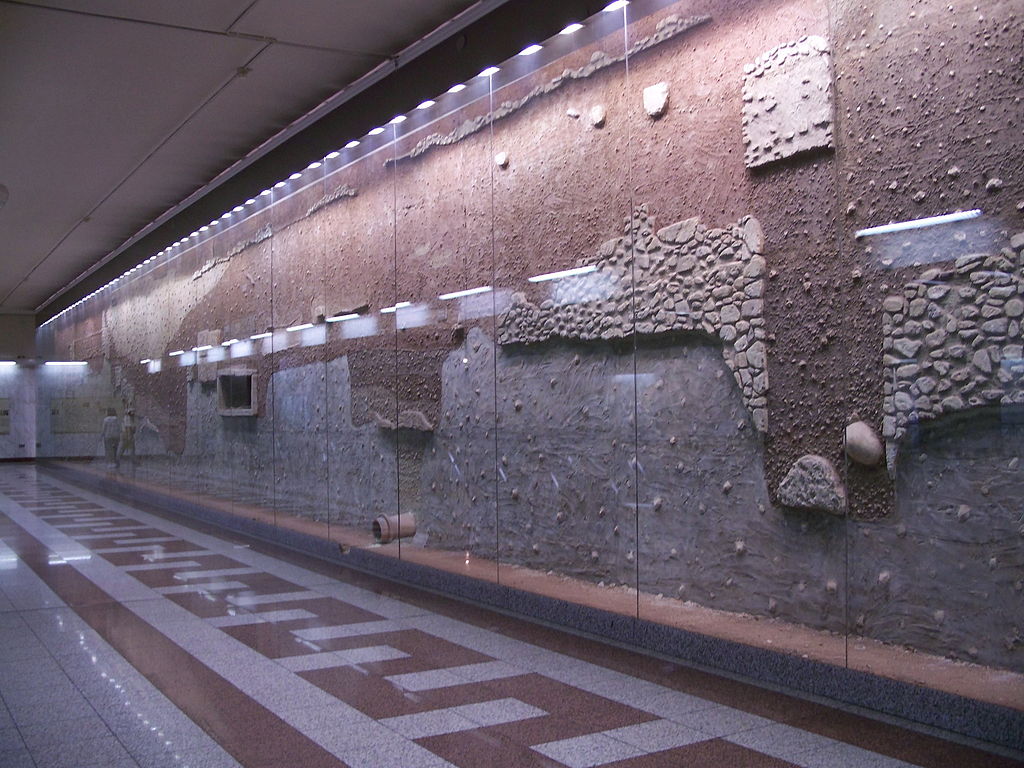
I've always wondered how super old cities like Athens and Rome deal with infrastructure. I mean, if you need to install new sewer or cabling systems underground you're dealing with literally thousands of years of stuff under the city, and I'm guessing there is no good documentation for what's there. How do civil engineers know where it's safe to build?
There is a museum near the Acropolis where they put a glass floor in and you can look down and see the ruins they've uncovered.
It's really remarkable. Buildings from the past were demolished and new buildings were built on top. It's interesting to look around and realize that you're walking over 30 ft worth of ruins everywhere.


Pretty damn useful to connect to services in my internal network wherever I go. I have it set up on my router, so I don't need to install it on every single server in the house :D